
Core Web Vitals for Medical Websites: Enhancing Patient Experience and Search Visibility
Optimizing core web vitals for medical websites is crucial for 2026 digital strategy, directly impacting patient experience and search engine visibility. This guide details Largest Contentful Paint (LCP), First Input Delay (FID), and Cumulative Layout Shift (CLS), explaining their unique challenges for healthcare sites. Readers will learn practical strategies for image optimization, JavaScript management, and mobile SEO to improve page speed and visual stability. Strong core web vitals foster E-E-A-T and patient trust, essential for YMYL medical content and competitive markets like London’s private healthcare.
Abdurrahman Şimşek, a Semantic SEO Strategist specializing in medical content networks, provides expert insights into technical SEO and user experience. His expertise helps medical clinics, including those on Harley Street, achieve topical authority and high-converting online presences.
To explore your options, contact us to schedule your consultation.
In 2026, optimizing core web vitals for medical websites is a critical component of a digital strategy. This guide explains these metrics, their importance for Your Money Your Life (YMYL) healthcare sites, and provides actionable strategies. Strong web vital scores directly correlate with a clinic’s online performance, patient experience, and search engine visibility.
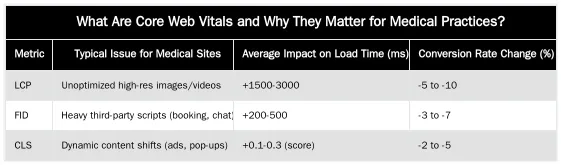
What Are Core Web Vitals and Why They Matter for Medical Practices?
Core Web Vitals are specific Google metrics that quantify user experience, focusing on loading performance (Largest Contentful Paint), interactivity (First Input Delay), and visual stability (Cumulative Layout Shift). For medical websites, these metrics indicate a site’s reliability and professionalism. A fast, responsive, and stable site fosters patient trust, which is paramount for Your Money Your Life (YMYL) content. Poor scores can deter patients, increase bounce rates, and negatively impact search rankings.
Google uses these performance signals in its ranking algorithm, especially for mobile search. A website with strong Core Web Vitals is more likely to rank higher and attract more organic traffic, while a site with poor scores risks being overlooked. Optimizing these vitals is a strategic necessity for clinics in competitive markets like London’s private healthcare sector.
Decoding Core Web Vitals: Unique Challenges for Medical Websites
Medical websites for plastic surgeons, aesthetic clinics, and dermatologists present unique challenges for achieving optimal web vital scores. Showcasing medical procedures and patient transformations involves rich media and complex interactive elements that can negatively impact these metrics.
Largest Contentful Paint (LCP): High-Res Imagery & Video Impact
Largest Contentful Paint (LCP) measures the time for the largest content element on the page to become visible in the viewport. For medical websites, this is often a high-resolution hero image, a before-and-after slider, or an embedded video. While these visuals are crucial for attracting patients, their large file sizes can delay page loading. Unoptimized images, videos, and large background elements directly contribute to poor LCP scores.
First Input Delay (FID) & Cumulative Layout Shift (CLS) in Patient Journeys
First Input Delay (FID) measures the time from a user’s first interaction to the browser’s response. Cumulative Layout Shift (CLS) quantifies unexpected layout shifts. Medical websites use interactive elements like appointment schedulers, chat widgets, patient portals, and consent forms. Heavy or unoptimized JavaScript can cause high FID, making the site feel unresponsive. Dynamically loaded ads, pop-ups, or late-loading fonts can cause high CLS scores. This instability erodes patient trust and can disrupt critical actions like filling out a booking form.
Practical Strategies: Optimizing Core Web Vitals for Clinic Success
Mastering Image & Video Optimization for LCP
Ensure all images are sized and responsive. Use modern image formats like WebP or AVIF, which offer better compression than JPEGs or PNGs. Implement lazy loading for off-screen images and videos. Use a Content Delivery Network (CDN) to serve media from servers closer to users, reducing latency. Preload or prioritize critical LCP elements in the HTML. Optimizing images is a foundational step. For video, use streaming services for efficient encoding and delivery.
Enhancing Interactivity: FID & CLS Fixes for Medical Sites
To improve FID, reduce JavaScript execution time. Defer or asynchronously load non-critical JavaScript, and minify and compress all JS files. Evaluate third-party scripts like booking widgets and load them with `defer` or `async` attributes. To combat CLS, specify dimensions for images and video elements in HTML to reserve space. Avoid inserting content dynamically above existing content unless space is reserved. Preload custom fonts to prevent text from flashing unstyled (FOUT) or invisible (FOIT). Efficient JavaScript handling is key for responsive interactions.
| Optimization Area | Techniques for LCP | Techniques for FID | Techniques for CLS |
|---|---|---|---|
| Imagery & Media | Responsive images, WebP/AVIF, lazy loading, CDN, preload LCP element | N/A | Specify image/video dimensions, avoid dynamic resizing |
| JavaScript | N/A | Defer/async non-critical JS, minify, optimize third-party scripts | N/A |
| Layout & Fonts | N/A | N/A | Preload fonts, reserve space for dynamic content, avoid injecting content above existing |
| Server & Hosting | Fast hosting, server-side rendering, caching | Fast hosting, server-side rendering | N/A |
Beyond the Metrics: Core Web Vitals as a Semantic SEO Imperative
For London-based private healthcare providers, Core Web Vitals are foundational to a semantic SEO strategy. Abdurrahman Şimşek, a semantic SEO strategist, states that web performance directly influences how Google perceives a website’s quality and relevance. Integrating web vital optimization with semantic engineering and Ruxi Data integration ensures technical excellence supports content authority and user trust.
E-E-A-T & Patient Trust: The Core Web Vitals Connection
Google’s E-E-A-T (Experience, Expertise, Authoritativeness, Trustworthiness) guidelines are stringent for YMYL medical content. A slow, unresponsive, or unstable website signals a lack of professionalism and can undermine trustworthiness, regardless of content accuracy. For Harley Street clinics, a superior user experience directly reinforces E-E-A-T. A fast, stable, and responsive site communicates reliability, a crucial factor in a patient’s decision-making. Google’s own documentation highlights the user experience aspect.
Integrating CWV into Your Topical Authority Strategy
Building topical authority requires creating a network of interconnected, high-quality content. Authoritative content will struggle to rank if website performance is poor. Core Web Vitals optimization ensures Google can efficiently access and index content and that users can engage with it. A technically sound website allows the semantic content architecture to improve visibility for high-value services. A well-performing site also improves other technical SEO efforts, such as those in a technical SEO audit.
Measuring Success: Tools and What to Expect in 2026
Essential Tools for Core Web Vitals Monitoring
Monitor Core Web Vitals with Google Search Console’s report, which provides field data (real user data) and categorizes pages as “Good,” “Needs Improvement,” or “Poor.” For lab data (simulated), use Google PageSpeed Insights and Lighthouse. PageSpeed Insights offers recommendations, while Lighthouse provides a comprehensive audit. Regularly checking these tools helps identify bottlenecks and track optimization impact. Search Console’s field data reflects a 28-day period, so changes take time to appear. PageSpeed Insights is a user-friendly starting point.
In 2026, Google’s algorithms increasingly emphasize user experience signals. While LCP, FID, and CLS remain central, expect refinements and new metrics capturing user interaction and visual stability. Continuous optimization is an ongoing commitment to providing the best online experience for patients.
Elevate Your Clinic’s Online Presence with Expert Core Web Vitals Optimization
Optimizing core web vitals for medical websites is a critical investment that impacts patient experience, search visibility, and practice growth. For London-based private healthcare providers, plastic surgeons, and aesthetic clinics, top-tier web performance is a competitive differentiator. A specialist in medical SEO and technical optimization can enhance your website’s performance, build topical authority, and attract high-value patients. Visit Abdurrahman Şimşek’s website to learn more about tailored strategies for your medical practice.
Frequently Asked Questions
What are the core web vitals for medical websites and why are they important?
Core Web Vitals are a set of specific metrics measuring a website’s user experience in terms of loading speed, interactivity, and visual stability. For medical websites, these metrics are crucial because they directly impact patient trust, engagement, and search engine visibility, especially in the sensitive Your Money Your Life (YMYL) niche. Optimizing them ensures a smooth, professional experience for potential patients.
Which Core Web Vital is most challenging for medical websites?
Largest Contentful Paint (LCP) is often the most challenging for core web vitals for medical websites. This is because surgeon websites rely heavily on high-resolution before-and-after images and videos, which can be large files that take a long time to load, negatively impacting the LCP score.
How can medical websites maintain high-quality images without a poor LCP score?
The key is modern image optimization. This involves using next-gen image formats like WebP, implementing lazy loading for images below the fold, and leveraging a Content Delivery Network (CDN) to serve images faster. These techniques ensure visual quality without sacrificing page speed, which is vital for a positive user experience on healthcare platforms.
What is Cumulative Layout Shift (CLS) and why does it matter for medical sites?
CLS measures the visual stability of a page. A high CLS score, often caused by elements like ads or images loading late and shifting content, creates a frustrating user experience. For a medical site, this instability can appear unprofessional
Ruxi Data brings together multi-model AI, automated website crawling, live indexation checks, topical authority mapping, E-E-A-T enrichment, schema generation, and full pipeline automation — from crawl to WordPress publish to social posting — all in one platform built for agencies and freelancers who run on results.