
EAV Modeling for Procedures: Structuring Medical Data for Semantic SEO
EAV modeling for procedures provides a flexible framework for organizing complex surgical treatment data, enhancing clarity and search engine visibility. This approach structures medical information using entities, attributes, and values, allowing for detailed descriptions of treatments like Rhinoplasty or Breast Augmentation. Implementing EAV modeling for procedures helps clinics build robust database schema, improve semantic data models, and feed structured data to search engines. This precision aids in establishing topical authority and ensures accurate information retrieval, ultimately boosting online presence and patient acquisition for medical practices.
Abdurrahman Şimşek, a Semantic SEO Strategist with 10+ years of experience, specializes in leveraging advanced data structures like EAV modeling to build high-authority content networks for medical clinics and plastic surgeons. His expertise ensures precise information architecture and enhanced digital visibility.
To explore your options, contact us to schedule your consultation. You can also reach us via: Book a Semantic SEO Audit, Direct WhatsApp Strategy Line: +90 506 206 86 86
Eav modeling for procedures is a framework for organizing surgical treatment data, improving patient clarity and search engine visibility. Entity-Attribute-Value (EAV) modeling structures a clinic’s content architecture to boost semantic SEO performance and attract high-value patients. By structuring medical information precisely, EAV ensures search engines accurately interpret your offerings, contributing to online authority and patient acquisition.
What is EAV Modeling for Surgical Procedures?
EAV modeling is a flexible data structure that defines information by associating entities with attributes and their values. For surgical procedures, this means breaking down each treatment into its descriptive components. This approach is effective for managing the diverse, customizable details of medical and aesthetic treatments, allowing for adaptable data organization.
The Core Components: Entity, Attribute, Value
The EAV model has three components. An Entity is the core item, such as a surgical procedure like ‘Rhinoplasty’ or ‘Breast Augmentation’. An Attribute is a property of that entity, like ‘Anesthesia Type’, ‘Recovery Time’, ‘Cost Range’, or ‘Ideal Candidate Profile’. The Value is the data for that attribute, such as ‘General’, ‘2-3 weeks’, ‘£5,000-£8,000’, or ‘Patients seeking nasal reshaping’. This structure accommodates many treatment parameters, allowing for detailed descriptions without rigid schema constraints.
For example, a ‘Rhinoplasty’ entity might have attributes like ‘Procedure Duration’ with a value of ‘2-4 hours’, ‘Post-Op Care’ with a value of ‘Nasal splint for 1 week’, and ‘Potential Risks’ with a value listing specific complications. This granular breakdown systematically catalogs each aspect of a procedure, facilitating precise information retrieval and content generation.
Why EAV is Essential for Semantic SEO in Medical Practices
EAV modeling benefits semantic SEO for medical clinics. By structuring data in a granular, entity-centric manner, EAV helps search engines understand the meaning and context of content. This precision builds topical authority and reduces the ‘Cost of Retrieval’ for search algorithms.
Feeding the Knowledge Graph with Structured Medical Data
EAV’s granular data structure helps search engines understand and categorize medical information. Each entity (e.g., ‘Liposuction’) and its attributes (e.g., ‘Target Areas’, ‘Technique Used’) contribute to a medical ontology. This organization improves entity recognition, enabling Google to map services to its Knowledge Graph. Providing clear, structured data enhances a clinic’s authority and signals expertise in surgical fields. This approach aligns with a semantic data model, making content interpretable by search algorithms.
Enhancing Topical Authority and Information Retrieval
An EAV model creates interconnected content that signals topical expertise to search engines. When every aspect of a surgical procedure, from pre-operative instructions to recovery timelines, is defined through entities and attributes, the website becomes a definitive resource. This improves information retrieval for patient queries. This systematic organization of structured data builds algorithm-resistant topical authority, helping your clinic rank for a broad spectrum of related medical terms and questions.
How to Implement EAV for Surgical Procedure Content
Implementing EAV for surgical procedure content involves backend and frontend considerations, including database schema design, content management system (CMS) capabilities, and structured data markup. This approach provides flexibility for content creators and ensures understanding by search engines.
Structuring Your Database and CMS with Custom Fields
A CMS like WordPress can manage EAV-like structures using custom post types and custom fields. For instance, create a ‘Surgical Procedure’ custom post type. Within each procedure post (e.g., ‘Facelift’), define custom fields for attributes like ‘Anesthesia Type’, ‘Average Procedure Time’, ‘Expected Recovery’, and ‘Cost Range’. These fields ensure consistent data entry, making each ‘treatment parameter’ clearly defined and retrievable. This method provides a flexible database schema without requiring complex database tables, simplifying content management.
Integrating this structured data with JSON-LD schema markup is crucial. Mapping your EAV attributes to relevant Schema.org types (e.g., MedicalProcedure, Physician, Service) communicates the meaning of your content to search engines. This enhances rich snippets and improves entity recognition.
EAV vs. Relational Model: A Comparison for Medical Data
Choosing between an EAV and a relational database model for medical procedure data is a trade-off between flexibility and complexity. Relational models offer data integrity and query performance for fixed structures, while EAV is more adaptable for evolving attributes. For medical content, where new techniques or parameters emerge, EAV’s flexibility is an advantage. Learn more about the EAV model on Wikipedia.
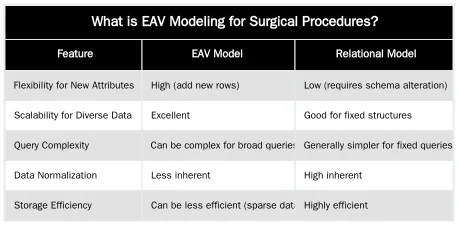
The choice depends on the medical practice’s needs and the anticipated rate of change in procedure details. For dynamic content and evolving medical fields, EAV’s flexibility often outweighs its query complexity.
| Metric | EAV Model Score (0-10) | Relational Model Score (0-10) |
|---|---|---|
| Attribute Addition Speed (hours) | 0.5 | 8 |
| Schema Change Impact (0-10, 10=high) | 1 | 9 |
| Query Complexity (varied attributes) | 6 | 4 |
| Data Storage Efficiency (0-10, 10=high) | 6 | 9 |
Unlock Precision: Partner for EAV-Driven Semantic SEO
For plastic surgeons, aesthetic clinic owners, and medical directors in London, mastering EAV modeling is crucial for digital growth. Partnering with a specialist in semantic SEO and web development ensures your content is optimized for search algorithms. This transforms your website into an authoritative hub for surgical procedures, attracting high-value patients.
Conclusion
EAV modeling for procedures provides a flexible framework for structuring surgical practice data. By defining entities, attributes, and values, medical clinics can enhance their semantic SEO, feed Google’s Knowledge Graph with precise information, and build topical authority. This approach future-proofs your content, ensuring long-term visibility and patient acquisition. To implement an EAV-driven semantic SEO strategy for your London clinic, contact us. Book a Semantic SEO Audit or reach out via WhatsApp Strategy Line: +90 506 206 86 86.
Frequently Asked Questions
What is eav modeling for procedures?
EAV (Entity-Attribute-Value) modeling is a data structuring method where the ‘Entity’ is the surgical procedure (e.g., Rhinoplasty), ‘Attributes’ are its properties (e.g., Anesthesia Type, Recovery Time, Cost), and ‘Values’ are the specific data for those properties. This approach allows for flexible and detailed organization of diverse medical and aesthetic treatment information, improving clarity for both patients and search engines.
Why is eav modeling for procedures superior to a traditional flat content structure?
It offers unparalleled flexibility and scalability for managing complex medical data. If a new attribute becomes relevant for all procedures, like ‘Minimally Invasive Option’, you can add it once without restructuring every single page. This adaptability is crucial for medical practices that continually evolve their service offerings and information requirements.
How does an EAV data model improve the user experience for patients?
An EAV model is the backbone for advanced user features like treatment comparison tools and dynamic filtering. It allows patients to easily filter and compare procedures based on attributes that matter most to them, such as recovery time or cost, leading to a more informed decision-making process and higher conversion rates. This structured approach enhances clarity and engagement on a clinic’s website.
Can eav modeling for procedures be implemented in a standard CMS like WordPress?
Yes, EAV principles can be effectively implemented in WordPress using a combination of Custom Post Types for the entities (procedures) and Advanced Custom Fields (ACF) or similar plugins to manage the attributes and values. This creates a powerful, structured content system within a familiar CMS, making content management and updates more efficient for medical practices.
How does EAV data translate into better SEO performance for medical websites?
Structured EAV data is easily translated into detailed Schema markup, like MedicalProcedure, providing search engines with a rich, unambiguous understanding of your services. This increases the likelihood of winning rich snippets and establishing your website as a definitive source for information on those procedures. Such semantic clarity boosts online visibility and authority, attracting more qualified patients.
How can I get started with implementing EAV modeling for my clinic’s website?
To begin leveraging EAV modeling for procedures to enhance your clinic’s online presence and patient engagement, you can book a Semantic SEO Audit with Abdurrahman Şimşek. This consultation will help tailor a strategy to your specific needs, ensuring optimal implementation and results. You can also reach out directly via WhatsApp for strategic advice.
Ruxi Data brings together multi-model AI, automated website crawling, live indexation checks, topical authority mapping, E-E-A-T enrichment, schema generation, and full pipeline automation — from crawl to WordPress publish to social posting — all in one platform built for agencies and freelancers who run on results.