
Healthcare Knowledge Base: Mastering YMYL SEO With Semantic Architecture
A healthcare knowledge base is a structured, interconnected repository crucial for establishing expertise and driving patient engagement in YMYL sectors. This article details how a semantic approach, leveraging robust information architecture with pillar pages and topic clusters, builds definitive topical authority. It explains how this strategy enhances E-E-A-T signals to search engines, ensuring medical content is recognized as a trusted source. Understanding this framework is vital for healthcare providers aiming for organic growth and patient education.
Abdurrahman Şimşek, a Semantic SEO Strategist, specializes in developing high-authority semantic content networks for medical clinics. His expertise focuses on optimizing information architecture to achieve robust topical authority and E-E-A-T in the competitive healthcare sector.
To explore your options, contact us to schedule your consultation.
A semantic healthcare knowledge base transforms your online presence by signaling expertise to Google and driving patient engagement. This is crucial for YMYL sectors like plastic surgery and aesthetic medicine. A structured medical knowledge system is a foundational asset for organic growth.
What is a Healthcare Knowledge Base & Why it Matters for YMYL?
A healthcare knowledge base is a structured, interconnected repository of medical information that educates patients and establishes institutional expertise. It provides comprehensive, accurate, and accessible answers to health-related queries. For Your Money or Your Life (YMYL) industries, like medical clinics and plastic surgery practices, this resource is critical. It signals to Google that your website is a definitive authority, which is essential for ranking in the YMYL healthcare sector.
A knowledge base demonstrates E-E-A-T (Experience, Expertise, Authoritativeness, Trustworthiness) by offering in-depth coverage of specific conditions, procedures, and treatments. For instance, a plastic surgery clinic might develop a section on facial surgery, detailing techniques, recovery processes, and potential outcomes. This detail and interconnectedness helps search engines understand a practice’s expertise, fostering trust with algorithms and patients. It provides patient education beyond service descriptions, addressing concerns and building confidence.
Leveraging Semantic Engineering for Harley Street Clinics
For London’s private healthcare market, especially plastic surgeons and aesthetic clinics in Harley Street, semantic engineering transforms a medical knowledge system into a semantic content network. This approach is crucial for local organic search and meeting E-E-A-T requirements. Abdurrahman Şimşek, with over 10 years of experience, specializes in building these content architectures.
Applying semantic engineering principles allows medical practices to move beyond generic SEO tactics. This involves mapping medical entities, attributes, and relationships within content to ensure each piece of information contributes to an authoritative digital presence. This precision is vital for clinics attracting high-value patients seeking specialized procedures.
The goal is to create a digital ecosystem where Google understands the depth of a clinic’s expertise, from surgical techniques to patient care protocols. This semantic optimization differentiates top-ranking medical sites. For a deeper understanding of semantic search, consult resources like Wikipedia’s explanation of Semantic Search.
The Role of Ruxi Data in Medical Content Configuration
Ruxi Data is pivotal in this medical content configuration. It maps entities, attributes, and relationships in medical content with precision. This enables better information retrieval and establishes topical authority. For instance, Ruxi Data can define procedure details, patient conditions, and specialist profiles, ensuring all information is semantically linked and understood by search engines.
This technology creates a granular and interconnected knowledge graph for a medical practice. It ensures that when a patient searches for a specific treatment or surgeon, the website provides the most relevant and authoritative information. This detail and accuracy is essential for building trust and visibility in the YMYL sector. Understanding how search engines process medical information is key, as detailed by Google’s guidelines on medical and health information.
What Results Can London Private Practices Expect from a Semantic Knowledge Base?
A semantic healthcare knowledge base yields tangible benefits for medical clinics, particularly in London’s private healthcare market. Practices can expect improved organic rankings for high-value medical terms and increased organic traffic. This visibility translates to higher conversion rates for consultations and procedures, as patients find trustworthy information on your site.
A well-constructed knowledge base enhances patient trust. Providing detailed, accurate, and navigable information demonstrates transparency and expertise. This builds confidence, which is crucial in the YMYL sector. It strengthens E-E-A-T signals, positioning the practice as an authoritative source in its specialty, like plastic surgery, dermatology, or aesthetic medicine. This is impactful for local search results in London postcodes like Harley Street, Marylebone, and Mayfair.
Measuring Success: Key Metrics for Healthcare SEO
Performance of a medical knowledge base is evaluated by tracking Key Performance Indicators (KPIs). These metrics provide insights into its effectiveness:
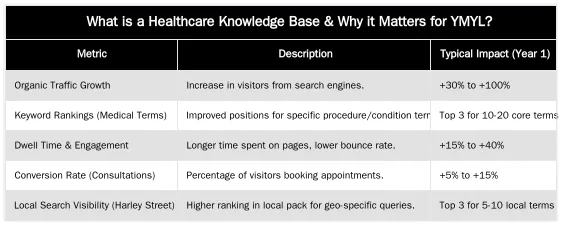
Monitoring these metrics allows clinics to refine their content strategy to drive organic growth and patient engagement.
Conclusion
A semantic healthcare knowledge base is a strategy for medical clinics to establish topical authority in the YMYL sector. Using entity-based content architecture enhances E-E-A-T signals, improves search visibility, and fosters patient trust. This approach to medical content strategy ensures your digital presence reflects your expertise and authority. To transform your online presence in London’s private healthcare market, partner with Abdurrahman Şimşek, a specialist in semantic SEO and web development for medical clinics. Visit abdurrahmansimsek.com to learn more.
Frequently Asked Questions
What is the purpose of building a healthcare knowledge base?
The purpose of a healthcare knowledge base is to create a comprehensive, interconnected resource on your core medical topics. This signals to Google that your website is a definitive authority, which is essential for ranking in the competitive YMYL (Your Money or Your Life) healthcare sector. It educates patients and establishes institutional expertise.
How does a semantic approach enhance a medical knowledge system?
A standard blog often presents content chronologically, lacking deep structural connections. In contrast, a semantic content architecture strategically organizes information with main “pillar pages” for broad topics and “cluster pages” for specific sub-topics. This structured approach helps search engines understand the relationships between your content pieces, boosting topical authority.
What role does internal linking play in a comprehensive medical resource?
Internal linking acts as the structural “glue” that connects all parts of your medical resource. Cluster pages link up to their respective pillar pages, and pillar pages link out to relevant clusters. This system funnels authority to your most important content and clearly communicates the semantic relationships within your site to search engines.
How does a well-structured healthcare knowledge base contribute to patient acquisition?
A robust healthcare knowledge base attracts patients at every stage of their research journey, from initial curiosity to specific procedural questions. It captures both broad informational searches and specific long-tail queries. By providing comprehensive, trustworthy information, it builds patient trust and establishes your clinic as a credible resource long before they are ready to book a consultation.
Is it possible to develop a healthcare knowledge base incrementally?
Yes, building a healthcare knowledge base can and should be done over time. Begin by identifying your main pillar topics based on the medical procedures or conditions you specialize in. Then, systematically develop the supporting cluster content for each pillar, creating a scalable and manageable content strategy that grows your authority organically.
How can London private practices begin building their medical content authority?
London private practices, especially those in Harley Street, can start by consulting with a specialist Semantic SEO Strategist like Abdurrahman Şimşek. This involves identifying core YMYL topics, mapping out a semantic content network, and implementing a strategy tailored for high-authority medical domains. Partnering with an expert ensures your content strategy aligns with Google’s E-E-A-T guidelines for optimal organic growth.
Ruxi Data brings together multi-model AI, automated website crawling, live indexation checks, topical authority mapping, E-E-A-T enrichment, schema generation, and full pipeline automation — from crawl to WordPress publish to social posting — all in one platform built for agencies and freelancers who run on results.