Google Ads No Conversions: Optimizing Your Patient Acquisition
When Google Ads generate clicks but no patients, it signals a critical breakdown in the patient acquisition funnel. This issue, often termed google ads no conversions, stems from misaligned ad copy, incorrect keyword intent, or ineffective landing page design. A comprehensive conversion audit identifies these disconnects, ensuring your PPC for doctors strategy attracts high-quality leads. By refining keyword targeting, optimizing landing page experiences, and crafting compelling calls to action, clinics can transform wasted ad spend into valuable patient appointments. Addressing these elements is crucial for resolving google ads no conversions and improving lead quality.
Abdurrahman Şimşek, a Semantic SEO Strategist, specializes in optimizing digital marketing for medical clinics. His expertise in holistic SEO strategy and semantic engineering helps healthcare providers build high-converting online presences and improve patient acquisition through precise targeting.
To explore your options, contact us to schedule your consultation.
If your Google Ads generate clicks but not patients, a problem termed google ads no conversions, it signals a disconnect in your digital marketing. A conversion audit can uncover root causes, from misaligned ad copy to ineffective landing pages, and provide strategies to transform clicks into patient appointments.
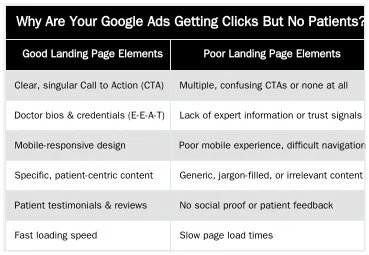
Why Are Your Google Ads Getting Clicks But No Patients?
High Google Ads clicks without patient conversions often result from a mismatch between the ad’s promise and the landing page’s delivery. Users click expecting specific information or a clear action path; they leave if the page is confusing, irrelevant, or lacks a compelling call to action. This disconnect wastes ad spend and misses patient acquisition opportunities.
Contributing factors include generic ad copy that attracts informational intent instead of booking intent, and broad keywords that draw clicks from individuals not seeking medical services. Poor landing page design, slow load times, or a lack of trust signals also deter potential patients. Addressing these issues is essential to translate your advertising budget into patient appointments.
The Conversion Audit: Uncovering Disconnects in Your Patient Journey
A conversion audit examines every stage of the patient’s digital journey, from search query to landing page interaction, to identify friction points that prevent clicks from becoming consultations. For medical clinics, understanding patient intent and the decision-making process is critical.
Is Your Ad Copy Attracting the Wrong People?
Ad copy for medical services must be precise. Generic headlines like “Best Clinic” attract broad attention but fail to filter for specific patient needs. Your ad copy should articulate the service, its benefits, and unique selling points. For instance, an ad for “Rhinoplasty London” should mention the surgeon’s expertise, the clinic’s location (e.g., Harley Street), and a benefit like “Natural-Looking Results.” If your ad promises a specific procedure but the landing page is about general cosmetic surgery, potential patients will disengage. Clear messaging attracts genuinely interested individuals.
Are Your Keywords Attracting Commercial Intent?
Keyword intent is a critical differentiator in PPC for doctors. Informational keywords, like “what is Botox,” attract users seeking knowledge who are typically not ready to book an appointment. Commercial intent keywords signal a readiness to act. Examples include “plastic surgery cost London,” “dermatologist appointment Marylebone,” or “breast augmentation consultation.” Focusing ad spend on these high-commercial intent keywords shows your ads to individuals actively seeking a medical provider. Regularly reviewing search terms and adjusting your keyword strategy is vital for attracting high-value leads.
Optimizing Landing Pages for Medical Patient Conversions
A poorly optimized landing page causes low conversion rates, even with ideal ad copy and keyword targeting. For medical clinics, a landing page must build trust and guide patients toward booking an appointment.
Designing High-Converting Landing Pages for Doctors
High-converting landing pages for medical practices prioritize clarity, trust, and ease of action. They feature a prominent, singular call to action (CTA) like “Book a Consultation” or “Request an Appointment,” making the next step obvious. Trust signals are essential in the YMYL (Your Money Your Life) medical sector. These include clear doctor bios with credentials, patient testimonials, before-and-after galleries (where appropriate and compliant), and accreditation logos. Mobile responsiveness is non-negotiable, as many patients research on smartphones. Patient-centric content that addresses concerns and highlights benefits improves conversion rates.
Why Directing Ads to Your Homepage is a Mistake
Directing Google Ads traffic to your homepage is a common error that causes low conversion rates. A homepage offers a broad overview of your clinic, which can overwhelm a visitor who clicked an ad for a specific reason. Dedicated landing pages are hyper-focused. They eliminate distractions, reinforce the ad’s message, and guide the user towards a single conversion goal. For example, an ad for “lip fillers London” should lead to a page solely about lip fillers, with relevant information, pricing, and a direct booking option, not a general aesthetics page.
Refining Your Campaigns: Negative Keywords & Lead Quality
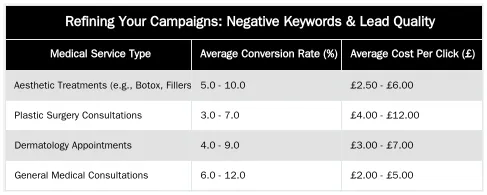
Continuous PPC campaign refinement is crucial to improve lead quality and optimize cost per lead. This involves filtering irrelevant traffic to ensure paid clicks come from interested potential patients. Negative keywords and a lead qualification process are key.
Leveraging Negative Keywords to Filter Out Irrelevant Clicks
Negative keywords prevent your ads from showing for irrelevant searches. For a plastic surgery clinic, examples might include “free,” “DIY,” “jobs,” “reviews” (for booking intent), or procedures you don’t offer. Reviewing your Google Ads search term report identifies these queries. Adding them as negative keywords prevents wasted ad spend on non-converting clicks, improving traffic quality and campaign efficiency.
Qualifying Leads: Beyond the Click for Medical Practices
Some leads may not be qualified, even with optimized keywords and ad copy. This occurs if the landing page fails to pre-qualify visitors, or if user intent doesn’t align with your services or pricing. Qualification questions on forms, clear pricing expectations, or different consultation tiers can help filter leads. Understanding why leads are not qualified (budget, location, procedure) helps refine targeting and messaging, ensuring your team focuses on high-potential patient inquiries.
Transforming Clicks into Consultations: An E-E-A-T Driven Approach
In the YMYL private healthcare space, establishing Expertise, Experience, Authoritativeness, and Trust (E-E-A-T) is paramount. E-E-A-T impacts paid advertising effectiveness, not just organic search. A digital strategy integrating semantic SEO can enhance Google Ads performance, turning clicks into consultations.
The Role of Topical Authority in PPC Performance for Surgeons
A semantic content network built around your medical specializations establishes your clinic as an authority. When Google sees your site as a trustworthy source for specific procedures (e.g., “facial aesthetics London”), it can indirectly boost the relevance and Quality Score of related PPC campaigns. This authority signals to search engines and patients that your clinic is a credible choice. Abdurrahman Şimşek specializes in building such topical authority for plastic surgeons and aesthetic clinics in London, ensuring your digital footprint reinforces trust and expertise. This foundational work makes paid efforts more effective, as users are more likely to convert when they perceive high expertise. Google’s E-E-A-T guidelines emphasize demonstrating these qualities for health-related content.
Benchmarking Success: What’s a Good Conversion Rate for Medical Ads?
Medical ad conversion rates vary by procedure, location (e.g., Harley Street), and conversion goal (form vs. call). A good conversion rate for a high-value consultation can range from 3% to 8% or higher for optimized campaigns targeting commercial intent. For example, a campaign for “lip fillers” might see higher conversion rates than one for “complex reconstructive surgery” due to differing patient journeys and decision cycles. Continuous A/B testing and data analysis are essential to improve campaign performance. Industry reports often provide broad PPC benchmarks, but specialized medical niches require a more nuanced interpretation.
Ready to Convert More Patients? Your Next Steps
If your Google Ads generate clicks but not patient conversions, rectifying disconnects in the patient journey is necessary. This requires expertise in PPC and the London private healthcare market. An audit and optimization strategy can transform ad spend into patient appointments.
Conclusion
Solving the problem of Google Ads clicks without patients requires ad-landing page alignment, precise keyword targeting, and an optimized patient journey. For medical clinics, demonstrating E-E-A-T is as crucial for paid campaigns as for organic visibility. Auditing your campaigns and implementing data-driven improvements can enhance conversion rates and attract more high-value patients. Contact Abdurrahman Şimşek today for a tailored conversion audit and strategic guidance.
Frequently Asked Questions
Why do my google ads no conversions despite high clicks?
The primary reason for high clicks but google ads no conversions is often a significant mismatch between your ad’s promise and the landing page’s content. If the landing page fails to deliver on the expectations set by the ad, visitors will quickly leave without taking action. This disconnect wastes ad spend and misses potential patient acquisitions.
Can sending Google Ads traffic to my homepage lead to google ads no conversions?
Yes, directing Google Ads traffic to your general homepage is a common reason for a lack of patient conversions. Instead, traffic should be sent to a dedicated landing page specifically designed for the ad’s offer, such as a page focused solely on a particular procedure. A cluttered homepage with too many options often confuses users and significantly reduces the likelihood of conversion.
How do incorrect keywords contribute to google ads no conversions?
Bidding on broad, informational keywords instead of high-intent commercial terms often results in clicks from users who aren’t ready to book, leading to a situation where ads get clicks but no patient conversions. Regularly analyzing your Google Ads search terms report is crucial to identify irrelevant queries and add them as negative keywords, ensuring your ads reach the right audience.
Beyond content, what technical issues can cause Google Ads to have poor conversion rates?
Even with great content, technical issues can severely hinder conversion rates from your Google Ads. Slow page load speeds, broken or confusing consultation forms, and non-functional mobile click-to-call buttons are common culprits. A comprehensive technical and user experience (UX) audit is vital to identify and resolve these hidden barriers to patient acquisition.
What strategies can improve lead quality and prevent Google Ads from failing to convert?
To improve lead quality and ensure your Google Ads generate actual patients, focus on highly specific ad copy and landing page content that pre-qualifies visitors. Providing clear information about your consultation process, pricing tiers, or specific service details helps filter out less serious inquiries. This ensures the clicks you pay for are from users genuinely interested in your medical services.
How can Abdurrahman Şimşek help my clinic resolve issues leading to google ads no conversions?
Abdurrahman Şimşek specializes in comprehensive conversion audits and semantic SEO strategies tailored for medical clinics. He identifies critical disconnects in your Google Ads campaigns and landing pages, helping resolve issues that lead to google ads no conversions. By implementing E-E-A-T-driven optimizations, he transforms clicks into valuable patient consultations. Contact us for a strategic consultation to boost your patient acquisition.
Ruxi Data brings together multi-model AI, automated website crawling, live indexation checks, topical authority mapping, E-E-A-T enrichment, schema generation, and full pipeline automation — from crawl to WordPress publish to social posting — all in one platform built for agencies and freelancers who run on results.