
Entity-attribute-value SEO: Precision Data for Medical Authority
Entity-attribute-value SEO fundamentally redefines how search engines process intricate medical information, particularly for surgical procedures. This data modeling approach structures content as distinct entities, attributes, and values, enabling machine-readable precision. By applying entity-attribute-value SEO, medical clinics and plastic surgeons can build robust topical authority and enhance their presence within the knowledge graph. This method moves beyond keyword matching, fostering a deeper semantic understanding of complex procedures, ultimately improving organic search visibility and information retrieval for patient queries.
Abdurrahman Şimşek, a Semantic SEO Strategist, specializes in leveraging advanced data models like EAV for medical clinics, plastic surgeons, and aesthetic practitioners. His expertise focuses on building high-authority semantic content networks, particularly for the competitive London private healthcare market.
To explore your options, contact us to schedule your consultation.
The entity-attribute-value seo data model transforms how search engines interpret complex information, particularly for surgical procedures. This article details EAV SEO’s principles, its applications for medical clinics, and how it builds topical authority for plastic surgeons and aesthetic practitioners. This data modeling approach enhances online presence and improves organic search visibility in competitive markets like London’s Harley Street.
What is the Entity-Attribute-Value (EAV) Model in SEO?
The Entity-Attribute-Value (EAV) model is a data structure where information is stored as an entity, an attribute, and a value. This model is effective for datasets with many optional or varying attributes, ideal for describing diverse entities like surgical procedures in a machine-readable format for search engines.
An entity is a distinct object or concept, such as “Rhinoplasty” or “Liposuction.” An attribute is a characteristic of that entity, like “Anesthesia Type” or “Recovery Time.” The value is the specific data for that attribute, such as “General Anesthesia” or “2-4 weeks.” This granular approach allows precise data modeling, enabling search algorithms to understand the nuances of complex medical topics.
For SEO, applying the EAV model means structuring website content to define these relationships explicitly. This helps search engines accurately interpret the subject matter, connect related concepts, and present more relevant results. It moves beyond keyword matching to a semantic understanding of content.
How EAV Transforms Medical SEO for Surgical Procedures
The EAV model is advantageous for medical SEO, especially for detailing surgical procedures. Traditional content often fails to convey medical treatment details in a machine-readable way. EAV structures this information with precision, enhancing semantic relevance and search visibility for clinics.
For a “Breast Augmentation” procedure, the entity’s attributes could include ‘Implant Type’, ‘Incision Location’, ‘Anesthesia Type’, ‘Recovery Time’, ‘Cost Range’, and ‘Potential Risks’. Each attribute has specific values, such as ‘Silicone’ or ‘Saline’ for implant type and ‘Inframammary’ or ‘Transaxillary’ for incision location. This breakdown explicitly defines every critical detail.
This granular data modeling lets medical clinics create comprehensive, machine-readable profiles for each procedure. It helps search engines understand nuances, improving matches for diverse patient queries, including long-tail and comparative searches. Integrating structured data using standards like Schema.org for medical procedures is simpler and more effective with an EAV framework.
Defining Entities and Attributes for Procedure Pages
Identifying core entities and their critical attributes is fundamental to EAV implementation. For a plastic surgery clinic, core entities are the procedures offered (e.g., “Rhinoplasty,” “Facelift,” “Tummy Tuck”). Attributes should cover aspects patients inquire about and those crucial for medical accuracy, such as ‘Procedure Duration’, ‘Pre-operative Requirements’, ‘Post-operative Care’, and ‘Expected Results’.
Entity reconciliation for SEO consistently defines these entities across all content, preventing ambiguity and strengthening their semantic identity. This data modeling ensures all information contributes to a cohesive representation of the medical service.
Implementing EAV: A Strategic Advantage for London Clinics
Implementing an EAV model requires strategic content and database design. For private healthcare providers in London, especially in competitive areas like Harley Street, this offers an advantage over traditional SEO. It involves identifying all relevant entities (procedures, conditions, doctors), defining their attributes, and systematically populating the values.
Methods include custom database design, content management system (CMS) extensions, or dedicated semantic platforms. The goal is to store and present all medical information in a structured, machine-readable format. This organization allows dynamic content generation, improved data consistency, and better information retrieval by search engines.
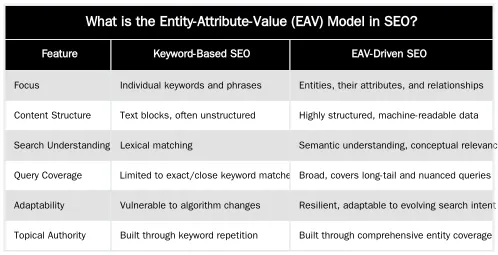
Unlike keyword-based SEO, which relies on keyword density and exact match phrases, EAV focuses on conceptual understanding. This makes it more resilient to algorithm updates and better captures evolving patient queries. For a London clinic, this attracts high-value patients searching for specific procedure details, surgeon qualifications, or recovery expectations.
EAV vs. Keyword-Based SEO
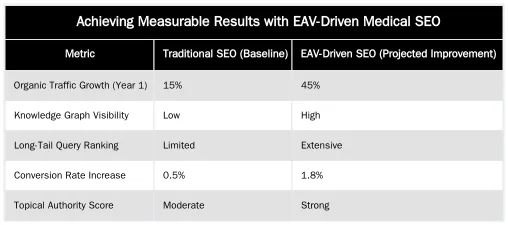
Achieving Measurable Results with EAV-Driven Medical SEO
An EAV-driven approach to medical SEO yields tangible, long-term results. Improved search visibility is a primary outcome, as search engines better understand the services offered. This leads to higher organic traffic, especially from patients researching specific procedures.
EAV enhances user engagement. Accurate search results reflecting site content reduce bounce rates and increase time on page. This relevance increases conversion rates, as qualified patients find the exact information they need, which fosters trust and encourages inquiries.
For competitive markets like Harley Street, a dominant online presence requires demonstrating expertise and trustworthiness. EAV modeling provides the framework for this. It also optimizes Cost of Retrieval (CoR), making it more efficient for search engines to process and rank complex medical data, benefiting the clinic.
Consider the impact on key performance indicators for a medical clinic:
Ready to Transform Your Clinic’s Online Presence?
The entity-attribute-value SEO model offers a path to topical authority and search visibility for medical clinics and plastic surgeons. Structuring content with precision helps search engines understand your expertise, attracting high-value patients in competitive markets like London. This approach is crucial for demonstrating E-E-A-T and leading in the YMYL search landscape.
Plastic surgeons and aesthetic clinic owners in London seeking superior online performance can leverage semantic engineering and data modeling. A tailored semantic SEO strategy can elevate your clinic’s digital footprint. Contact Abdurrahman Şimşek to discuss your needs.
Conclusion
The Entity-Attribute-Value (EAV) model is a strategic evolution in SEO, moving beyond keywords to semantic understanding. For medical clinics, especially for surgical procedures, EAV provides a framework for structuring complex information, enhancing machine readability, and strengthening topical authority. This approach builds a strong online presence, improves E-E-A-T signals, and connects with patients seeking detailed medical information. EAV SEO supports long-term organic growth and market dominance in digital healthcare.
Frequently Asked Questions
Can you give a simple example of the Entity-Attribute-Value (EAV) model for a surgical procedure?
The Entity-Attribute-Value (EAV) model helps define complex services with precision. For “Breast Augmentation,” the entity, attributes like ‘Anesthesia Type’ and ‘Implant Type’ describe its characteristics. Their corresponding values, such as ‘General’ or ‘Silicone’, provide specific details, making the procedure’s data highly structured and machine-readable for search engines.
How does the entity-attribute-value seo approach benefit my clinic’s search engine visibility?
This structured approach provides Google with unambiguous, factual data about your services, which is crucial for YMYL queries. It helps Google’s AI confidently understand exactly what you offer, improving rankings in AI Overviews and enhancing overall search engine visibility for your medical practice.
Do I need to be a database expert to implement an EAV model for SEO?
While the concept originates from database design, you don’t need to be a developer to apply its principles. The core idea is to logically organize your content, which a specialist can then translate into technical formats like JSON-LD schema for optimal search engine understanding. This ensures your clinic’s information is presented effectively.
How does Ruxi Data leverage the Entity-Attribute-Value (EAV) model for medical practices?
Ruxi Data is an advanced SEO infrastructure that automates the creation of EAV models for medical practices. It programmatically analyzes procedures, building these data structures to generate complex topical maps and advanced schema markup at scale. This significantly enhances a clinic’s semantic footprint and authority online.
Is entity-attribute-value seo only suitable for large medical websites?
No, the principles of entity-attribute-value seo are highly beneficial for websites of any size. For a private clinic, clearly defining core procedures as entities with specific attributes is a powerful way to differentiate expertise and build topical authority, even with a smaller number of pages. It helps Google understand your unique offerings.
How can Abdurrahman Şimşek help my London clinic implement an EAV SEO strategy?
Abdurrahman Şimşek specializes in building high-authority Semantic Content Networks for medical clinics, leveraging EAV modeling and Ruxi Data. You can contact him through his website, abdurrahmansimsek.com, to discuss a tailored strategy for enhancing your clinic’s online presence and achieving measurable organic growth in competitive markets like London.
Ruxi Data brings together multi-model AI, automated website crawling, live indexation checks, topical authority mapping, E-E-A-T enrichment, schema generation, and full pipeline automation — from crawl to WordPress publish to social posting — all in one platform built for agencies and freelancers who run on results.