
CDN Strategies for London Clinics: Optimizing Performance and Patient Trust
Implementing advanced cdn strategies for london clinics is essential for enhancing website speed, security, and overall performance. This article details how content delivery networks and multi-layered caching (browser, server, edge) reduce latency and improve Time to First Byte (TTFB) for UK patients. By optimizing content delivery, clinics can improve Core Web Vitals, strengthen E-E-A-T signals, and secure their online presence against threats like DDoS attacks. Effective cdn strategies for london clinics ensure rapid access to critical medical information, fostering patient trust and supporting local search dominance in competitive areas like Harley Street.
Abdurrahman Şimşek, a Semantic SEO Strategist specializing in medical clinics, provides expert guidance on technical web development and holistic SEO. His approach leverages semantic engineering and Ruxi Data infrastructure to build high-authority online presences for healthcare providers.
To explore your options, contact us to schedule your consultation. You can also reach us via: Book a Semantic SEO Audit, Direct WhatsApp Strategy Line: +90 506 206 86 86
Advanced cdn strategies for london clinics improve website speed, security, and performance. These improvements help attract and convert patients in competitive London postcodes, supporting clinical excellence and local search dominance.
Why Advanced Caching & CDN Strategies are Crucial for London Clinics
Advanced caching and content delivery network (CDN) strategies are critical for London clinics because they provide rapid content delivery, enhanced security, and an improved user experience for local patients. These optimizations ensure medical websites load quickly and reliably, which helps attract and retain patients in a competitive, trust-sensitive market.
What is a Content Delivery Network (CDN) and Caching?
A Content Delivery Network (CDN) is a geographically distributed network of proxy servers and data centers that provides high availability and performance by distributing content closer to end-users. Caching stores copies of data in a temporary location (cache) for faster access than refetching from the primary source. Together, they accelerate website content delivery.
The Unique Performance Demands of Medical Websites in London
London clinic websites have unique performance demands due to high-resolution imagery (e.g., before-and-after galleries) and video testimonials. These large media types can slow page load times if unoptimized. For local patient acquisition, speed is a trust factor, as slow sites deter patients. In a Your Money or Your Life (YMYL) context, a fast, secure website conveys the professionalism and reliability medical sites require.
How CDNs and Caching Optimize Website Performance for UK Patients
CDNs and caching enhance website performance by placing content closer to the user and reusing fetched data. This reduces page load times for patients accessing information or booking appointments.
Reducing Latency and Improving Time to First Byte (TTFB)
Latency is the delay before data transfer begins. A CDN minimizes latency for UK patients by serving content from a local Point of Presence (PoP). This proximity reduces the distance data travels, lowering latency and improving Time to First Byte (TTFB). TTFB measures the time for a browser to receive the first byte of content from the server. A lower TTFB is a Core Web Vital metric indicating a faster server response and better user experience for local patients.
Browser, Server, and Edge Caching Explained
A multi-layered caching strategy improves website performance. Browser caching stores static assets (images, CSS, JavaScript) on a user’s device for faster loading on subsequent visits. Server-side caching stores generated HTML or database query results on the web server, reducing the processing load for dynamic content. Edge caching, performed by the CDN, stores static asset copies at its PoPs. The CDN delivers content from the nearest edge server, bypassing the origin server to speed up delivery for high-traffic medical sites.
Implementing CDN & Caching: A Guide for London Clinics
Effective CDN and caching implementation requires careful planning and configuration. London clinics should select providers with strong local infrastructure and policies that align with medical data handling requirements.
Choosing the Right CDN with UK Points of Presence (PoPs)
Clinics should evaluate CDN providers like Cloudflare or AWS CloudFront, prioritizing those with multiple UK Points of Presence (PoPs). Local PoPs minimize latency for London-based patients, improving page speed and user experience. Considerations include performance, cost, security features, and ease of integration. A CDN is a foundational element of a Harley Street SEO strategy.
Configuring Advanced Caching Rules for Medical Content
Effective caching requires specific policies for different content types. Static assets (high-resolution images, CSS, JavaScript) can be cached aggressively with long expiry times. Dynamic content (appointment forms, patient portals) requires intelligent caching to ensure real-time data is displayed. Ensure GDPR compliance by not caching sensitive patient data. Most CDNs offer granular control over caching rules for precise configuration.
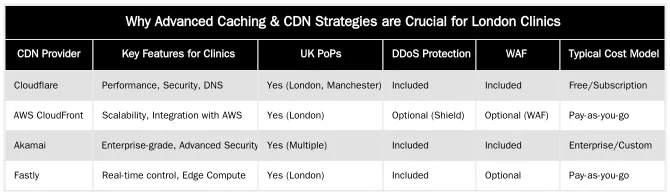
Beyond Speed: CDN’s Role in E-E-A-T, Security, and Cost of Retrieval
A CDN’s benefits extend beyond speed. For medical clinics, a CDN helps establish Expertise, Experience, Authoritativeness, and Trust (E-E-A-T), improves security, and optimizes the ‘Cost of Retrieval’ for search engines.
Enhancing Trust and Authority Through Site Performance
A fast, secure, and available website contributes to Google’s E-E-A-T signals. Patients expect medical websites to be professional and reliable; a site that loads instantly and functions well demonstrates quality, building trust and reinforcing authority. Google’s Quality Rater Guidelines link website quality and user experience for YMYL sites to perceived trustworthiness. Google’s Search Quality Evaluator Guidelines show how site performance impacts user perception and quality ratings.
DDoS Protection and Data Integrity for YMYL Sites
Medical websites handle sensitive patient information, making them targets for cyberattacks. CDNs provide security layers like Distributed Denial of Service (DDoS) mitigation, which absorbs malicious traffic to ensure site availability. Many CDNs also offer Web Application Firewalls (WAFs) to protect against web vulnerabilities and enforce SSL/TLS encryption, securing data in transit. These security features are essential for YMYL websites to protect patient data and maintain the clinic’s reputation. Understanding these layers is part of reducing the cost of retrieval, as search engines crawl and trust secure sites more efficiently. The National Cyber Security Centre (NCSC) provides guidance on DDoS protection.
Measuring the Impact: Core Web Vitals and SEO Gains for Your Clinic
Implementing caching and CDN solutions requires measuring outcomes. Clinics must monitor key performance indicators to correlate these technical optimizations with SEO and patient acquisition goals.
Monitoring Page Speed and User Experience Metrics
After deploying a CDN and optimizing caching, clinics should use tools like Google PageSpeed Insights, Lighthouse, and Google Search Console’s Core Web Vitals reports. These tools provide data on metrics like Largest Contentful Paint (LCP), First Input Delay (FID), Cumulative Layout Shift (CLS), and Time to First Byte (TTFB). Tracking these metrics before and after implementation shows improvements in page speed and user experience. Consistent monitoring ensures strategies remain effective and identifies performance bottlenecks. For details, see Google’s Core Web Vitals documentation.
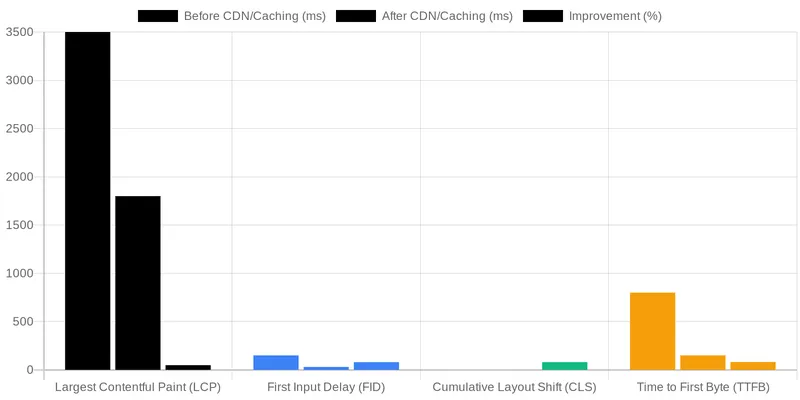
Connecting Performance Improvements to Patient Acquisition
Faster load times lead to lower bounce rates and higher conversion rates on consultation forms and appointment bookings. Search engines favor fast, user-friendly websites, which can improve local search rankings for London clinics. These performance enhancements improve the patient journey, driving patient acquisition and supporting clinic growth.
Future-Proofing Your Clinic’s Online Presence
Advanced caching and CDN strategies are fundamental to a high-performing online presence for London clinics. These technical optimizations improve speed, security, and patient trust, influencing visibility and conversion rates.
Conclusion
Optimizing a London clinic’s website with advanced caching and CDN solutions reduces latency, improves page speed, enhances security, and contributes to E-E-A-T signals and Core Web Vitals. These improvements can build patient trust and achieve higher rankings in London search results. For a tailored strategy, contact us, Book a Semantic SEO Audit, or use our Direct WhatsApp Strategy Line: +90 506 206 86 86.
Frequently Asked Questions
Why are specific cdn strategies for london clinics essential for local SEO?
For London clinics, attracting local patients is paramount. A CDN with UK-based Points of Presence significantly reduces latency by serving website assets from a server physically closer to the patient. This dramatically improves page load speed, enhances user experience, and positively impacts local search engine rankings, making robust cdn strategies for london clinics a competitive advantage.
How do advanced CDN strategies for London clinics improve Core Web Vitals?
Advanced content delivery network approaches significantly improve Core Web Vitals, especially Largest Contentful Paint (LCP). By serving heavy assets like high-resolution before-and-after images from fast, local servers, a CDN ensures pages load quickly, which is a critical factor for Google’s ranking algorithms. This directly contributes to a better patient experience and stronger SEO performance.
How does caching complement CDN strategies for London clinics?
A CDN primarily caches static assets at its edge locations, while browser caching instructs a returning visitor’s browser to store these assets locally. Implementing both caching mechanisms alongside effective cdn strategies for london clinics provides the fastest possible experience for both new and returning patients, optimizing resource delivery and reducing server load.
Can a Content Delivery Network enhance the security of a medical clinic’s website?
Yes, a modern CDN provides a crucial layer of security for medical websites. While not a substitute for GDPR compliance on your origin server, it can mitigate DDoS attacks, block malicious bots, and offer a Web Application Firewall (WAF) to prevent common exploits, safeguarding the availability and integrity of your clinic’s online presence.
Is implementing a CDN for an existing medical website a complex process?
No, for most websites, implementing a CDN is a relatively straightforward process. Services like Cloudflare can be activated with a simple DNS change, requiring minimal technical configuration to get started. Advanced caching rules can then be fine-tuned for optimal performance and security.
How can Abdurrahman Şimşek help implement advanced cdn strategies for London clinics?
Abdurrahman Şimşek specializes in holistic SEO and semantic engineering, including optimizing technical performance for medical clinics. You can book a Semantic SEO Audit through his website or contact him directly via WhatsApp at +90 506 206 86 86 to discuss tailored cdn strategies for London clinics and other performance enhancements.
Ruxi Data brings together multi-model AI, automated website crawling, live indexation checks, topical authority mapping, E-E-A-T enrichment, schema generation, and full pipeline automation — from crawl to WordPress publish to social posting — all in one platform built for agencies and freelancers who run on results.