
GDPR HIPAA Compliance: Ensuring Secure Patient Data & Legal Adherence
Achieving gdpr hipaa compliance is crucial for UK medical clinics to safeguard sensitive patient data. This guide outlines essential web development requirements for adhering to GDPR and the UK Data Protection Act 2018, which are mandatory for all personal data processing. While HIPAA is a US law, its robust principles offer best practices for enhancing medical data security and patient data privacy, particularly for clinics with international patients or US-based digital services. The article provides a practical web development checklist to ensure secure contact forms, encrypted data transmission, and a compliant cookie consent policy, fostering patient trust and legal adherence.
Authored by Abdurrahman Şimşek, a Semantic SEO Strategist, this content provides expert guidance on integrating critical compliance measures into healthcare website development. It emphasizes building trust and E-E-A-T through proactive digital security strategies.
To explore your options, contact us to schedule your consultation. You can also reach us via: Book a Semantic SEO Audit, Direct WhatsApp Strategy Line: +90 506 206 86 86
In the sensitive realm of healthcare, ensuring robust patient data privacy is not just a legal obligation but a cornerstone of trust. This comprehensive guide provides a web development checklist for UK medical clinics to navigate the complexities of gdpr hipaa compliance, ensuring your digital presence is secure, ethical, and legally sound. Understanding these regulations is vital for protecting sensitive patient information and maintaining a credible online presence. Proactive compliance builds patient confidence and strengthens your clinic’s reputation in the digital landscape.
Do UK Medical Clinics Need Both GDPR and HIPAA Compliance?
UK medical clinics must comply with GDPR, as it governs the processing of personal data for individuals residing in the EU and UK. While HIPAA (Health Insurance Portability and Accountability Act) is a US federal law and does not directly apply to UK entities, adhering to its robust data security principles is a highly recommended best practice. This is particularly relevant if a UK clinic treats international patients, especially those from the US, or utilizes US-based software and cloud services that process Protected Health Information (PHI).
GDPR, enforced in the UK through the Data Protection Act 2018, sets stringent requirements for data protection, privacy, and the rights of individuals. It mandates explicit consent for data processing, data minimization, and robust security measures for all personal data, including sensitive medical information. HIPAA, on the other hand, specifically focuses on safeguarding PHI within the US healthcare system, covering administrative, physical, and technical safeguards. Adopting HIPAA-aligned security measures can significantly enhance a UK clinic’s overall medical data security posture, even if not legally obliged by US law.
GDPR & UK DPA 2018: Essential Web Development Requirements
For UK medical clinics, compliance with GDPR and the UK Data Protection Act 2018 is non-negotiable. Your website serves as a primary interface for patient interaction, making it a critical point for data collection and processing. Implementing the correct web development practices ensures patient data privacy and legal adherence. This involves careful consideration of how personal data is collected, stored, and managed from the moment a patient interacts with your digital platforms.
Key requirements include transparent data processing, obtaining explicit consent, and ensuring data subjects can exercise their rights. This translates into specific website features and backend configurations. Neglecting these aspects can lead to significant penalties and erode patient trust. A proactive approach to secure web development is fundamental for any healthcare provider operating online in the UK.
Implementing Robust Cookie Consent Policies and Mechanisms
A compliant cookie consent policy is essential for any UK medical website. This means more than just a banner; it requires granular control for users. Your website must present a clear, easily understandable cookie banner upon first visit, allowing users to accept, decline, or customize their cookie preferences. Pre-ticked boxes for non-essential cookies are not permitted under GDPR. The system should record user choices and allow them to change their preferences at any time via an accessible link, typically in the footer.
Furthermore, the website’s backend must prevent non-essential cookies from loading until explicit consent is given. This includes analytics cookies, marketing cookies, and third-party tracking scripts. A detailed cookie policy page, linked from the banner, should explain what cookies are used, their purpose, and how users can manage them. This transparency is crucial for building trust and ensuring .
Secure Contact Forms and Data Minimization Principles
Contact forms are a common entry point for collecting patient data. Under GDPR, the principle of data minimization dictates that you should only collect data that is absolutely necessary for the stated purpose. For instance, if a form is for a general inquiry, asking for sensitive medical history might be excessive. Each form field should have a clear purpose, and this purpose should be communicated to the user.
Beyond data minimization, the security of these forms is paramount. All must use SSL/TLS encryption to protect data during transmission. Data submitted through forms should be stored securely, ideally encrypted at rest, and access should be restricted to authorized personnel. Implementing CAPTCHA or reCAPTCHA can prevent spam, but ensure it doesn’t hinder accessibility. Clearly state how the collected data will be used and link to your comprehensive privacy policy directly from the form.
HIPAA Principles for UK Clinics: A Best Practice Security Checklist
While HIPAA is a US regulation, its comprehensive approach to protecting sensitive health information offers a valuable framework for UK clinics seeking to elevate their . Adopting HIPAA’s principles demonstrates a commitment to the highest standards of patient confidentiality, which is increasingly important in a globally connected healthcare landscape. This is particularly pertinent for clinics that cater to international clientele or integrate with US-based software solutions that might handle Protected Health Information (PHI).
The HIPAA Security Rule outlines three main types of safeguards: Administrative, Physical, and Technical. Translating these into web development practices helps create a robust digital environment. By proactively implementing these safeguards, UK clinics can not only protect patient data but also enhance their reputation for trustworthiness and ethical practice, which contributes significantly to their E-E-A-T (Expertise, Experience, Authoritativeness, Trustworthiness) signals.
Technical Safeguards: Encrypted Data Transmission (SSL/TLS)
A foundational technical safeguard for any healthcare website is robust encryption for data in transit. This means implementing HTTPS across your entire site using SSL/TLS certificates. HTTPS encrypts all communication between a user’s browser and your server, preventing eavesdropping and tampering. For medical clinics, this is non-negotiable, as it protects sensitive patient inquiries, appointment bookings, and any other personal data exchanged.
Ensure your SSL/TLS certificates are up-to-date and configured correctly. Use strong encryption protocols and regularly audit your site for any mixed content warnings (HTTP content on an HTTPS page), which can compromise security. This measure is critical for , safeguarding patient information from interception during online interactions. For robust infrastructure, consider the principles of SaaS technical SEO, which often includes high-level security protocols.
Secure Hosting Environments and Access Controls
The physical and administrative safeguards of HIPAA translate directly into requirements for your website’s hosting environment. Your hosting provider must offer robust security measures, including firewalls, intrusion detection systems, and regular security audits. Data backups should be performed frequently and stored securely, ensuring data recovery in case of an incident.
Furthermore, strict access controls are vital. Only authorized personnel should have access to the server, database, and content management system (CMS) where patient data might be stored or processed. Implement strong password policies, multi-factor authentication (MFA), and regularly review access logs. This minimizes the risk of unauthorized access to sensitive patient information, reinforcing the overall of your digital operations.
Building Trust & E-E-A-T Through Proactive Compliance
In the highly sensitive YMYL (Your Money Your Life) sector of healthcare, demonstrating Expertise, Experience, Authoritativeness, and Trustworthiness (E-E-A-T) is paramount for both patients and search engines. Robust is not merely a legal hurdle; it is a foundational element for establishing and communicating E-E-A-T. When a clinic’s website clearly prioritizes patient data privacy and security, it signals a deep commitment to ethical practice and professionalism.
Abdurrahman Şimşek, a Semantic SEO Strategist specializing in medical clinics, emphasizes that a compliant digital infrastructure reduces the ‘Cost of Retrieval’ for search engines. Search engines strive to deliver trustworthy results. A website that clearly adheres to data protection regulations is inherently more trustworthy, making it easier for algorithms to confidently rank its content. This proactive approach to compliance becomes a cornerstone of building and a strong semantic content network.
How Data Privacy Signals Enhance Your Medical Website’s E-E-A-T
Transparent privacy policies, clear consent mechanisms, and secure data handling practices are powerful E-E-A-T signals. When a patient visits your website, they are looking for reassurance that their sensitive medical information will be protected. A well-articulated privacy policy, easily accessible and written in plain language, demonstrates your clinic’s commitment to patient rights and data protection.
Technically, the presence of SSL/TLS certificates, secure server configurations, and proper cookie management all contribute to a secure user experience. These technical signals are interpreted by search engines as indicators of a trustworthy website. By prioritizing these elements in your , you not only protect your patients but also enhance your site’s perceived authority and trustworthiness in the eyes of search algorithms.
Compliance as a Foundation for Semantic Content Networks
A compliant digital infrastructure provides a stable and trustworthy foundation for building sophisticated semantic content networks. Semantic SEO, which focuses on entities and their relationships rather than just keywords, thrives on accurate and reliable information. When your website adheres to strict data protection standards, it ensures that the medical entities and attributes presented are handled with the utmost care and integrity.
This alignment with ethical data practices reinforces the trustworthiness of your content, making it more likely to be recognized as authoritative by search engines. A secure and compliant website is better positioned to host and connect high-quality, medically accurate content, forming a robust semantic SEO for surgeons strategy. This holistic approach ensures that your clinic’s digital presence is both legally sound and highly effective in establishing topical authority.
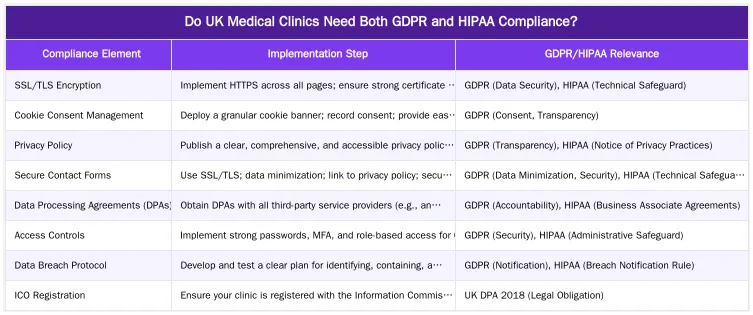
Web Development Compliance Checklist for UK Medical Clinics
Achieving comprehensive requires a systematic approach to web development. This checklist provides actionable steps for UK medical clinics to ensure their digital platforms meet the necessary legal and ethical standards for patient data protection. Each item represents a critical component of a secure and trustworthy online presence.
Implementing these steps not only mitigates legal risks but also fosters patient confidence, which is invaluable in the healthcare sector. This proactive strategy ensures that your website is a safe and reliable resource for patients, aligning with the highest standards of and data governance.
Key Compliance Elements and Implementation Steps
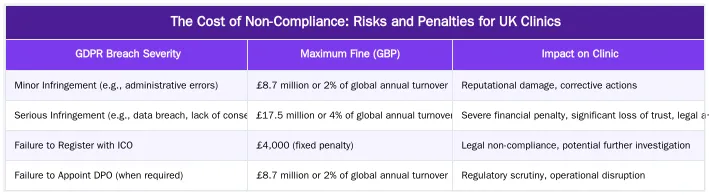
The Cost of Non-Compliance: Risks and Penalties for UK Clinics
The repercussions of failing to adhere to data protection regulations extend far beyond legal fines. For UK medical clinics, non-compliance with GDPR and the UK Data Protection Act 2018 can result in severe financial penalties, significant reputational damage, and a profound loss of patient trust. The Information Commissioner’s Office (ICO) actively investigates breaches and imposes substantial fines, underscoring the necessity of proactive measures.
Beyond the direct financial impact, a data breach can lead to operational disruption, legal action from affected individuals, and long-term damage to a clinic’s brand. Patients entrust medical clinics with their most sensitive personal information; a failure to protect this data can irrevocably harm a clinic’s standing in the community and its ability to attract new patients. Investing in robust is an investment in the clinic’s long-term viability and ethical reputation.
ICO Registration and Data Protection Officer (DPO) Requirements
All organizations that process personal data in the UK, including medical clinics, are generally required to register with the Information Commissioner’s Office (ICO) and pay an annual data protection fee. Failure to register is a criminal offense and can result in fines. This registration ensures accountability and transparency in data handling practices.
Furthermore, certain organizations are mandated to appoint a Data Protection Officer (DPO). For medical clinics, a DPO is required if you carry out large-scale processing of special categories of data (which includes health data) or large-scale, regular, and systematic monitoring of individuals. The DPO acts as an independent advisor on data protection, overseeing compliance and acting as a point of contact for the ICO and data subjects. Understanding these requirements is crucial for legal operation.
Secure Your Clinic’s Digital Future with Expert Web Development & SEO
Navigating the intricate landscape of data protection regulations requires specialized expertise. For UK medical clinics, ensuring robust in web development is not just about avoiding penalties; it’s about building a foundation of trust and authority. A secure, compliant website is essential for attracting and retaining patients in today’s digital age.
Partner with a Specialist in Medical Website Compliance and SEO
Abdurrahman Şimşek specializes in building high-authority Semantic Content Networks for medical clinics, understanding the unique compliance and E-E-A-T requirements of the healthcare sector. Partnering with an expert ensures your website is not only compliant but also optimized for organic search, driving high-value patient inquiries. Secure your clinic’s digital future with a strategic approach that integrates compliance with cutting-edge SEO. Book a Semantic SEO Audit today or reach out via Direct WhatsApp Strategy Line: +90 506 206 86 86.
Conclusion
For UK medical clinics, robust GDPR compliance is a legal imperative, while adhering to HIPAA’s security principles represents a gold standard in patient data protection. Integrating these requirements into your web development strategy is crucial for safeguarding sensitive information, building patient trust, and establishing strong E-E-A-T signals with search engines. Proactive compliance mitigates risks and enhances your clinic’s digital reputation. By prioritizing secure web development and transparent data handling, clinics can ensure a resilient and trustworthy online presence. To ensure your clinic’s website meets these critical standards and achieves optimal organic visibility, contact us. You can also Book a Semantic SEO Audit or use our Direct WhatsApp Strategy Line: +90 506 206 86 86.
Frequently Asked Questions
Does my UK clinic’s website need to ensure gdpr hipaa compliance?
Yes, your website must be GDPR compliant as it processes data of UK/EU residents. While HIPAA is a US law, adhering to its data security principles is a best practice, especially if you treat international patients or use US-based software for patient management. Achieving gdpr hipaa compliance helps protect sensitive patient information and builds trust.
What is the most important technical measure for website compliance?
The most critical technical measure is implementing end-to-end encryption (SSL/TLS) across your entire website. This ensures that any data submitted by patients, such as through a contact form, is securely transmitted and protected from interception. It’s a foundational step for data privacy and security.
How does Abdurrahman Şimşek’s web development process ensure gdpr hipaa compliance?
Our process, guided by a security-first mindset, includes implementing mandatory SSL, creating privacy-by-design contact forms that minimize data collection, and setting up compliant cookie consent mechanisms. We also advise on secure hosting environments to ensure robust gdpr hipaa compliance for your clinic’s digital presence.
Are standard WordPress contact form plugins inherently compliant with data regulations?
Not by default. Standard plugins require correct configuration to be compliant. This involves adding explicit consent checkboxes, linking to your privacy policy, and ensuring data is not stored on the web server longer than necessary, aligning with GDPR principles.
What considerations are there for patient data from online booking systems?
When integrating third-party booking systems, we ensure they are fully GDPR compliant and that a Data Processing Agreement (DPA) is in place. The security of patient data across all integrated systems is a top priority in our technical architecture, maintaining a high standard of protection.
How can I get expert help to achieve gdpr hipaa compliance for my UK medical clinic’s website?
You can secure your clinic’s digital future by booking a Semantic SEO Audit with Abdurrahman Şimşek to assess and enhance your website’s compliance. We specialize in medical SEO and web development, ensuring your site meets all necessary regulations for gdpr hipaa compliance. Alternatively, you can reach out directly via our WhatsApp Strategy Line: +90 506 206 86 86.
Ruxi Data brings together multi-model AI, automated website crawling, live indexation checks, topical authority mapping, E-E-A-T enrichment, schema generation, and full pipeline automation — from crawl to WordPress publish to social posting — all in one platform built for agencies and freelancers who run on results.