
Managing URL Parameters: Optimizing Medical SEO and Crawl Budget
Effectively managing url parameters is crucial for medical websites utilizing patient portals and booking systems. These dynamic URL additions frequently generate duplicate content and deplete valuable crawl budget, directly impacting SEO performance and E-E-A-T signals. This article details how to identify parameter-induced issues and implement strategic solutions, including canonical tags and Google Search Console configurations, to ensure optimal indexing and preserve topical authority for healthcare entities. Understanding proper url parameter handling is vital for maintaining search engine visibility.
Authored by Abdurrahman Şimşek, a Semantic SEO Strategist, this guide provides actionable insights into technical SEO challenges specific to healthcare platforms. It emphasizes maintaining robust online visibility and search engine trust through meticulous parameter control and strategic indexing practices.
To explore your options, contact us to schedule your consultation. You can also reach us via: Book a Semantic SEO Audit, Direct WhatsApp Strategy Line: +90 506 206 86 86
Managing url parameters is essential for platforms like patient portals and booking systems. These dynamic URL additions can create SEO challenges, including duplicate content and wasted crawl budget. This guide explains their impact and provides strategies to maintain crawlability, preserve topical authority, and support E-E-A-T signals for medical websites.
What Are URL Parameters and Why Do They Impact Medical SEO?
URL parameters are dynamic values appended to a web address after a question mark (?), used to pass data. For medical websites with patient portals or booking systems, parameters manage user sessions, filter content, or track behavior. Their proliferation can cause SEO problems like duplicate content and inefficient crawl budget usage, which are critical concerns for YMYL (Your Money Your Life) sites that require accuracy and authority.
Parameters like `?sessionid=`, `?date=`, or `?filter=` create unique URLs for nearly identical content. Search engines interpret each unique URL as a distinct page, which can confuse algorithms, dilute ranking signals, and hinder the indexing of medical information. For a clinic building topical authority, these issues can undermine its expertise and trustworthiness.
Common Parameters in Healthcare Systems
Patient portals and booking platforms use several parameter types. Session IDs (`?sessionid=XYZ123`) maintain a user’s state. Date selectors (`?date=2026-03-15`) show available appointments. Filtering options (`?filter=specialty&value=dermatology`) narrow search results for doctors or services. Tracking parameters (`?ref=googleads`, `?utm_source=email`) are used for analytics and also create unique URLs. This multiplication of dynamic URLs creates many pages with little unique value for search engines.
Diagnosing Parameter-Induced Duplicate Content & Crawl Budget Issues
Parameter-driven URLs cause duplicate content. When multiple URLs show near-identical information, search engines struggle to identify the authoritative version. This splits link equity from backlinks and internal links, weakening the canonical page’s authority. For medical sites, this harms E-E-A-T and can be detrimental to ranking for health-related queries.
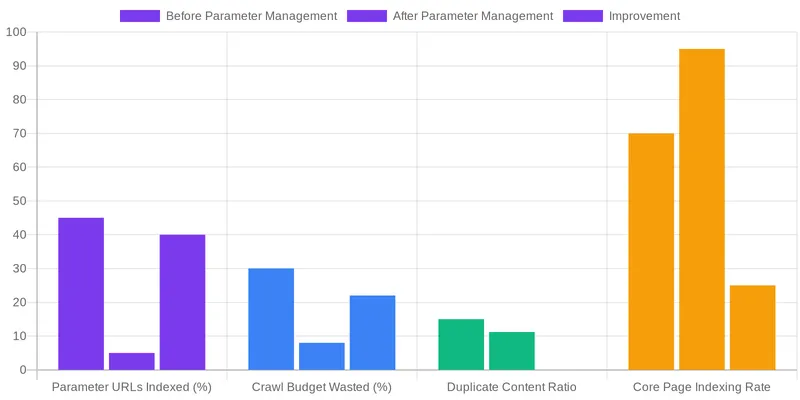
Excessive parameter URLs also impact a site’s crawl budget. Search engines allocate finite resources to crawl a website. If much of this budget is spent on redundant, parameter-generated pages, important content like medical service pages or doctor profiles may be crawled less frequently or missed. This inefficiency hinders indexing, preventing valuable content from appearing in search results.
The ‘Cost of Retrieval’ for Parameter-Heavy Sites
‘Cost of Retrieval’ (CoR) is the resources search engines expend to crawl and index pages. On sites with many parameter-heavy URLs, Google uses more processing power and bandwidth on redundant pages. This increased CoR means resources are spent on low-value content, which can lower the indexing priority of high-value medical content. Reducing CoR is vital for efficient indexing, helping search engines discover and rank important information and strengthening your site’s semantic network and topical authority.
Strategic Solutions for URL Parameter Management in 2026
URL parameter handling combines technical directives to guide search engine bots. The primary tools are canonical tags and robots.txt disallow directives. Google Search Console’s URL Parameters tool was deprecated in 2022, but its function provides historical context and may be relevant for other search engines. For Google, the focus is now on canonicalization and robots.txt.
Implementing Canonical Tags for Parameter URLs
The canonical tag (“) tells search engines the preferred URL among a set of duplicates. For parameter-generated URLs, it is often the most effective solution. For instance, `https://example.com/book-appointment?date=2026-04-01` should have a canonical tag pointing to `https://example.com/book-appointment`. This consolidates ranking signals to the preferred URL, preventing authority dilution. Canonicalization is ideal when the parameter-driven page has user value but should not be indexed independently.
When to Use Robots.txt Disallow for Parameters
The `robots.txt` file tells search engine crawlers which parts of a website to avoid. Use `Disallow` directives for parameter-generated URLs that offer no SEO value and should not be crawled or indexed. Examples include session IDs (`Disallow: /*?sessionid=`), internal search results (`Disallow: /*?q=`), or tracking parameters that don’t alter content. Do not disallow a canonicalized page, as this can prevent search engines from discovering the canonical tag. This method optimizes crawl budget by preventing bots from crawling irrelevant URLs.

Advanced Parameter Handling: Beyond the Basics for Medical Websites
For medical websites with extensive services or complex booking flows, advanced parameter handling goes beyond basic canonicalization and robots.txt. It requires understanding site architecture and how search engines interpret dynamic content. Faceted navigation, common in specialist directories, generates parameters. A combination of canonical tags for primary category pages and noindexing specific filter combinations can prevent index bloat. Server-side URL rewrites transform dynamic URLs into clean, static paths before they are served, eliminating parameter issues at the source. This requires development expertise but creates a clean URL structure.
A site architecture designed for SEO reduces the need for parameter cleanup. For YMYL sites, a clean, logical structure reinforces E-E-A-T by presenting information clearly. Abdurrahman Şimşek’s methodology builds semantic content networks where clearly defined core entities minimize reliance on parameters for navigation or content differentiation. This approach helps search engines understand the site’s expertise and trustworthiness.
Leveraging Log File Analysis to Uncover Hidden Parameter Issues
While Google Search Console offers insights, log file analysis provides a granular view of bot interactions with your site. Server logs show precisely which parameter URLs are crawled, how frequently, and by which bots. This can reveal hidden crawl budget waste, unexpected indexed parameters, or whether `robots.txt` directives are being respected. For complex medical sites, log file analysis diagnoses issues not apparent in standard tools, providing data to refine parameter management.
Integrating Parameter Management with Semantic SEO Architecture
Abdurrahman Şimşek’s semantic SEO approach uses a clear, entity-based content architecture that informs parameter management. Structuring a website around well-defined entities (e.g., medical procedures, conditions, doctor profiles) and their relationships reduces the need for complex parameters to differentiate content. A semantic network prioritizes core content, ensuring parameter-created variations are either canonicalized to the primary entity page or disallowed. This integration gives every page a clear purpose within the topical map, reducing redundancy and enhancing site authority and relevance.
Ensuring Optimal Indexing and Authority for Your Medical Practice
Effective URL parameter management benefits medical websites by improving crawl efficiency, allowing bots to focus on valuable content. This strengthens page authority for core service and informational pages because ranking signals are consolidated, not diluted. Better indexing of medical content helps patients find information, enhancing user experience and driving organic traffic.
Ongoing monitoring and maintenance are required. Regularly audit your site for new parameter patterns, especially after updates to patient portals or booking systems. Periodically review canonical tags and robots.txt directives for accuracy. Proactive parameter handling is part of technical SEO that contributes to a medical practice’s online visibility and E-E-A-T.
Monitoring Parameter Performance in Google Search Console
Google Search Console (GSC) is a key tool for monitoring parameter management. The Index Coverage report highlights URLs excluded by canonicalization or robots.txt, verifying your directives are working. The URL Inspection tool shows how Google sees a specific URL, including its canonical status and crawlability. Watch key metrics like the number of indexed pages, the ratio of valid to excluded pages, and spikes in crawl errors related to parameters. Regular checks ensure your parameter management contributes to site health and search performance.
Partner with a Semantic SEO Expert for Technical Excellence
Technical SEO for medical websites with patient portals and booking systems demands specialized expertise. Managing url parameters, optimizing for Cost of Retrieval, and building semantic content networks are critical for high search visibility. Abdurrahman Şimşek, a London-based Semantic SEO Strategist, specializes in these techniques for medical clinics. His understanding of information retrieval and entity-attribute-value modeling ensures a website’s technical foundation supports its authority and E-E-A-T. For London’s private healthcare sector, partnering with an expert is a necessity for organic search performance.
Conclusion
URL parameters, while functional, present SEO challenges that require proactive management. Using canonical tags, robots.txt directives, and log file analysis, medical websites can mitigate duplicate content, optimize crawl budget, and reinforce topical authority. A parameter management strategy is fundamental to technical SEO, ensuring medical content is indexed and visible to patients. For a comprehensive approach to technical and semantic SEO, Contact us to discuss your practice’s online performance. You can also Book a Semantic SEO Audit or reach out via Direct WhatsApp Strategy Line: +90 506 206 86 86.
Frequently Asked Questions
Why is managing url parameters from a booking system so important for SEO?
Managing url parameters from booking systems and patient portals is crucial because these dynamic additions often create numerous duplicate or low-value URLs. This proliferation can severely dilute your website’s SEO authority, waste valuable crawl budget, and hinder search engines from efficiently discovering your most important content. Proper handling ensures that search engines focus on your canonical pages, preserving your site’s overall SEO health.
What are the best practices for managing url parameters to optimize crawl budget?
The best approach for managing url parameters involves a two-pronged strategy. Implement the `rel=”canonical”` tag on parameterized URLs, directing search engines to the preferred, clean version of the page. Additionally, utilize the `Disallow` directive within your `robots.txt` file to prevent crawlers from accessing low-value parameterized URLs, thereby optimizing your crawl budget and ensuring efficient indexing.
How does managing url parameters impact topical authority for medical websites?
In medical SEO, effective managing url parameters is vital for maintaining topical authority. Uncontrolled parameters create duplicate content, which can confuse search engines about the primary topic of a page and dilute its authority signals. By consolidating signals to canonical URLs, you reinforce the relevance and expertise of your medical content, strengthening your E-E-A-T.
Can URL parameters ever be beneficial for SEO, and how should they be handled?
Yes, “active” URL parameters that genuinely alter page content, such as for pagination or specific content filters (e.g., `?specialty=rhinoplasty`), can be beneficial for user experience and SEO. For these, it’s crucial to use `rel=”canonical”` tags to prevent duplicate content issues while still allowing search engines to discover and index the unique content they present. This careful approach ensures that useful variations are accessible without diluting authority.
Will blocking URL parameters in robots.txt impact user experience?
No, blocking URL parameters in your `robots.txt` file will not affect user functionality or experience. The `robots.txt` file serves solely as a directive for search engine crawlers, instructing them on which parts of your site to access or avoid. Human users will continue to interact with your patient portal or booking system URLs exactly as intended, without any disruption.
How can Abdurrahman Şimşek assist with managing url parameters for my medical practice?
Abdurrahman Şimşek, a Holistic SEO Strategist, specializes in technical SEO for medical and plastic surgery clinics, including complex parameter management. He can conduct a comprehensive semantic SEO audit to identify and resolve parameter-induced issues, ensuring optimal crawlability and topical authority. To discuss a tailored strategy for your practice, you can book a Semantic SEO Audit or reach out via WhatsApp at +90 506 206 86 86.
Ruxi Data brings together multi-model AI, automated website crawling, live indexation checks, topical authority mapping, E-E-A-T enrichment, schema generation, and full pipeline automation — from crawl to WordPress publish to social posting — all in one platform built for agencies and freelancers who run on results.