
Good Organic Growth Rate: Benchmarking Clinic SEO Success
A good organic growth rate for a medical clinic signifies consistent, non-paid search traffic increases, crucial for patient acquisition and online visibility. This article outlines realistic SEO benchmarks for new and established healthcare practices, detailing essential healthcare KPIs like organic traffic growth, keyword ranking improvements, and conversion rates. Understanding these industry standards helps clinics set achievable marketing goals and leverage Google Search Console data for year-over-year growth, ensuring digital efforts translate into tangible patient engagement.
Abdurrahman Şimşek, a Semantic SEO Strategist, provides expert insights into optimizing clinic online presence. This content offers actionable strategies for sustainable organic traffic growth, focusing on E-E-A-T principles and technical foundations essential for competitive healthcare markets.
To explore your options, contact us to schedule your consultation. You can also reach us via: Book a Semantic SEO Audit, Direct WhatsApp Strategy Line: +90 506 206 86 86
A good organic growth rate is fundamental for a medical clinic to expand its online presence and attract patients. This article defines organic growth for search engine optimization (SEO), provides benchmarks for new and established healthcare practices, and outlines strategies for sustainable organic traffic growth in competitive markets like London, ensuring digital efforts translate into patient acquisition and visibility.
What is a Good Organic Growth Rate for Your Clinic?
A good organic growth rate for a medical clinic is a consistent increase in non-paid search traffic, indicating improved visibility and relevance in search results. This metric correlates with patient acquisition, brand visibility, and trust. Organic growth is a sustainable, long-term asset, reducing reliance on advertising spend.
Defining Organic Growth & Its Importance for Medical Practices
Organic growth rate measures the percentage increase in visitors from unpaid search results. For medical practices, this metric reflects SEO effectiveness in connecting with patients searching for healthcare services. A healthy growth trajectory indicates the clinic is addressing patient search intent, building authority, and expanding its digital footprint. This leads to qualified leads and reinforces the clinic’s reputation as a trusted source of medical information.
Realistic Benchmarks: New vs. Established Clinics
The expected organic traffic growth rate varies by a clinic’s online maturity, market competitiveness, and SEO investment. New websites often experience rapid initial gains, while established sites focus on sustained, incremental improvements.
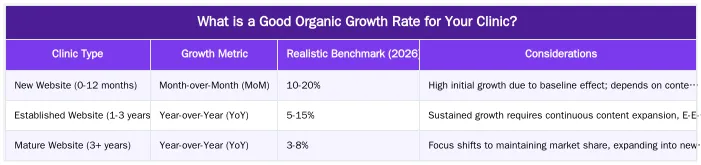
These figures are guidelines. Competitive markets, like private healthcare in London, may require more aggressive strategies and expertise to achieve the higher end of these benchmarks.
Beyond Traffic: Essential SEO Benchmarks & KPIs for Clinics
Organic traffic volume is a primary indicator, but a comprehensive SEO assessment requires tracking broader key performance indicators (KPIs). These metrics provide insights into user engagement, conversion effectiveness, and business impact, moving beyond website visits to patient acquisition.
Key Performance Indicators (KPIs) for Healthcare SEO
For healthcare SEO, critical KPIs include keyword ranking improvements for medical terms, and organic conversion rate (consultation bookings, form submissions, calls) which measures how traffic translates into patient leads. Click-through rate (CTR) from search results reflects snippet appeal and relevance. Patient lead quality is paramount; high traffic is less valuable if it doesn’t attract interested individuals. Google Search Console provides data on impressions, clicks, and average position; Google Analytics tracks on-site behavior and conversions for a complete performance view.
Setting Marketing Goals & Measuring Year-Over-Year Growth
Clinics should set measurable marketing goals aligned with business objectives, like increasing patient consultations by a percentage or expanding inquiries for a procedure. Analyzing year-over-year growth is crucial for understanding long-term trends and the impact of SEO. This perspective smooths seasonal fluctuations and provides an accurate picture of progress. Consistent year-over-year improvements demonstrate an adaptable SEO strategy, essential for success in the healthcare landscape. This long-term view helps refine strategies and allocate resources.
Factors Influencing Organic Growth in the YMYL Landscape
The ‘Your Money Your Life’ (YMYL) nature of medical content presents challenges and opportunities for organic growth. Search engines prioritize accuracy, trustworthiness, and expertise for health queries, making E-E-A-T and topical authority paramount for sustained visibility.
The Critical Role of E-E-A-T for Medical Websites
Expertise, Experience, Authoritativeness, and Trustworthiness (E-E-A-T) are foundational for a medical website to rank well. Google’s algorithms scrutinize YMYL content, demanding signals that information is accurate, current, and from credible sources. For clinics, this means showcasing professional qualifications and experience, providing evidence-based content, and ensuring a secure, user-friendly website. Demonstrating E-E-A-T involves surgeon bios, patient testimonials, academic citations, and transparent operational information. Without strong E-E-A-T signals, technically optimized sites may struggle to achieve a good organic growth rate in the healthcare sector.
Building Topical Authority for Sustainable Growth
Developing topical authority signals expertise to search engines beyond individual keywords. Clinics should build interconnected content networks covering every facet of a medical topic. For example, a plastic surgery clinic needs a “Rhinoplasty” page plus articles on “Rhinoplasty recovery,” “Types of rhinoplasty,” “Choosing a rhinoplasty surgeon,” and “Rhinoplasty cost.” This approach demonstrates a thorough understanding, positioning the clinic as a definitive resource. This strategy improves rankings for related queries and fosters long-term organic growth by establishing the clinic as an authority in its specialty. Understanding how to quantify topic cluster impact is key.
Accelerating Growth with Specialist Semantic SEO Strategies
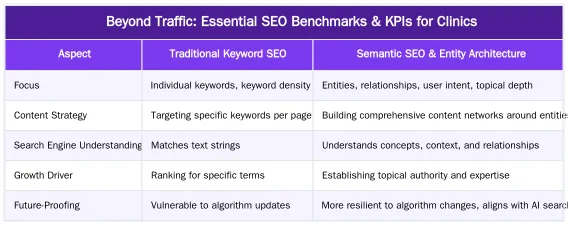
Achieving organic growth in the medical sector requires more than traditional keyword-centric SEO. Semantic SEO strategies, entity architecture, and Cost of Retrieval (CoR) optimization provide an advantage, allowing clinics to communicate their expertise more effectively to search engines.
The Semantic Advantage: Beyond Traditional Keyword SEO
Semantic SEO moves beyond matching keywords to understanding the meaning and relationships between entities. For a medical clinic, this means structuring content to define medical procedures, conditions, and specialists as distinct entities with their attributes and connections. This helps Google comprehend the clinic’s offerings with more depth, leading to more accurate rankings. Ruxi Data helps automate identifying these entities and relationships, facilitating relevant and authoritative content networks. This allows clinics to capture a broader spectrum of patient queries, including complex and conversational searches, driving organic traffic growth.
Optimizing Cost of Retrieval (CoR) for Enhanced Indexing
Cost of Retrieval (CoR) is the resources Google expends to crawl, process, and index a website’s content. Optimizing CoR is vital for complex medical websites. A technically efficient site with clean code, fast loading speeds, and logical internal linking reduces the effort for search engine bots to understand and index its pages. This efficiency leads to faster indexing of new content and quicker updates, impacting organic visibility. Minimizing CoR ensures E-E-A-T-rich content is discovered and ranked promptly, contributing to a healthy organic growth rate. This technical foundation is a critical component of SEO success.
Implementing Strategies for Consistent Organic Traffic Growth
To maintain a healthy organic growth rate, medical clinics must implement an SEO strategy encompassing content, technical, and local optimization. These elements work together to enhance visibility, attract patient traffic, and establish the clinic as a trusted authority.
Content Strategy: Addressing Patient Intent & Building Authority
A content strategy for medical clinics should create patient-centric content addressing various search intents. This includes informational articles on conditions and procedures, transactional pages for booking consultations, and comparative content for patient decisions. Emphasize medical accuracy, clarity, and empathy. Regularly updating existing content and publishing new, authoritative pieces signals relevance and expertise to search engines. Answering patient questions builds trust and positions clinics as valuable resources, driving organic traffic growth. This approach aligns with Google’s emphasis on helpful, reliable content in YMYL niches.
Technical & Local SEO Foundations for Growth
Technical and local SEO are essential for organic growth. Technical SEO ensures a website is crawlable, indexable, and provides a good user experience. Key aspects include site speed optimization (meeting Core Web Vitals), mobile-friendliness, and a clean site architecture. For London clinics, local SEO is critical. Optimizing your Google Business Profile with accurate information, engaging with reviews, and building local citations helps your clinic appear in “near me” searches and local map results. These elements ensure potential patients can discover your clinic, contributing to a strong organic growth rate.
Achieve Predictable Organic Growth for Your London Clinic
Achieving a consistent organic growth rate in medical SEO requires specialized expertise. Abdurrahman Şimşek offers consulting for London’s private healthcare, plastic surgery, and aesthetic skin clinic markets. Leverage a decade of experience in semantic engineering and a proven track record of delivering organic growth for medical practitioners. Partner with a specialist who understands YMYL content, E-E-A-T, and semantic strategies to build a high-converting website and dominate local organic search across Harley Street and London postcodes. For a discussion on your clinic’s digital future, contact us. You can also Book a Semantic SEO Audit or reach out via Direct WhatsApp Strategy Line: +90 506 206 86 86.
Frequently Asked Questions
What is a realistic good organic growth rate for a new clinic’s website?
For a new website with a consistent and well-executed SEO strategy, a 10-20% month-over-month increase in organic traffic is a strong initial benchmark for a good organic growth rate. This initial surge reflects successful foundational work and will naturally stabilize as the site matures and traffic volume increases.
For an established clinic, what is considered a good organic growth rate?
An established clinic operating in a competitive market, such as London, should aim for a 20-50% year-over-year (YoY) growth in organic traffic and qualified leads. Achieving this demonstrates a sustained good organic growth rate, indicating effective market share acquisition against entrenched competitors and continuous improvement in online visibility.
Is traffic the only metric that defines a good organic growth rate?
No, traffic alone can be a misleading vanity metric. A truly good organic growth rate is primarily measured by the increase in high-value qualified leads, such as direct phone calls and appointment requests originating from organic search. Growth in non-branded keyword rankings for high-value procedures is another critical performance indicator.
How do seasonality and algorithm updates affect organic growth benchmarks?
Seasonal peaks, common in industries like aesthetics (e.g., pre-summer demand), must be carefully factored into year-over-year comparisons to accurately assess growth. Additionally, Google algorithm updates can introduce short-term volatility. Therefore, it’s more reliable to measure organic growth trends over quarters and years rather than focusing solely on month-to-month fluctuations.
What factors can significantly accelerate a clinic’s organic growth rate?
Key accelerators for achieving a better-than-average organic growth rate include a high content velocity, consistently publishing expert-led content, and a robust technical SEO foundation ensuring fast site speed and clean architecture. A targeted digital PR strategy to earn high-authority backlinks also plays a crucial role in boosting domain authority and visibility.
How can I assess my clinic’s current organic growth and develop a strategy for improvement?
To gain a precise understanding of your clinic’s specific SEO performance and to develop a tailored strategy for sustained organic growth, consider booking a Semantic SEO Audit with Abdurrahman Şimşek. You can also reach out directly via WhatsApp at +90 506 206 86 86 for a personalized strategy discussion.
Ruxi Data brings together multi-model AI, automated website crawling, live indexation checks, topical authority mapping, E-E-A-T enrichment, schema generation, and full pipeline automation — from crawl to WordPress publish to social posting — all in one platform built for agencies and freelancers who run on results.