
Plastic Surgery SEO: Attracting High-value Patients Strategically
A strategic blueprint for plastic surgery seo outlines a semantic approach to optimize online visibility and attract high-value patients. This guide details how aesthetic clinics can achieve organic growth by integrating technical SEO, topical authority, and E-E-A-T signals. It emphasizes moving beyond conventional keyword tactics to focus on patient acquisition for surgeons through a comprehensive medical SEO framework. Implementing these strategies helps practices dominate search results in competitive markets, ensuring a robust cosmetic surgery marketing presence.
Abdurrahman Şimşek, a Semantic SEO Strategist, provides this framework to help aesthetic clinics build digital authority and convert organic traffic into consultations. The content delivers actionable insights for developing a robust surgeon SEO strategy, focusing on patient-centric content and structured data.
To explore your options, contact us to schedule your consultation. You can also reach us via: Book a Semantic SEO Audit, Direct WhatsApp Strategy Line: +90 506 206 86 86
What is a Strategic Blueprint for Plastic Surgery SEO Success?
A strategic blueprint for plastic surgery SEO is a framework to optimize a clinic’s online visibility and patient acquisition. It integrates technical SEO, topical authority building, E-E-A-T (Expertise, Experience, Authoritativeness, Trust) signals, and a patient-centric content strategy. This approach ensures a practice ranks highly, converts organic traffic into high-value consultations, and establishes a presence in competitive markets.
This blueprint extends beyond keyword optimization, focusing on a practice’s digital ecosystem. It encompasses site speed, mobile responsiveness, structured data implementation, and understanding patient search intent. It creates an authoritative online experience guiding prospective patients from research to consultation. This strategy is vital for YMYL (Your Money Your Life) categories like healthcare, where accuracy and trust are paramount.
Beyond Keywords: A Holistic Approach for Aesthetic Clinics
Aesthetic clinic SEO is more than keyword targeting. It involves creating a good user experience, ensuring technical excellence, and demonstrating topical relevance. Understanding the patient journey—from awareness to selecting a surgeon—is key. Every online touchpoint should reinforce your clinic’s authority and trustworthiness. For foundational strategies, explore our overall SEO guide for private healthcare.
Why Semantic SEO is Crucial for Attracting High-Value Patients
Semantic SEO helps plastic surgery practices by enabling search engines to understand the meaning and context of medical content, not just keywords. This allows clinics to rank for more relevant, high-intent queries, attracting patients further in their decision-making process. Semantic information structure establishes clinics as authorities on specific procedures, attracting high-value patients seeking specialized care.
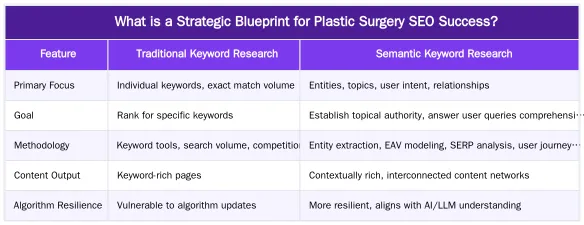
Unlike traditional SEO, which relies on keyword density, semantic SEO focuses on entities, their attributes, and their relationships. This approach aligns with how modern search engines and generative AI process information, rewarding websites with comprehensive, organized, and contextually rich content. For medical topics, information must be digestible for users and algorithms to improve visibility and trust signals.
Structuring Content with Entity-Attribute-Value (EAV) Modeling
Entity-Attribute-Value (EAV) modeling is a framework for defining surgical procedures (entities) and their characteristics (attributes). For example, a “Rhinoplasty” entity has attributes like “recovery time,” “anesthesia type,” “ideal candidate,” “cost range,” and “potential risks.” Defining these relationships in content and data helps search engines understand procedure nuances. This structured data improves chances of appearing in rich snippets and enhances entity recognition, which is vital for medical content. Learn more in our Entity-Attribute-Value (EAV) SEO guide.
Reducing Cost of Retrieval (CoR) for Medical Websites
Cost of Retrieval (CoR) is the computational resources a search engine uses to crawl, process, and index content. CoR is significant for complex medical sites with extensive pages, images, and information. A semantic network and efficient technical infrastructure minimize CoR. This improves crawlability, indexing, and search engine resource allocation, enhancing ranking potential. Tools like Ruxi Data streamline this process, making medical websites comprehensive and efficient for search engine bots. A Cost of Retrieval audit can identify areas for improvement.
Crafting Your Plastic Surgery SEO Strategy: A Practical Guide
An effective plastic surgery SEO strategy requires focusing on patient needs and search engine requirements. It involves keyword research, local optimization, and patient-centric content for every stage of the patient journey. Combining these elements builds an online presence that attracts and converts patients. The goal is an authoritative, discoverable digital footprint, especially in competitive markets like London.
Targeting High-Intent Keywords for Cosmetic Procedures
Identifying keywords that signal high patient intent is critical for cosmetic procedures. These queries show users are seeking information for a consultation or booking, such as “breast augmentation London cost,” “best rhinoplasty surgeon Harley Street,” or “tummy tuck recovery time.” Long-tail and question-based queries often reveal specific patient concerns and readiness to act. Semantic keyword research uncovers related entities and concepts for coverage beyond exact match terms.
Optimizing for Local Dominance in London’s Private Healthcare
For clinics in London, especially in postcodes like Harley Street, local SEO is critical. Strategies include Google Business Profile optimization, accurate and consistent NAP (Name, Address, Phone) information across online directories, and building local citations. Geo-targeted service pages (e.g., “Facelift Kensington,” “Liposuction Chelsea”) help capture local demand. High local pack rankings are essential to attract patients searching for nearby medical services, impacting patient acquisition.
Leveraging E-E-A-T and Ruxi Data for Unrivaled Authority
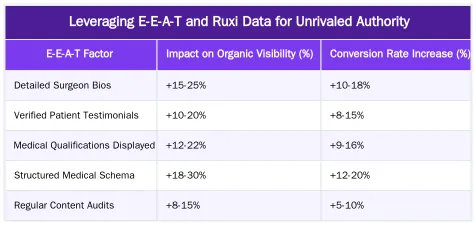
Building Expertise, Experience, Authoritativeness, and Trust (E-E-A-T) is critical for any medical website, especially in the YMYL category of plastic surgery. Abdurrahman Şimşek’s methodology integrates E-E-A-T as a core component of semantic SEO, so every content and technical element reinforces clinic credibility. This involves showcasing surgeon credentials, using patient testimonials, and structuring content to demonstrate medical knowledge. Ruxi Data automates the identification of authoritative content gaps and scales content production while maintaining E-E-A-T standards.
As generative AI’s role in search increases (2026), clear E-E-A-T is critical. Search engines prioritize content from credible sources, and an E-E-A-T framework ensures your clinic’s information is perceived as reliable. This improves rankings and builds patient confidence.
Building Trust: Showcasing Surgeon Expertise and Credentials
For plastic surgery practices, showcasing surgeon expertise and credentials is a key part of E-E-A-T. Include detailed surgeon biographies with qualifications, years of experience (e.g., Abdurrahman Şimşek’s 10+ years in search engineering), specializations, and professional memberships. Patient testimonials, before-and-after galleries with clear consent, and affiliations with medical institutions build trust. These elements are signals to Google’s algorithms that content is produced and reviewed by qualified medical professionals, which is vital for YMYL content. For more on E-E-A-T in medical contexts, see our Medical SEO Services for Surgeons.
Automating Topical Authority with Ruxi Data Semantic Engine
Ruxi Data helps build algorithm-proof topical authority. This LLM-driven infrastructure automates creating topical maps, identifying content gaps and opportunities. Ruxi Data analyzes data to ensure a clinic’s website covers every relevant aspect of a topic, from procedures to recovery protocols and patient FAQs. This automation allows scaled content production while maintaining accuracy and E-E-A-T, positioning the clinic as a resource for plastic surgery information. It reduces the manual effort for topical coverage, making it a tool for aesthetic clinic SEO.
Measuring Success: What Results Can You Expect from Advanced Plastic Surgery SEO?
An advanced plastic surgery SEO blueprint yields measurable results impacting a clinic’s growth and profitability. Outcomes include increased organic visibility for high-value keywords, more qualified patient leads, and improved conversion rates to consultations. The focus is on revenue-driven outcomes, not just traffic, demonstrating ROI. Long-term benefits include brand authority, a stronger competitive position in London, and a digital presence resilient to algorithm changes.
Key Performance Indicators (KPIs) for this strategy include organic lead volume, cost per acquisition (CPA) for organic patients, and the lifetime value (LTV) of patients acquired through search. Tracking these metrics provides insights into SEO effectiveness and informs data-driven decisions to optimize patient acquisition funnels. This makes SEO an investment in growth, not just a marketing expense.
Beyond Rankings: Focusing on High-Value Patient Acquisition
The goal of advanced plastic surgery SEO is to attract high-value patients for consultations, not just to increase rankings or traffic. Semantic targeting and E-E-A-T ensure traffic is qualified. This attracts individuals with clear intent who are ready to engage with a surgeon. Focusing on high-intent segments optimizes marketing spend and increases conversion rates for profitable services. Optimizing technical aspects like Core Web Vitals for surgeons ensures a good user experience, which is critical for conversion.
Partner with a Specialist: Elevate Your Clinic’s Digital Presence
Medical SEO for plastic surgery in a competitive market like London requires specialist expertise. Partnering with a semantic SEO strategist like Abdurrahman Şimşek provides a methodology integrating semantic engineering, Ruxi Data, and an understanding of YMYL guidelines. This approach builds algorithm-proof topical authority and attracts high-value patients. A specialist partner understands the demands of the private healthcare sector.
Book a Semantic SEO Audit to assess your current strategy and uncover growth opportunities. For strategic discussions, reach out via Direct WhatsApp Strategy Line: +90 506 206 86 86.
Conclusion
A strategic blueprint for plastic surgery SEO is necessary for aesthetic clinics. Using semantic SEO, Entity-Attribute-Value modeling, and optimizing for ‘Cost of Retrieval,’ practices can build topical authority and demonstrate E-E-A-T. This approach, using tools like Ruxi Data, helps clinics attract high-value patients, dominate local search in areas like Harley Street, and achieve organic growth. Partnering with a specialist semantic SEO strategist helps surgeons and clinics improve their digital presence and market position.
Contact us to discuss a tailored semantic SEO strategy. You can also Book a Semantic SEO Audit or reach out via WhatsApp: +90 506 206 86 86.
Frequently Asked Questions
What does a strategic blueprint for plastic surgery SEO involve?
A strategic blueprint for plastic surgery seo success involves a multi-faceted approach. It combines technical SEO to reduce Cost of Retrieval, builds topical authority around specific procedures, and demonstrates high E-E-A-T. This comprehensive strategy focuses on attracting high-value patients through a semantically structured website, ensuring long-term organic growth.
How is SEO for plastic surgery different from other medical fields?
Search engine optimization for plastic surgery is distinct due to its highly visual and aesthetic-driven nature, heavily relying on high-quality imagery and patient testimonials. It operates within an extremely competitive Your Money Your Life (YMYL) niche, demanding meticulous attention to Google’s Quality Rater Guidelines and robust E-E-A-T signals. This focus ensures trust and credibility in a sensitive field.
What are the most important ranking factors for a surgeon’s website?
Crucial ranking factors for a surgeon’s website include deep, expert-written content covering specific procedures comprehensively. A technically flawless website with fast loading times (LCP < 2.0s) is essential, alongside strong local SEO signals for target areas like London’s Harley Street. Robust E-E-A-T signals, such as surgeon credentials, patient reviews, and academic contributions, are also vital for authority.
How can I use content to attract more rhinoplasty patients?
To attract more rhinoplasty patients, create a comprehensive content hub using an Entity-Attribute-Value model. This hub should cover all aspects like procedure types, benefits, risks, recovery, and cost, answering every potential patient question. This approach builds deep topical authority, positioning your practice as the leading expert, which is a core part of an effective plastic surgery seo strategy.
Why is a mobile-friendly website crucial for plastic surgery SEO?
A mobile-friendly website is crucial because most potential patients research cosmetic procedures on their smartphones. A poor mobile experience results in high bounce rates and signals to Google that your site offers a low-quality user experience. This significantly damages your search rankings and hinders patient acquisition efforts for your clinic.
How can Abdurrahman Simsek help my clinic achieve plastic surgery SEO success?
Abdurrahman Simsek, a Semantic SEO Strategist with 10+ years of experience, specializes in medical and plastic surgery seo for London clinics. He employs a unique Semantic SEO Framework and Entity Architecture, leveraging the Ruxi Data Semantic Engine to build topical authority and optimize for high-value patient acquisition. You can book a Semantic SEO Audit or contact him directly via WhatsApp to discuss a tailored strategy.
Ruxi Data brings together multi-model AI, automated website crawling, live indexation checks, topical authority mapping, E-E-A-T enrichment, schema generation, and full pipeline automation — from crawl to WordPress publish to social posting — all in one platform built for agencies and freelancers who run on results.