
Technical SEO for Medical Websites: Optimizing Performance for Patient Trust
Technical SEO for medical websites is crucial for establishing a dominant online presence and attracting high-value patients in the YMYL sector. This guide details optimizing Core Web Vitals, enhancing crawl efficiency, and reducing the Cost of Retrieval (CoR) to build a robust digital infrastructure. Effective technical SEO for medical websites involves implementing semantic HTML5, JSON-LD schema, and page speed optimizations to improve search engine visibility and reinforce E-E-A-T signals. A strong technical foundation ensures medical content is discoverable, trustworthy, and provides an excellent user experience, directly impacting patient acquisition and conversion rates.
Abdurrahman Şimşek, a Semantic SEO Strategist, provides expertise in crafting technically superior medical websites. His approach focuses on foundational SEO elements that enhance search engine understanding and user experience, critical for healthcare providers aiming for digital authority and patient acquisition.
To explore your options, contact us to schedule your consultation. You can also reach us via: Book a Semantic SEO Audit, Direct WhatsApp Strategy Line: +90 506 206 86 86, Hire as Semantic SEO Architect
A technically superior medical website is the bedrock of online success, especially in the high-stakes YMYL sector. This blueprint guides medical professionals and clinic owners through optimizing core web vitals, enhancing crawl efficiency, and reducing the Cost of Retrieval (CoR) to establish a dominant online presence and attract high-value patients, focusing on technical seo for medical websites. Understanding these foundational elements ensures a robust digital infrastructure that supports patient trust, search engine visibility, and ultimately, conversion.
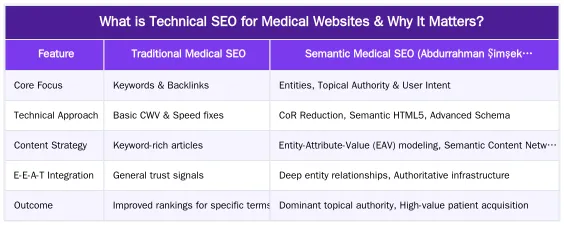
What is Technical SEO for Medical Websites & Why It Matters?
Technical search engine optimization for medical websites involves optimizing the underlying infrastructure of a site to improve its crawlability, indexability, and overall performance in search engine results. This encompasses elements like site speed, mobile-friendliness, structured data, and security, all tailored to the unique requirements of healthcare content. These optimizations ensure search engines can efficiently discover and understand the site’s offerings, which is crucial for attracting patients seeking medical information or services.
For medical practices, a strong technical foundation directly influences online visibility and patient acquisition. It addresses how search engines interact with the site, ensuring content is not only found but also perceived as authoritative and trustworthy. This groundwork is essential for any clinic aiming to rank prominently for competitive terms, especially in areas like Harley Street.
The YMYL Imperative: Trust & Authority
Medical websites fall under Google’s “Your Money Your Life” (YMYL) category, meaning they deal with topics that can significantly impact a person’s health, financial stability, or safety. Consequently, Google applies stringent quality standards, emphasizing Expertise, Experience, Authoritativeness, and Trustworthiness (E-E-A-T). Technical foundations directly contribute to these E-E-A-T signals.
For instance, a secure HTTPS connection is a fundamental trust signal, protecting sensitive patient data. Fast loading times and a stable user experience demonstrate professionalism, reinforcing patient confidence. Without robust technical SEO, even high-quality medical content may struggle to achieve the necessary E-E-A-T signals required to rank and build patient trust. Learn more about E-E-A-T for YMYL in 2026.
Mastering Core Web Vitals & Page Speed for Patient Experience
Core Web Vitals (CWV) are a set of metrics that measure real-world user experience for loading performance, interactivity, and visual stability. For medical websites, these metrics are not just ranking factors; they are critical for patient engagement. A slow or visually unstable site can deter potential patients, leading to higher bounce rates and missed opportunities. Optimizing these vitals ensures a seamless journey for users seeking vital health information or booking appointments.
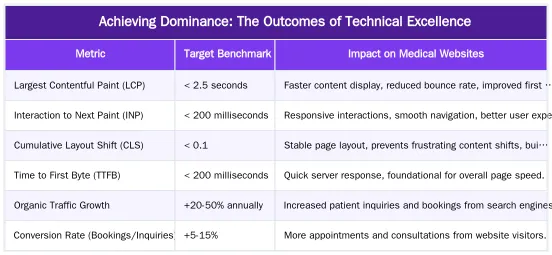
Key CWV metrics include Largest Contentful Paint (LCP), Interaction to Next Paint (INP), and Cumulative Layout Shift (CLS). Improving these directly enhances user satisfaction. Server response time, measured by Time to First Byte (TTFB), is a foundational element of page speed. Optimizing TTFB involves efficient server configurations and content delivery networks (CDNs). Image optimization, including proper sizing, compression, and modern formats like WebP, also significantly reduces page load times. A fast, responsive site contributes to a seamless mobile booking experience, directly impacting patient conversion funnels. This technical excellence is a cornerstone of effective medical SEO services for surgeons.
Optimizing Largest Contentful Paint (LCP) & Interaction to Next Paint (INP)
Largest Contentful Paint (LCP) measures the time it takes for the largest content element on the page to become visible. For medical sites, this often includes hero images of clinics, doctor profiles, or critical service descriptions. To improve LCP, prioritize loading critical CSS, compress images, implement lazy loading for off-screen media, and ensure efficient server response. Reducing render-blocking resources is also vital.
Interaction to Next Paint (INP) assesses a page’s responsiveness to user interactions. A low INP means the page responds quickly to clicks, taps, and keyboard inputs. Strategies for improving INP include reducing JavaScript execution time, optimizing main thread work, and breaking up long tasks. These technical adjustments ensure that when a patient clicks to view a procedure or book an appointment, the site responds instantly, preventing frustration and abandonment. These efforts are integral to reducing Cost of Retrieval (CoR), as efficient rendering requires fewer resources.
Unlocking Crawl Efficiency & Reducing Cost of Retrieval (CoR)
Crawl efficiency refers to how effectively search engine bots can discover and process content on a website within a given crawl budget. For medical websites, which often contain extensive, complex, and frequently updated information, optimizing crawl efficiency is paramount. It ensures that new research, updated service pages, or doctor profiles are quickly indexed and made available to searchers. A well-structured site with clean code allows bots to navigate and understand content with minimal effort.
Cost of Retrieval (CoR) is the computational resource Google expends to crawl, process, and index a website’s content. A high CoR indicates an inefficient site, potentially leading to slower indexing, reduced visibility, and a perceived lower quality by search engines. For high-stakes YMYL topics like medicine, a low CoR signals an efficient, high-quality site, directly impacting crawl efficiency and ranking potential. Strategies to reduce CoR include optimizing server response times, minimizing code bloat, managing redirects, and ensuring a logical site architecture. This focus on efficiency is a core component of advanced search engine optimization for medical websites.
The Ruxi Data Advantage: Semantic CoR Reduction
Abdurrahman Şimşek’s Ruxi Data infrastructure automates topical maps and Entity-Attribute-Value (EAV) modeling, inherently lowering the Cost of Retrieval for search engines. By providing a clear, semantically rich structure, Ruxi Data helps search engines understand complex medical information with greater ease and fewer computational resources. This precision in content organization means Google’s crawlers spend less time deciphering context and more time indexing valuable, relevant pages.
This approach is particularly beneficial for medical practices with extensive services, conditions, and procedures. Ruxi Data ensures that every piece of content contributes to a cohesive semantic content network, making the site’s topical authority undeniable and its information highly accessible to search engines. This strategic reduction in CoR translates directly into improved indexing efficiency and enhanced organic visibility for critical medical queries.
Structuring Medical Content: Semantic HTML5 & JSON-LD Schema
Semantic HTML5 uses elements like “, `
The Abdurrahman Şimşek Difference: Holistic Medical SEO
Abdurrahman Şimşek specializes in building high-authority Semantic Content Networks for medical clinics, skin clinics, and plastic surgeons. This integrated approach combines advanced technical foundations with semantic content architecture and E-E-A-T optimization. The focus extends beyond generic SEO tactics to address the specific needs of the London private healthcare market, including Harley Street and premium London postcodes.
This methodology ensures that every aspect of a medical website, from its underlying code to its content structure, is optimized for patient acquisition and search engine dominance. By leveraging Ruxi Data for automated topical mapping and EAV modeling, Abdurrahman Şimşek creates a digital infrastructure that inherently reduces Cost of Retrieval, enhances crawl efficiency, and establishes deep topical authority. This holistic strategy is designed to attract high-value patients by presenting a clear, authoritative, and trustworthy online presence.
Why a Specialist Semantic Engineer for Your Clinic?
Working with a specialist semantic engineer like Abdurrahman Şimşek offers distinct advantages for medical clinics. With over 10 years of experience in search engineering, Abdurrahman brings a deep understanding of Google’s algorithms and the nuances of the YMYL sector. His expertise in semantic content architecture and advanced technical SEO ensures that your website is not just optimized, but engineered for long-term success.
Specialization in the London private healthcare market means strategies are tailored to attract high-value patients in competitive areas. This includes building local trust with patient reviews and leveraging geo-targeted web infrastructure for London clinics. The integration of Ruxi Data and a focus on reducing Cost of Retrieval sets a new standard for medical website performance and patient acquisition. Explore comprehensive medical SEO services for surgeons.
Achieving Dominance: The Outcomes of Technical Excellence
Implementing a technically superior medical website yields tangible results that directly impact a clinic’s bottom line. Improved search engine rankings lead to increased organic traffic, bringing more potential patients to your site. This enhanced visibility is not merely about traffic volume; it’s about attracting high-intent users actively searching for medical services or information.
Higher conversion rates are a direct outcome of a fast, secure, and user-friendly website. When patients encounter a seamless mobile booking experience and an intuitive information architecture, they are more likely to complete inquiries or schedule appointments. Furthermore, a technically robust site reinforces patient trust, a critical factor in the YMYL sector. This trust is built on a foundation of reliability, security, and a professional online presence, leveraging patient testimonials to increase bookings and reinforce expertise with structured data.
Measuring Success: KPIs for Medical Website Performance
Tracking key performance indicators (KPIs) is essential to gauge the effectiveness of technical optimizations. Core Web Vitals scores provide direct insights into user experience. Organic visibility metrics, such as keyword rankings and search impression share, indicate how well the site is performing in search results. Conversion rates for bookings and inquiries directly measure business impact.
Monitoring crawl stats in Google Search Console reveals how efficiently search engines are processing the site. These metrics collectively demonstrate how page speed impacts patient conversions and overall online success. A secure HTTPS connection is a fundamental trust signal, and its consistent implementation is also a key KPI for a medical website. Regular analysis of these KPIs allows for continuous improvement and sustained growth for medical practices. For a deeper dive into performance, consider our medical SEO services for surgeons.
Build Your High-Converting Medical Website Today
A technically superior medical website is not an option; it is a necessity for attracting and converting high-value patients in 2026 and beyond. By prioritizing Core Web Vitals, optimizing crawl efficiency, and implementing advanced semantic engineering, your clinic can establish a dominant online presence. Leverage specialized expertise to transform your digital footprint.
Ready to elevate your medical website’s performance and patient acquisition? Book a Semantic SEO Audit with Abdurrahman Şimşek today. For direct strategic consultation, reach out via Direct WhatsApp Strategy Line: +90 506 206 86 86. Alternatively, Hire as Semantic SEO Architect to build a robust, high-converting digital presence for your medical practice.
Conclusion
The blueprint for a technically superior medical website integrates Core Web Vitals, crawl efficiency, and Cost of Retrieval reduction into a cohesive strategy. This foundational work is indispensable for YMYL domains, directly influencing E-E-A-T, patient trust, and conversion rates. By embracing semantic HTML5, advanced JSON-LD schema, and a holistic approach to web development, medical clinics can achieve significant organic growth and attract high-value patients. Partnering with a specialist in semantic engineering ensures your website is not merely present online, but positioned for market dominance.
Take the next step towards a high-performing medical website. Book a Semantic SEO Audit, connect via Direct WhatsApp Strategy Line: +90 506 206 86 86, or Hire as Semantic SEO Architect to build your clinic’s future online.
Frequently Asked Questions
What is Cost of Retrieval (CoR) and why is it critical for medical websites?
Cost of Retrieval (CoR) represents the computational resources Google uses to crawl, process, and index your website. For medical sites, which are high-stakes YMYL (Your Money or Your Life) topics, a low CoR signals an efficient, high-quality site. This efficiency is a foundational element of effective technical seo for medical websites and directly influences crawl priority and ranking potential.
How does a technically superior website build patient trust?
A fast, secure, and seamlessly functioning website provides a positive user experience, directly reflecting a clinic’s professionalism and attention to detail. Slow loading times or errors can quickly erode patient trust, while a high-performance site builds confidence. This technical excellence is crucial for establishing credibility even before the first consultation.
Are Core Web Vitals more important for medical sites than other industries?
Yes, Core Web Vitals are exceptionally important for medical websites because they fall under Google’s YMYL (Your Money or Your Life) category. User experience signals are scrutinized more heavily here, as a poor experience can lead to patient frustration and mistrust. Google’s algorithms prioritize protecting users seeking critical health information, making these metrics vital for visibility.
What exactly does technical SEO for medical websites encompass?
Technical SEO for medical websites involves optimizing the underlying infrastructure of your site to improve its crawlability, indexability, and overall user experience for search engines. This includes elements like site speed, mobile-friendliness, secure connections, structured data, and efficient server responses. It ensures your critical health information is easily found and understood by both patients and search engines.
What is the first step in a technical SEO audit for a plastic surgeon?
The initial step in a technical SEO audit for a plastic surgeon involves a comprehensive crawl analysis paired with a Core Web Vitals assessment. This data-driven approach pinpoints immediate issues related to page speed, mobile usability, and overall crawlability. It establishes a crucial baseline for developing a strategic plan focused on improving the technical seo for medical websites.
How can Abdurrahman Şimşek help improve the technical SEO for my medical website?
Abdurrahman Şimşek, a Semantic SEO Strategist, specializes in enhancing the technical foundation of medical and plastic surgery websites. He applies a holistic Semantic SEO Framework to optimize Core Web Vitals, improve crawl efficiency, and reduce Cost of Retrieval. You can book a Semantic SEO Audit to get started or contact him directly via WhatsApp at +90 506 206 86 86 for a strategy discussion on your technical SEO for medical websites.
Ruxi Data brings together multi-model AI, automated website crawling, live indexation checks, topical authority mapping, E-E-A-T enrichment, schema generation, and full pipeline automation — from crawl to WordPress publish to social posting — all in one platform built for agencies and freelancers who run on results.