
Multi Model AI Content: Elevating SERP Rankings With Diverse Llms
Multi model AI content strategically combines various large language models like GPT-4o, Claude, and Gemini to generate superior content. This approach mitigates individual LLM weaknesses, producing diverse, accurate, and semantically rich material. By orchestrating multiple AI systems, businesses enhance content quality, strengthen topical authority, and improve E-E-A-T signals. This methodology is crucial for outranking competitors and achieving dominant organic visibility, providing a distinct advantage in competitive online landscapes through sophisticated content automation and semantic SEO principles.
Abdurrahman Şimşek, a Semantic SEO Strategist, emphasizes leveraging diverse AI models to build robust semantic content networks. This strategy ensures comprehensive topic coverage and deep entity-attribute-value modeling, critical for establishing strong topical authority and reducing search engine Cost of Retrieval.
To explore your options, contact us to schedule your consultation. You can also reach us via: Book a Semantic SEO Audit, Direct WhatsApp Strategy Line: +90 506 206 86 86, Hire as Semantic SEO Architect
Leveraging multi model ai content is transforming how businesses approach digital strategy, offering a distinct advantage in search engine rankings. This approach involves orchestrating multiple large language models (LLMs) to generate diverse, high-quality content that addresses complex search intents. By combining the strengths of various AI systems, content creators can produce more nuanced, accurate, and semantically rich material. This article explores how a blended AI strategy enhances content quality, strengthens topical authority, and ultimately helps outrank competitors in competitive online landscapes. Understanding this methodology is crucial for any entity aiming for dominant organic visibility in 2026.
Understanding Multi-Model AI Content
Multi-model AI content generation refers to the strategic integration of several distinct large language models (LLMs) to produce a single piece of content or a comprehensive content network. Instead of relying on one AI, this method leverages the unique capabilities of different models for various stages of content creation. For instance, one model might excel at generating factual outlines, another at creative prose, and a third at summarizing complex information or ensuring specific stylistic adherence.
This approach directly addresses the limitations inherent in single-model generation. Each LLM possesses its own biases, knowledge cutoffs, and stylistic tendencies. By orchestrating multiple models, content creators can mitigate these individual weaknesses and capitalize on collective strengths. This leads to more robust, accurate, and semantically diverse content that resonates better with both human readers and search engine algorithms. The goal is to create a richer, more authoritative content experience, reducing the search engine’s Cost of Retrieval (CoR) by providing highly relevant and well-structured information. This sophisticated method is a cornerstone of modern why a multi-model AI approach outranks single-model content in 2026.
The underlying principle aligns with semantic SEO architecture, where entities and their relationships are meticulously mapped. A diverse language model strategy allows for deeper entity-attribute-value (EAV) modeling, ensuring that content covers a topic comprehensively from multiple angles. This depth is critical for building strong topical authority and establishing a robust semantic content network.
Benefits of Diverse AI Models for SEO and Content Quality
Employing diverse AI models in content creation offers significant advantages for both search engine optimization and overall content quality. By combining the strengths of different LLMs, content gains enhanced accuracy, improved factual consistency, and a broader stylistic range. One model might be adept at data synthesis, while another excels at crafting engaging narratives, resulting in content that is both informative and readable.
This blended approach directly contributes to higher content quality scores, which Google prioritizes. Search engines are increasingly sophisticated at evaluating content depth, relevance, and originality. Content generated through a multi-LLM process tends to exhibit greater semantic richness and less repetitive phrasing, signaling higher quality to algorithms. This reduces the likelihood of producing generic or thinly veiled content that struggles to rank.
Furthermore, using multiple AI models can significantly improve content’s ability to cover a topic comprehensively, thereby strengthening topical authority. Each model can contribute unique perspectives or data points, ensuring that all facets of a subject are addressed. This holistic coverage is essential for establishing a domain as an authoritative source within its niche. For a detailed look at scaling content production, explore scaling content production with an AI workflow.
The orchestration of these models also allows for more precise alignment with live SERP data, ensuring that generated content directly addresses user intent as reflected in current search results. This precision is vital for outranking competitors who may rely on less sophisticated, single-model approaches. The result is content that is not only well-written but also strategically optimized for visibility.
Comparing Leading LLMs: GPT-4o, Claude, and Gemini
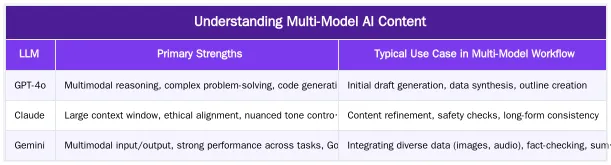
Leading large language models like GPT-4o, Claude, and Gemini each possess distinct strengths that make them valuable components in a multi-model AI content strategy. GPT-4o excels in multimodal capabilities and complex reasoning, Claude is known for its extensive context window and ethical alignment, while Gemini offers strong performance across various modalities and integration with Google’s ecosystem.
Integrating these models allows for a synergistic approach. For instance, GPT-4o might be used for initial content generation and complex data interpretation due to its advanced reasoning. Claude could then refine the output for tone, safety, and adherence to specific brand guidelines, leveraging its larger context window for consistency across longer pieces. Gemini, with its multimodal capabilities, could be employed for integrating diverse data types, such as transcribing video content or analyzing images to inform textual output. This strategic combination ensures comprehensive and high-quality content.
Practical Implementation and Workflow Steps
Implementing a multi-model AI content workflow requires a structured approach to orchestrate different LLMs effectively. The process typically begins with thorough keyword research and SERP analysis to understand user intent and identify content gaps. This initial data informs the content brief, which then guides the AI generation process.
The first step involves using a primary LLM, such as GPT-4o, to generate an initial outline and draft. This model can quickly synthesize information and structure the content based on the brief. Following this, a secondary model like Claude might be employed to refine the draft, focusing on tone, style, and ensuring factual accuracy. Claude’s larger context window is particularly useful for maintaining consistency in longer articles.
Further refinement can involve a third model, perhaps Gemini, for specific tasks like integrating data from images or videos, or performing advanced fact-checking against external sources. This iterative process ensures that each model contributes its unique strengths to enhance the overall quality and depth of the content. Tools like Ruxi Data play a crucial role in automating this semantic architecture, streamlining the workflow from data ingestion to content publication. This is how Ruxi Data automates semantic architecture, transforming raw data into structured, SEO-optimized content. For more on this, see scaling medical SEO automation.
Finally, human oversight remains critical. An editor reviews the AI-generated content for nuance, brand voice, and any remaining inaccuracies. This human touch ensures the content is not only technically sound but also resonates authentically with the target audience. This comprehensive workflow is detailed further in our guide on multi-model AI SEO workflow.
Impact on E-E-A-T and Topical Authority
The strategic deployment of multi-model AI content significantly enhances a website’s E-E-A-T (Experience, Expertise, Authoritativeness, Trustworthiness) signals and strengthens its topical authority. By leveraging diverse AI models, content can achieve a level of depth and accuracy that is challenging with a single model. This is particularly vital for YMYL (Your Money Your Life) niches, such as medical clinics and plastic surgeons, where accuracy and trustworthiness are paramount.
As a Semantic SEO Strategist with 10 years of experience, I’ve observed that a blended AI approach, especially when integrated with Ruxi Data’s semantic engine, allows for the creation of highly specialized content. This content not only addresses complex medical queries with precision but also demonstrates comprehensive understanding of specific procedures and conditions. This meticulous approach to content generation helps establish a domain as a definitive source of information, directly contributing to higher E-E-A-T scores. The technical SEO foundation for surgeon E-E-A-T is built upon such robust content strategies, which you can explore further in our Cost of Retrieval audit services.
For London-based aesthetic clinics, building topical authority around specific surgical procedures or treatments is crucial. Multi-model AI content allows for the rapid generation of interconnected articles that cover every facet of a topic, from patient education to post-operative care. This comprehensive coverage signals to search engines that the website is an expert in its field, reducing the search engine’s Cost of Retrieval (CoR) by providing clear, well-organized information. Using automation to reduce Cost of Retrieval is a core benefit of the Ruxi Data infrastructure, as detailed in scaling medical SEO automation.
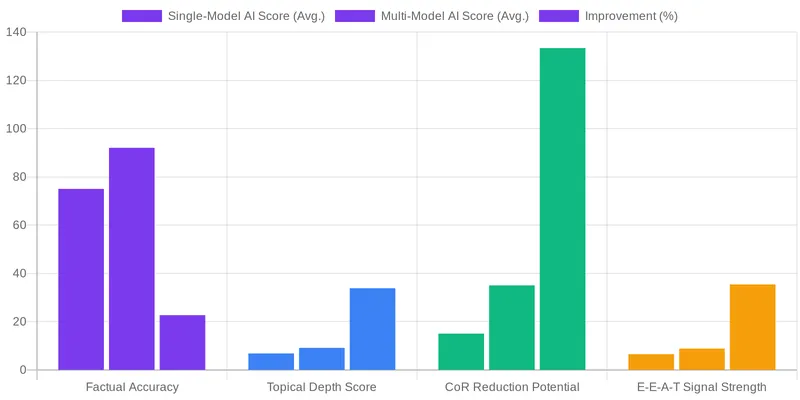
This strategy is particularly effective for domains requiring high levels of trust, such as those in the healthcare sector. By combining the strengths of various LLMs, content can be rigorously fact-checked and refined, ensuring that information is not only comprehensive but also verifiable and trustworthy. This aligns with Google’s emphasis on reliable sources, especially for health-related queries. For more insights into how a clean architecture reduces retrieval costs, visit our page on Cost of Retrieval audit.
The Future Outlook of AI Content Generation
The landscape of AI content generation is rapidly evolving, with multi-model approaches poised to become the standard for high-performance SEO. As LLMs continue to advance, their integration will become more seamless, enabling even more sophisticated content orchestration. The focus will shift further towards Generative Engine Optimization (GEO), where content is not just generated but strategically designed to interact optimally with search engine algorithms and user intent.
Future developments will likely include more specialized AI models tailored for specific industries or content types. Imagine an LLM specifically trained on medical literature, combined with another adept at crafting patient-friendly explanations. This specialization will further refine content accuracy and relevance, particularly for complex fields like plastic surgery. The ability to dynamically select and combine models based on real-time SERP data and user engagement signals will be a significant leap forward.
The role of human strategists will evolve from content creators to AI orchestrators and semantic engineers. Their expertise will be crucial in designing the prompts, defining the workflow, and providing the final layer of human review and strategic direction. This symbiotic relationship between human intelligence and diverse AI models will unlock new levels of content quality and efficiency. For a deeper dive into leveraging AI for content at scale, refer to our insights on AI content at scale using SERP data.
Ultimately, the future points towards an era where content is not merely generated but intelligently composed, continuously optimized, and deeply integrated into a comprehensive semantic content network. This will allow businesses, especially those in competitive sectors like medical aesthetics, to maintain dominant topical authority and achieve sustained organic growth.
Elevate Your Content Strategy with Semantic AI
Outranking competitors in today’s search landscape demands more than just keyword stuffing; it requires a sophisticated approach to content creation and semantic optimization. Leveraging diverse AI models is not merely a trend but a strategic imperative for building robust topical authority and enhancing E-E-A-T signals.
As a Semantic SEO Strategist specializing in medical and aesthetic clinics, I understand the unique challenges and opportunities within YMYL niches. My expertise, combined with the power of Ruxi Data’s semantic engine, can transform your digital presence. We build high-authority Semantic Content Networks designed to minimize search engine Cost of Retrieval and maximize organic visibility.
If your goal is to achieve dominant topical authority and ensure your content stands out, it’s time to explore a multi-model AI strategy. Discover how my core semantic SEO framework can be applied to your domain. For a personalized consultation and to discuss how we can implement these advanced strategies for your business, please contact us today.
You can also Book a Semantic SEO Audit, reach me directly via WhatsApp Strategy Line: +90 506 206 86 86, or Hire as Semantic SEO Architect to build your next-generation content infrastructure.
Conclusion
The shift towards multi-model AI content represents a significant evolution in SEO and content strategy. By combining the unique strengths of various large language models, businesses can generate content that is not only more accurate and comprehensive but also deeply aligned with semantic search principles. This advanced approach is crucial for building strong E-E-A-T signals, establishing undeniable topical authority, and ultimately securing a leading position in competitive search results. Embracing diverse AI models is no longer an option but a necessity for those aiming to dominate their niche in 2026. To explore how these strategies can be tailored for your specific needs, contact us. You can also Book a Semantic SEO Audit, reach me directly via WhatsApp Strategy Line: +90 506 206 86 86, or Hire as Semantic SEO Architect.
Frequently Asked Questions
What is multi model ai content generation and why is it superior for SEO?
Multi model ai content generation involves orchestrating several distinct large language models (LLMs) in a single workflow. This approach leverages the unique strengths of each model, resulting in more nuanced, diverse, and higher-quality content that is less generic and significantly more likely to outrank competitors.
How does Ruxi Data utilize multiple AI models to create superior content?
Ruxi Data integrates 7 advanced AI models, assigning specific tasks to each based on their individual strengths, such as research, creative writing, or factual accuracy. This ensures the generated content is comprehensive, E-E-A-T compliant, and consistently outperforms outputs from single-model systems.
How does live SERP
Ruxi Data brings together multi-model AI, automated website crawling, live indexation checks, topical authority mapping, E-E-A-T enrichment, schema generation, and full pipeline automation — from crawl to WordPress publish to social posting — all in one platform built for agencies and freelancers who run on results.