
Knowledge Graph Reconciliation: Fixing Brand Entity Ambiguity for SEO
Knowledge graph reconciliation is the systematic process of aligning a brand’s digital identity across the web to resolve entity ambiguity. This article provides a comprehensive workflow for fixing brand entity ambiguity, ensuring search engines accurately understand and represent your organization. By harmonizing disparate online information, brands can consolidate their digital presence, enhance E-E-A-T, and improve visibility in search results. Understanding how to manage your brand entity SEO through precise reconciliation is crucial for establishing authority and trust with Google’s Knowledge Graph.
Abdurrahman Şimşek, a Semantic SEO Strategist, outlines practical steps for brands to achieve precise entity resolution. This guidance helps businesses establish a unified digital identity, crucial for bolstering E-E-A-T and maintaining credibility in complex search environments.
To explore your options, contact us to schedule your consultation. You can also reach us via: Book a Semantic SEO Audit, Direct WhatsApp Strategy Line: +90 506 206 86 86, Hire as Semantic SEO Architect
In the complex landscape of modern search, a brand’s digital identity is paramount. Knowledge graph reconciliation is the critical process of aligning your brand’s information across the web to ensure Google accurately understands and represents your entity. This article will provide a comprehensive workflow to fix brand entity ambiguity, enhancing your online presence and E-E-A-T. Understanding and resolving discrepancies in how search engines perceive your brand is fundamental for establishing authority and trust in 2026.
What is Knowledge Graph Reconciliation & Why It Matters?
Knowledge graph reconciliation is the systematic process of identifying, verifying, and harmonizing all digital representations of a brand or entity across the web. Its purpose is to resolve entity ambiguity, ensuring search engines like Google consolidate disparate information into a single, coherent understanding. This clarity is fundamental for accurate brand visibility, establishing trust, and bolstering E-E-A-T in search results.
When a brand’s identity is fragmented across various online sources, search engines struggle to form a definitive understanding. This ambiguity can lead to an incomplete or incorrect Knowledge Panel, reduced visibility for brand-related queries, and a diminished perception of authority. For businesses, especially those in sensitive YMYL (Your Money Your Life) sectors like healthcare, precise entity resolution is not merely an SEO tactic; it is a prerequisite for credibility. It directly impacts how Google perceives the expertise, experience, authoritativeness, and trustworthiness of a brand.
Defining Entity Ambiguity in the Digital Age
Entity ambiguity arises when conflicting or inconsistent information about a brand exists across the internet. This can manifest as variations in company names, addresses, phone numbers (NAP data), or even different brand logos and descriptions. Search engines encounter these discrepancies and cannot definitively connect all mentions to a single, authoritative entity. This lack of clear signals directly impedes a brand’s ability to establish a strong, unified authority with search engines, hindering its overall entity reconciliation in SEO efforts.
Brand Entity Ambiguity: Causes, Risks, and E-E-A-T Impact
Brand entity ambiguity stems from several common issues. Inconsistent NAP data across directories, a lack of comprehensive structured data on a brand’s website, unlinked mentions on third-party sites, and legacy information from past business changes all contribute. These discrepancies create a fragmented digital footprint, making it difficult for search engines to form a clear ‘semantic triple’ (subject-predicate-object) about the brand. For YMYL industries, such as medical clinics, these risks are amplified, as E-E-A-T is paramount for user safety and trust.
The Silent Threat to Your Knowledge Panel
Entity ambiguity directly threatens the display and accuracy of a brand’s Knowledge Panel. If Google’s Knowledge Graph API cannot confidently identify and consolidate information about an entity, the Knowledge Panel may not appear, or it could display incorrect, outdated, or incomplete data. This impacts brand perception and direct search visibility, as the Knowledge Panel often serves as a primary source of information for users searching for a brand. A distorted panel can erode trust and misrepresent a brand’s services or identity.
Understanding how the Google Knowledge Graph API consumes and interprets entity data is crucial. The API relies on consistent, verifiable signals to construct its knowledge base. When these signals are muddled, the system defaults to caution, often withholding or presenting minimal information. This directly affects a brand’s ability to control its narrative in search results.
Why E-E-A-T Suffers from Discrepant Brand Data
E-E-A-T (Expertise, Experience, Authoritativeness, Trustworthiness) is a critical evaluation framework for search engines, particularly in YMYL sectors. Discrepant brand data directly undermines E-E-A-T. Inconsistent information signals a lack of control or reliability, which search engines interpret as a lower level of trustworthiness. For medical clinics, where patient health is at stake, a consistent and verifiable digital identity is non-negotiable. Clear entity signals demonstrate a brand’s established presence, professional consistency, and verifiable credentials, all of which contribute to a higher E-E-A-T score.
Your Workflow: Reconciling Brand Entities with Google
A structured workflow is essential for effectively identifying and resolving brand entity ambiguity. This process involves meticulous data auditing, identifying authoritative sources, and implementing precise structured data. By systematically addressing each component, brands can guide search engines toward a singular, accurate understanding of their identity.
Step-by-Step: From Audit to Disambiguation
- Entity Identification: Clearly define all entities representing your brand. This includes the primary organization, key personnel (physicians, founders), specific services, and locations.
- Data Consistency Audit: Conduct a thorough audit of all online mentions. Verify NAP (Name, Address, Phone) data across your website, social media profiles, business directories, and review sites. Identify any variations or outdated information.
- Schema.org Implementation: Integrate comprehensive structured data using schema.org/Organization and other relevant types (e.g., `MedicalBusiness`, `Physician`). This explicitly communicates your brand’s attributes and relationships to search engines. For medical practices, specialized schema is vital for conveying expertise. Learn more about medical schema for surgeons.
- Leveraging Authoritative Sources: Ensure your brand is accurately represented on high-authority platforms. These include Wikidata, Crunchbase, LinkedIn, industry-specific directories, and government registries. These sources act as strong corroborating signals for search engines.
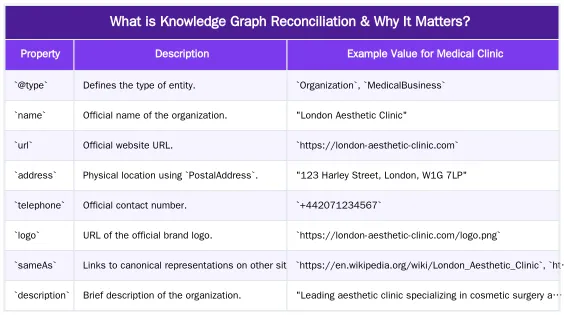
Implementing Schema.org/Organization and SameAs Property
The `schema.org/Organization` type is foundational for defining your brand entity. Within this, the `SameAs` property is critical for linking your brand to its canonical representations across the web. This property tells search engines that various URLs (e.g., your Wikipedia page, LinkedIn profile, official social media accounts) all refer to the *same* entity. This explicit linking is a powerful disambiguation signal.
For medical businesses, this might include linking to professional association profiles, hospital affiliations, or verified medical directories. Consistent application of `SameAs` across all relevant structured data helps consolidate your brand’s digital identity.
| Metric | With Ambiguity (%) | After Reconciliation (%) | Improvement (%) |
|---|---|---|---|
| Knowledge Panel Display Rate | 35 | 85 | 143 |
| Brand Search CTR | 8 | 15 | 87.5 |
| Organic Visibility for Brand Terms | 60 | 95 | 58.3 |
| E-E-A-T Score (Internal Estimate) | 4.5/10 | 8.0/10 | 77.8 |
| Search Engine Crawl Efficiency | Low | High | Significant |
Ruxi Data: Automating Entity Reconciliation for Brands
Abdurrahman Şimşek, a London-based Semantic SEO Strategist, leverages Ruxi Data to streamline and enhance entity reconciliation for specialized sectors. Ruxi Data is a semantic engine designed to automate the complex processes involved in building robust semantic content networks. It utilizes advanced natural language processing (NLP) and entity extraction techniques to create precise Entity-Attribute-Value (EAV) models for brands, significantly reducing the ‘Cost of Retrieval’ (CoR) for search engines.
From Manual Audits to Automated Entity Extraction
Traditionally, identifying and auditing brand entities across the web is a labor-intensive task. Ruxi Data transforms this process by automating entity extraction from various online sources. It identifies brand mentions, associated attributes, and potential ambiguities at scale. This automated workflow ensures comprehensive coverage and accuracy, far surpassing manual efforts. For medical clinics, this means faster identification of inconsistent doctor profiles or service descriptions, allowing for rapid correction and improved data integrity. This automation is a cornerstone of effective Knowledge Graph SEO automation.
Optimizing Cost of Retrieval (CoR) with Semantic Architecture
The ‘Cost of Retrieval’ (CoR) refers to the computational resources search engines expend to understand and index information. A clear semantic architecture, built through precise entity reconciliation, directly reduces this cost. Ruxi Data’s semantic engine constructs detailed EAV models that present brand information in a highly structured and unambiguous format. This clarity allows search engines to process and understand the brand entity more efficiently, requiring fewer resources for disambiguation and indexing. Optimizing CoR leads to improved crawl efficiency, faster indexing, and ultimately, better visibility for the brand.
By applying semantic architecture to medical SEO, Ruxi Data helps clinics achieve dominant topical authority while minimizing search engine processing overhead. This approach ensures that search engines can quickly and accurately grasp the full scope of a medical practice’s expertise and services.
Measuring Success: What to Expect from Reconciliation?
Successful knowledge graph reconciliation yields tangible benefits for brands. The most immediate outcome is an improved and accurate Knowledge Panel, which serves as a verified digital identity card in search results. Beyond this, brands can expect enhanced E-E-A-T signals, leading to greater trust from both users and search engines. This is particularly crucial for YMYL sectors, where credibility directly impacts patient acquisition and retention.
Key metrics to monitor include the frequency and accuracy of your Knowledge Panel display, brand search click-through rates (CTR), and the overall organic visibility for brand-related queries. Increased mentions and consistent data across authoritative third-party sites also indicate progress. Over time, a well-reconciled entity contributes to stronger topical authority, as search engines gain a deeper, more confident understanding of the brand’s expertise within its niche. This foundational work supports broader SEO initiatives, such as building E-E-A-T for London aesthetic clinics.
Furthermore, a clear entity definition can improve the performance of voice search and other AI-driven search modalities, as these systems rely heavily on structured, unambiguous data. Brands that invest in this process are better positioned for the evolving search landscape of 2026 and beyond.
Partnering for Precision: Your Semantic SEO Architect
Achieving precise knowledge graph reconciliation and building dominant topical authority requires specialized expertise. Abdurrahman Şimşek, a Semantic SEO Strategist with over 10 years of experience, specializes in crafting bespoke semantic architectures for medical clinics and plastic surgeons. His methodology, powered by Ruxi Data, ensures your brand entity is accurately understood and highly authoritative in search results. For a tailored strategy to resolve brand entity ambiguity and elevate your digital presence, contact us today.
Take the next step towards semantic clarity and search dominance:
- Book a Semantic SEO Audit
- Direct WhatsApp Strategy Line: +90 506 206 86 86
- Hire as Semantic SEO Architect
Conclusion
Knowledge graph reconciliation is a foundational element of modern SEO, particularly for brands in competitive and high-stakes sectors like healthcare. By systematically addressing entity ambiguity, brands can ensure search engines accurately represent their identity, fostering trust and enhancing E-E-A-T. The workflow outlined, from meticulous data auditing to advanced schema implementation and leveraging tools like Ruxi Data, provides a clear path to semantic clarity. Investing in this process secures a brand’s digital identity, improves search visibility, and establishes a robust foundation for long-term topical authority. For expert guidance in navigating these complexities, consider partnering with a specialist in semantic engineering.
Frequently Asked Questions
What common issues necessitate knowledge graph reconciliation?
The most common causes are generic brand names shared by other entities, inconsistent Name, Address, and Phone (NAP) data across the web, and a lack of structured data. These issues create conflicting signals for search engines, making a thorough knowledge graph reconciliation process essential to establish a clear, authoritative identity.
How long does a typical knowledge graph reconciliation take to show results?
After implementing correct schema and harmonizing inconsistent data, it can take several weeks to a few months for Google to process the changes. The speed depends on crawl frequency and the consistency of the new signals. Successful knowledge graph reconciliation is a gradual process that builds trust with the search engine over time.
Why is Wikidata crucial for a successful knowledge graph reconciliation?
Wikidata is a primary, machine-readable data source that Google’s Knowledge Graph trusts implicitly. Creating a detailed, well-sourced Wikidata entry for your brand and linking to it via ‘sameAs’ schema is a powerful signal. This step is a cornerstone of effective knowledge graph reconciliation, as it provides a definitive, third-party reference point for your entity.
How can automation assist with entity reconciliation?
Automation tools like the Ruxi Data Semantic Engine streamline entity reconciliation by analyzing a brand’s digital footprint at scale. They identify conflicting information and generate precise Organization and Person schema with ‘sameAs’ properties. This links your entity to authoritative sources, sending clear, consistent signals to Google to resolve ambiguity.
Can entity reconciliation help fix a negative Knowledge Panel?
While it cannot directly remove negative information, a robust entity reconciliation strategy helps control your brand’s narrative. By consistently feeding Google structured, positive, and authoritative data about your entity, you can influence and populate the Knowledge Panel with more accurate and favorable information over time.
How can I get expert help with my brand’s knowledge graph reconciliation?
For complex cases of entity ambiguity, partnering with a specialist is the most effective approach. A semantic SEO architect can perform a deep audit and implement a precise strategy for your brand’s reconciliation. You can book a Semantic SEO Audit to begin the process of clarifying your brand’s identity with search engines.
Ruxi Data brings together multi-model AI, automated website crawling, live indexation checks, topical authority mapping, E-E-A-T enrichment, schema generation, and full pipeline automation — from crawl to WordPress publish to social posting — all in one platform built for agencies and freelancers who run on results.