
Saas Knowledge Graph: Mastering Entity SEO for Brand Dominance
Optimizing a saas knowledge graph is crucial for SaaS companies seeking robust online visibility and authority. This article details how structured data, entity SEO, and advanced semantic strategies enhance search engine understanding and brand presence. Readers will learn practical optimization techniques, the impact of E-E-A-T, and innovative approaches like Cost of Retrieval (CoR) optimization. Leveraging LLM-driven semantic content networks further secures a dominant position in search results. Mastering your saas knowledge graph transforms your brand into a recognized entity, improving search engine recognition and user trust through comprehensive information display.
Abdurrahman Şimşek, a Semantic SEO Strategist, provides expert guidance on building brand authority and E-E-A-T through precise entity optimization. This content offers actionable strategies for SaaS brands to achieve prominent online recognition and trust.
To explore your options, contact us to schedule your consultation. You can also reach us via: Book a Semantic SEO Audit, Direct WhatsApp Strategy Line: +90 506 206 86 86, Hire as Semantic SEO Architect
Optimizing a saas knowledge graph is fundamental for software-as-a-service (SaaS) companies aiming to establish robust online visibility and authority in 2026. This article explores the critical role of the Google Knowledge Graph for SaaS brands, detailing how structured data, entity SEO, and advanced semantic strategies contribute to enhanced search engine understanding and improved brand presence. We will cover practical optimization techniques, the impact of E-E-A-T, and innovative approaches like Cost of Retrieval (CoR) optimization and LLM-driven semantic content networks to secure a dominant position in search results.
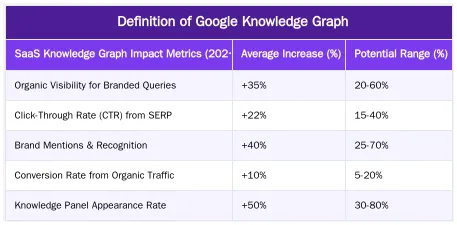
Definition of Google Knowledge Graph
The Google Knowledge Graph is a vast semantic network of entities and their relationships, designed to enhance search results by providing direct answers and rich contextual information. It aggregates facts about people, places, organizations, and concepts from various sources, presenting them in a structured format, often as Knowledge Panels in the SERP. For a SaaS company, this means Google can understand not just keywords, but the actual entities related to the software, its features, and its industry. This understanding allows search engines to deliver more relevant and comprehensive results to users, moving beyond simple keyword matching to a deeper comprehension of user intent.
The Knowledge Graph operates by identifying and connecting entities, forming a web of interconnected data points. When a user searches for a SaaS product, the Knowledge Graph can display information like the company’s founding date, key features, reviews, and even competitors, all without the user needing to click through multiple websites. This direct presentation of information significantly impacts user experience and brand perception. Understanding how to contribute to this graph is crucial for any SaaS brand aiming for prominent online visibility.
Importance for SaaS Brands
For SaaS brands, appearing in the Google Knowledge Graph signifies a high level of recognition and trust from search engines. It transforms a brand from a collection of web pages into a recognized entity with defined attributes and relationships. This recognition is vital for several reasons. Firstly, it enhances visibility through prominent Knowledge Panels, which occupy significant SERP real estate and often appear for branded searches. Secondly, it improves click-through rates (CTR) by offering immediate, authoritative information, reducing the need for users to browse extensively.
Beyond direct visibility, a strong presence in the Knowledge Graph contributes to overall brand authority and semantic search performance. When Google understands your SaaS product as a distinct entity, it can better connect it with related topics, problems it solves, and target audiences. This leads to more accurate and diverse ranking opportunities, especially as search engines increasingly rely on entity-based understanding to fulfill complex queries. For SaaS companies, this means moving beyond traditional keyword SEO to a more holistic approach focused on building a robust digital identity.
How to Optimize for the Knowledge Graph
Optimizing for the Google Knowledge Graph involves a multi-faceted approach focused on clear entity definition and consistent data provision. The core strategy revolves around providing structured data and establishing strong brand signals across the web.
- Implement Schema Markup: Use JSON-LD to mark up your organization, product, services, and any relevant entities on your website. Key schema types include Organization, Product, and SoftwareApplication. This explicitly tells search engines about your brand and its offerings.
- Establish Google My Business (GMB): For SaaS companies with a physical presence or a defined service area, a verified GMB profile is crucial. It feeds directly into the Knowledge Graph, providing essential business information.
- Build Brand Mentions and Citations: Consistent and accurate brand mentions across reputable industry directories, news sites, and review platforms reinforce your entity’s existence and attributes.
- Create a Wikipedia Page (if applicable): For established SaaS brands, a Wikipedia entry can be a powerful signal, as Wikipedia is a primary source for the Knowledge Graph.
- Develop Entity-Rich Content: Create content that clearly defines your SaaS product, its features, benefits, and the problems it solves, using related entities and semantic connections. This includes detailed product pages and solution guides.
- Utilize Social Media Profiles: Maintain active and consistent profiles on major social media platforms, linking them back to your official website.
These steps collectively help search engines accurately identify, categorize, and display information about your SaaS brand, strengthening its presence within the Knowledge Graph.
Impact and Benefits of Knowledge Graph Optimization
Optimizing for the Knowledge Graph delivers tangible benefits for SaaS companies, extending beyond mere visibility. The primary impact is a significant boost in brand recognition and perceived authority. When a user sees a Knowledge Panel for your SaaS product, it instills immediate trust and credibility, as the information is presented directly by Google.
Key benefits include:
- Enhanced SERP Visibility: Knowledge Panels and rich snippets stand out, capturing user attention and increasing brand exposure.
- Improved Click-Through Rates (CTR): Direct answers and comprehensive information in the SERP can lead to more qualified clicks to your website.
- Stronger Brand Authority: Being recognized as an entity by Google elevates your brand’s status, signaling expertise and trustworthiness.
- Better Semantic Search Performance: A well-defined entity helps your SaaS rank for a wider array of semantically related queries, not just exact keywords.
- Voice Search Advantage: As voice search grows, direct answers from the Knowledge Graph become even more critical for being found.
- Competitive Edge: Outperforming competitors in Knowledge Graph presence can differentiate your SaaS in a crowded market.
These advantages collectively contribute to a stronger digital footprint, driving more targeted traffic and ultimately supporting growth for your SaaS business.
Cost of Retrieval (CoR) Optimization for SaaS Search Engines
Cost of Retrieval (CoR) optimization refers to the strategic effort to reduce the computational resources and time search engines expend to crawl, index, and understand a website’s content. For SaaS companies, optimizing CoR is a sophisticated yet critical aspect of technical SEO that directly impacts how efficiently search engines process and rank their digital assets. A lower CoR means search engines can more frequently and thoroughly access your content, leading to better indexing and potentially higher rankings.
This optimization involves streamlining website architecture, ensuring clean semantic HTML5 structure, and minimizing unnecessary code or resource-heavy elements. For instance, a well-designed semantic architecture for CoR optimization inherently contributes to a lower Cost of Retrieval by making content easier for bots to parse. This is particularly relevant for complex SaaS platforms with extensive documentation, product features, and user-generated content. By reducing the “effort” required by search engines, SaaS brands can achieve more comprehensive indexing and improve their chances of appearing in relevant search results. Tools like Ruxi Data provide the automated infrastructure to execute and scale medical SEO strategies, which includes capabilities to reduce Cost of Retrieval with Ruxi Data by streamlining content processing and entity modeling. This approach ensures that valuable content is discovered and understood without burdening search engine resources, ultimately enhancing overall search performance.
Leveraging LLM-Driven Semantic Content Networks for SaaS
The advent of Large Language Models (LLMs) has revolutionized how semantic content networks are built and managed, offering unprecedented automation and scalability for SaaS SEO. LLM-driven semantic content networks move beyond traditional keyword-centric approaches by focusing on entities, their attributes, and their relationships. This allows SaaS brands to construct comprehensive topical authority around their products and industry niches.
Ruxi Data, for example, is a semantic SEO infrastructure that leverages AI to automate topical maps and Entity-Attribute-Value (EAV) modeling. This technology enables SaaS companies to generate highly relevant, semantically rich content at scale, ensuring every piece contributes to a cohesive and authoritative knowledge base. By automating the identification of related entities and the creation of interconnected content, Ruxi Data helps reduce search engine Cost of Retrieval (CoR) by presenting information in a highly organized and machine-readable format. This approach allows SaaS brands to build topical authority for aesthetic practices and other specialized niches by systematically covering all relevant sub-topics and entities. Leveraging AI for automated SEO with Ruxi Data ensures that content is not only optimized for current search algorithms but also future-proofed for evolving semantic search capabilities. This strategic integration of AI and semantic engineering is key to achieving dominant online presence in 2026.
Building E-E-A-T for SaaS: Specific Strategies
Building robust E-E-A-T for a SaaS brand requires specific, actionable strategies that demonstrate genuine experience, expertise, authoritativeness, and trustworthiness. These go beyond generic SEO tactics and focus on showcasing the unique value and credibility of your software and team.
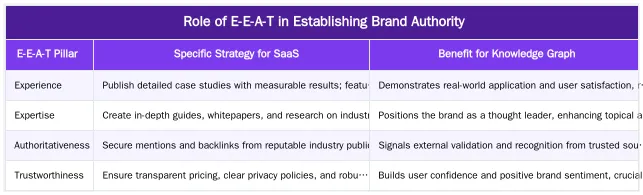
For SaaS companies, especially those in specialized sectors like healthcare, establishing E-E-A-T is crucial for achieving dominance in the competitive London medical market. This involves not only showcasing the software’s capabilities but also the expertise of the individuals behind it. Abdurrahman Şimşek, as a Semantic SEO Strategist, helps clients implement advanced schema for entity modeling, ensuring that all E-E-A-T signals are clearly communicated to search engines. This includes optimizing product entity optimization to boost SaaS visibility in the Knowledge Graph. By systematically addressing each E-E-A-T pillar, SaaS brands can build a credible and authoritative digital presence that search engines reward with higher visibility and trust.
Partnering for SaaS Knowledge Graph Dominance
Achieving dominance in the Google Knowledge Graph for your SaaS brand requires a specialized approach that integrates semantic engineering with robust SEO strategies. The complexities of entity modeling, structured data implementation, and E-E-A-T cultivation demand expert guidance. Partnering with a specialist who understands the nuances of semantic search and the specific challenges of the SaaS industry can accelerate your path to prominent online visibility.
Abdurrahman Şimşek, a London-based Semantic SEO Strategist, offers the expertise to navigate these challenges. With 10 years of experience, he specializes in building high-authority Semantic Content Networks, leveraging infrastructure like Ruxi Data to transform your SaaS product into a recognized and trusted entity. His focus on reducing search engine Cost of Retrieval (CoR) and establishing strong E-E-A-T signals ensures your brand achieves dominant topical authority. To explore how a tailored semantic strategy can elevate your SaaS knowledge graph presence, Book a Semantic SEO Audit today. You can also reach out directly via WhatsApp Strategy Line: +90 506 206 86 86, or Hire as Semantic SEO Architect to build your brand’s semantic foundation.
Conclusion
Optimizing for the Google Knowledge Graph is no longer an optional SEO tactic but a fundamental requirement for SaaS brands seeking to establish authority and achieve dominant online visibility in 2026. By meticulously defining your brand as a recognized entity through structured data, consistent brand mentions, and a strong focus on E-E-A-T, SaaS companies can significantly enhance their presence in search results. Leveraging advanced strategies like Cost of Retrieval optimization and LLM-driven semantic content networks further refines this approach, ensuring efficient indexing and comprehensive topical coverage. Embracing these semantic principles is key to securing a competitive edge and fostering long-term growth for your SaaS business. For a deeper dive into these strategies and to elevate your brand’s semantic footprint, contact us today. You can also Book a Semantic SEO Audit, connect via Direct WhatsApp Strategy Line: +90 506 206 86 86, or Hire as Semantic SEO Architect.
Frequently Asked Questions
What is the significance of a saas knowledge graph for SaaS brands?
The Google Knowledge Graph is a vast database of facts about people, places, and things. For SaaS brands, optimizing your saas knowledge graph means Google understands your company, products, and services as distinct entities, leading to enhanced visibility in SERP features and AI Overviews. This foundational understanding is crucial for establishing digital authority.
How does Ruxi Data assist in building a strong saas knowledge graph for companies?
Ruxi Data’s AI analyzes SERP data to identify relevant entities and automates the creation of entity-rich content and schema markup. This explicitly defines your brand and its offerings to Google, strengthening your saas knowledge graph presence. It ensures your unique identity is accurately represented and understood by search engines.
What is “entity reconciliation” and why is it important for optimizing a SaaS brand’s Knowledge Graph?
Entity reconciliation is the process of ensuring Google correctly identifies and disambiguates your brand and its products from similar entities. This is vital for a SaaS brand’s Knowledge Graph to accurately represent its unique identity. Ruxi Data helps resolve brand ambiguity, ensuring your offerings are clearly understood by search engines.
How does schema markup contribute to building a robust saas knowledge graph?
Schema markup, particularly Organization, Product, and Service schema, provides structured data that explicitly tells Google about your SaaS brand’s identity, offerings, and relationships. This is crucial for building and reinforcing your presence in the saas knowledge graph. It helps search engines connect your brand to relevant concepts and user queries.
What are the key benefits of a strong Knowledge Graph presence for a SaaS business?
A strong Knowledge Graph presence leads to higher visibility in search results, rich snippets, and AI Overviews. It builds brand authority, trust, and can improve click-through rates by providing immediate, authoritative information about your SaaS. This enhanced visibility helps attract more qualified leads and establish market leadership.
How can I get started with optimizing my SaaS brand’s Knowledge Graph?
To begin optimizing your SaaS brand’s Knowledge Graph, you can book a Semantic SEO Audit with Abdurrahman Şimşek. This audit will identify specific strategies and opportunities for your business. You can also reach out directly via WhatsApp at +90 506 206 86 86 for a strategy discussion.
Ruxi Data brings together multi-model AI, automated website crawling, live indexation checks, topical authority mapping, E-E-A-T enrichment, schema generation, and full pipeline automation — from crawl to WordPress publish to social posting — all in one platform built for agencies and freelancers who run on results.