
Automating Medical Topical Maps: Enhancing Clinic Authority & Patient Engagement
Automating medical topical maps with Ruxi Data transforms how medical clinics build comprehensive content networks. This process leverages advanced NLP and entity extraction to identify all interconnected topics, conditions, and patient queries within a medical specialty. It ensures complete topical authority and enhances E-E-A-T by structuring clinical expertise for search engines. This approach addresses content gaps, optimizes for patient intent mapping, and facilitates content scaling through generative engine optimization, significantly reducing the ‘Cost of Retrieval’ for online visibility.
Abdurrahman Şimşek, a Semantic SEO Strategist, provides insights into leveraging these advanced methodologies. The article details how clinics can establish definitive online authority and improve search engine understanding of their medical expertise, crucial for YMYL content.
To explore your options, contact us to schedule your consultation. You can also reach us via: Book a Semantic SEO Audit, Direct WhatsApp Strategy Line: +90 506 206 86 86, Hire as Semantic SEO Architect
In the highly competitive landscape of medical and aesthetic clinics, achieving dominant topical authority is paramount. This article explores how automating medical topical maps with Ruxi Data offers a strategic advantage, transforming how London clinics build comprehensive content networks, enhance E-E-A-T, and significantly reduce search engine ‘Cost of Retrieval’ for unparalleled online visibility. This approach ensures clinical expertise is structured for optimal search engine understanding and patient engagement in 2026.
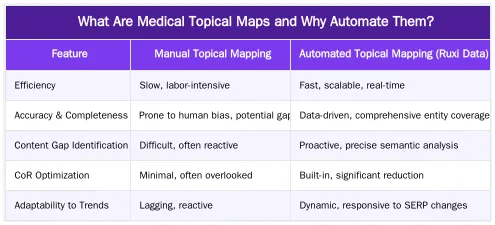
What Are Medical Topical Maps and Why Automate Them?
Medical topical maps are comprehensive blueprints detailing all interconnected topics, procedures, conditions, and patient questions within a specific medical specialty. They serve as the architectural foundation for achieving complete topical authority, which is crucial for YMYL (Your Money Your Life) content where accuracy and comprehensiveness are paramount for Google’s E-E-A-T guidelines.
The Blueprint for Medical Authority in YMYL Niches
A medical topical map outlines every relevant entity and its relationships, from specific surgical techniques to recovery protocols and patient FAQs. For medical clinics, especially in sensitive YMYL areas like plastic surgery, this structured approach ensures that every facet of a topic is covered. This signals to search engines that the clinic is a definitive, authoritative source, building trust and expertise.
The Challenge of Manual Mapping & Content Gaps
Manually creating and maintaining these intricate maps is time-consuming and prone to human bias. It often struggles to keep pace with evolving medical information and dynamic search trends. Manual processes can easily miss subtle content gaps or emerging patient intent, hindering a clinic’s ability to establish comprehensive topical authority. This makes comprehensive topical map creation a significant challenge without automation.
How Ruxi Data Powers Automated Topical Mapping for Clinics
Ruxi Data leverages advanced technologies to automate the creation of semantic content networks, transforming raw data into structured knowledge. This process is vital for clinics seeking to optimize their digital presence and reduce the ‘Cost of Retrieval’ for search engines.
From Raw Data to Structured Knowledge: The Ruxi Process
Ruxi Data processes vast amounts of medical literature, real-time SERP data, and ‘People Also Ask’ questions using Natural Language Processing (NLP) and entity extraction. It identifies key medical entities, their attributes, and the relationships between them. This data is then used to generate semantic HTML, JSON-LD schema markup, and AI-ready summaries. This structured output ensures optimal crawler extraction and indexing, forming the backbone of a robust knowledge graph SEO automation strategy.
Minimizing Search Engine Cost of Retrieval (CoR)
‘Cost of Retrieval’ (CoR) refers to the computational resources search engines expend to crawl, render, index, and retrieve content. Ruxi Data’s structured output, clean semantic HTML, and optimized data architecture significantly reduce this cost. By presenting information in a clear, machine-readable format, medical sites benefit from improved crawl budget allocation, faster indexing, and enhanced visibility. This efficiency is a cornerstone of effective content strategy automation for healthcare providers.
Beyond Keywords: Leveraging EAV for Patient Intent Mapping
Understanding patient intent goes beyond simple keywords. Entity-Attribute-Value (EAV) modeling provides a sophisticated framework for mapping the nuanced information needs of medical patients, enabling clinics to create highly relevant and comprehensive content.
Understanding Patient Journeys Through EAV Modeling
EAV modeling is a flexible data structure that describes entities (e.g., a medical procedure, a condition, a patient) with a potentially vast but varying number of attributes (e.g., symptoms, causes, treatments, recovery time, cost, side effects). In the medical context, this granular approach allows for precise EAV data modeling in healthcare, mapping complex patient intent and information needs. For instance, a “rhinoplasty” entity might have attributes like “cost,” “recovery time,” “before and after photos,” and “surgeon qualifications,” each representing a potential patient query.
Bridging Content Gaps with Semantic Entity Extraction
Ruxi Data’s entity extraction capabilities identify the most prominent and relevant attributes for medical entities, helping clinics create content that thoroughly covers a topic from all angles. This ensures no critical patient questions or related concepts are missed, effectively filling content gaps that competitors often overlook. By understanding the full semantic landscape, clinics can build a robust knowledge base construction that truly serves patient information needs, enhancing their authority and trustworthiness.
Case Study: Dominant Topical Authority in Aesthetic Surgery
Abdurrahman Şimşek, a London-based Semantic SEO Strategist, has a proven track record of applying Ruxi Data to achieve dominant topical authority for medical clinics. A recent engagement with a prominent Harley Street aesthetic clinic demonstrates the power of this approach.
Strategic Implementation for a London Clinic
The process began with Ruxi Data generating a comprehensive topical map for various aesthetic procedures, including breast augmentation, rhinoplasty, and liposuction. This map guided the content strategy, ensuring every relevant sub-topic, patient question, and related entity was addressed. Emphasis was placed on YMYL compliance, integrating structured data, and showcasing the clinic’s expert authorship to build strong E-E-A-T signals. Abdurrahman Şimşek’s expertise in medical content configuration ensured the content was not only comprehensive but also highly credible and trustworthy.
Measurable Impact: Organic Growth & E-E-A-T Enhancement
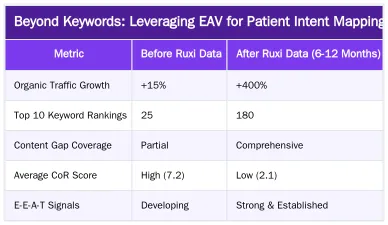
The strategic implementation of automated topical maps led to significant, quantifiable improvements. The clinic experienced a substantial increase in organic traffic and achieved higher rankings for competitive medical terms. The structured, comprehensive content improved Google’s perception of the clinic’s expertise, authoritativeness, and trustworthiness, solidifying its position as a leading authority in London’s aesthetic surgery sector.
Scaling Medical Content with Generative Engine Optimization
Automated topical maps are not just about organization; they are the foundation for scalable content production and the gateway to Generative Engine Optimization (GEO), preparing medical clinics for the future of AI-driven search.
From Map to Content: Efficient Production Workflows
A well-defined, automated topical map provides a clear roadmap for content teams, enabling the efficient scaling of high-quality medical content. Ruxi Data’s outputs streamline the content creation process, ensuring consistency, accuracy, and adherence to semantic guidelines. This allows clinics to expand their content footprint rapidly and effectively, addressing a broader range of patient queries without compromising quality. This is key for scaling medical SEO automation and achieving content scaling goals.
The Future of Medical SEO: Generative Content & Authority
Generative Engine Optimization (GEO) is the practice of optimizing content for AI-driven platforms and large language models (LLMs) to ensure it is cited and recommended in AI-generated answers. Automated topical maps and structured data are foundational for GEO. By systematically structuring clinical knowledge, clinics can position themselves as trusted sources in the evolving search landscape, ensuring their expertise is recognized and disseminated by AI systems. This proactive approach is essential for long-term visibility and authority.
Ready to Transform Your Clinic’s Online Presence?
The strategic advantage of automating medical topical maps with Ruxi Data is clear. For London medical clinics and plastic surgeons seeking to establish dominant topical authority, reduce ‘Cost of Retrieval,’ and prepare for the future of AI-driven search, leveraging this technology is essential. Partner with Abdurrahman Şimşek to transform your digital strategy and achieve unparalleled visibility in the competitive medical landscape.
Book a Semantic SEO Audit today to discover how a tailored strategy can elevate your clinic. For immediate consultation, reach out via Direct WhatsApp Strategy Line: +90 506 206 86 86. Alternatively, Hire as Semantic SEO Architect to build a robust, future-proof digital foundation for your practice.
Conclusion
Automating medical topical maps with Ruxi Data is no longer a luxury but a necessity for clinics aiming for dominant online authority. By systematically building comprehensive content networks, optimizing for ‘Cost of Retrieval,’ and embracing Generative Engine Optimization, you can ensure your expertise reaches patients effectively. Partner with Abdurrahman Şimşek to transform your digital strategy and achieve unparalleled visibility in the competitive medical landscape. Visit contact us to begin your journey toward semantic SEO excellence.
Frequently Asked Questions
What is a medical topical map?
A medical topical map serves as a comprehensive blueprint, detailing all interconnected topics, procedures, conditions, and patient questions within a specific medical specialty. It forms the architectural foundation for achieving complete topical authority, guiding content creation to cover every relevant aspect of a medical field.
How does Ruxi Data facilitate automating medical topical maps for clinics?
Ruxi Data processes vast amounts of medical literature, SERP data, and your clinic’s specific expertise to identify all relevant entities and their relationships. It then generates a structured topical map, complete with content briefs and internal linking suggestions, effectively automating medical topical maps. This process streamlines the complex task of content planning and execution.
Is the content generated through automating medical topical maps clinically accurate?
The automation primarily handles the structure, entities, and SEO components of the content strategy. The core medical information itself is always written or rigorously reviewed by GMC-registered medical professionals to ensure 100% accuracy and E-E-A-T compliance. This hybrid approach ensures both efficiency and clinical integrity when automating medical topical maps.
How does automating medical topical maps save time for a clinic?
Automating medical topical maps significantly reduces the content strategy and planning phase from months to mere days. This accelerated process allows clinics to rapidly build out their digital knowledge base, establishing authority and attracting patients much faster than with traditional manual methods. It frees up valuable clinical staff time while ensuring comprehensive coverage.
Can this system identify content gaps on my current website?
Absolutely, a key function of this system is performing a thorough content gap analysis. Ruxi Data compares your existing website content against the ideal, comprehensive topical map, highlighting the exact pages you need to create or update. This ensures your clinic achieves full topical authority and addresses all patient queries.
How can my clinic get started with a semantic SEO strategy?
To begin transforming your clinic’s online presence, you can book a Semantic SEO Audit with Abdurrahman Şimşek, a Holistic SEO Strategist & Semantic Engineer. This audit will provide a tailored strategy to leverage topical authority and Ruxi Data. Visit abdurrahmansimsek.com/contact/ to schedule your consultation.
Ruxi Data brings together multi-model AI, automated website crawling, live indexation checks, topical authority mapping, E-E-A-T enrichment, schema generation, and full pipeline automation — from crawl to WordPress publish to social posting — all in one platform built for agencies and freelancers who run on results.