
WordPress SEO Automation: Scaling Agency Performance
WordPress SEO automation empowers agencies to transcend basic plugin limitations, achieving scalable and consistent results for client websites. This article details how advanced systems move beyond tools like Yoast SEO and Rank Math, integrating semantic engineering and AI for comprehensive optimization. It covers automating technical SEO, dynamic schema markup, and intelligent internal linking, ensuring robust site speed and improved Core Web Vitals. Agencies gain efficiency, reduce manual effort, and enhance topical authority, crucial for dominant search visibility in competitive digital landscapes.
Abdurrahman Şimşek, a Holistic SEO Strategist, provides insights into leveraging these advanced strategies. The content emphasizes data-driven approaches for optimizing performance and achieving superior search engine rankings, particularly for agencies managing extensive client portfolios.
To explore your options, contact us to schedule your consultation.
For marketing agencies managing numerous client websites, implementing effective wordpress seo automation is essential for scalability and consistent results. This article explores how advanced automation tools move beyond basic plugin functionalities to deliver comprehensive search engine optimization. We will delve into semantic engineering, technical SEO, and content strategies that streamline workflows and enhance online visibility. Understanding these capabilities allows agencies to optimize performance, reduce manual effort, and achieve superior outcomes for their clients in competitive digital landscapes.
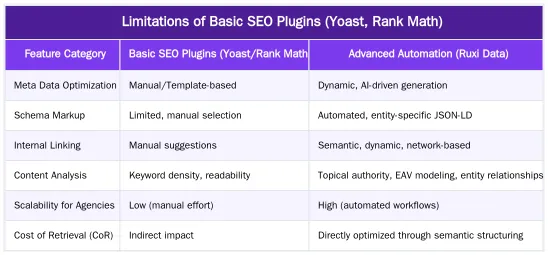
Limitations of Basic SEO Plugins (Yoast, Rank Math)
Many agencies begin their WordPress SEO efforts with popular plugins like Yoast SEO or Rank Math. These tools provide foundational optimization features, including meta title and description editing, XML sitemap generation, and basic schema markup. They are effective for individual page optimization and offer helpful content analysis suggestions.
However, for agencies managing a large portfolio of clients, these plugins present scalability challenges. Manual configuration for hundreds or thousands of pages becomes time-consuming and prone to human error. They often lack the depth required for advanced technical SEO, such as dynamic internal linking based on semantic relationships or sophisticated schema generation for complex entities. Their content analysis is typically keyword-centric, not entity-centric, which limits their ability to build comprehensive topical authority.
Furthermore, these plugins do not inherently integrate with external data sources or AI-driven semantic engines. This means agencies must still perform significant manual research and content planning to ensure topical coverage and E-E-A-T signals. While essential starting points, their capabilities fall short when aiming for dominant search visibility across specialized niches, particularly for YMYL (Your Money Your Life) sectors like healthcare.
Advanced WordPress SEO Automation for Agencies
Advanced WordPress SEO automation for agencies involves leveraging specialized platforms and AI to streamline complex SEO tasks beyond basic plugin functions. This approach focuses on efficiency, scalability, and achieving superior search engine rankings through data-driven strategies.
These systems automate processes such as comprehensive technical SEO audits, dynamic schema markup generation, and intelligent internal linking. They integrate with semantic engines to understand content relationships and build topical authority. For agencies, this means less manual effort, faster deployment of SEO strategies across multiple client sites, and more consistent, measurable results. The goal is to reduce the “Cost of Retrieval” for search engines, making content easier to find and understand, thereby improving organic visibility and client ROI.
Semantic Engineering and CoR Reduction with Ruxi Data
True SEO automation extends into semantic engineering, a discipline focused on structuring content to align with how search engines understand entities and their relationships. Abdurrahman Şimşek, a Holistic SEO Strategist and Semantic Engineer, emphasizes this approach, particularly for high-stakes sectors like medical clinics and plastic surgeons. Ruxi Data serves as a core infrastructure for this advanced methodology.
Ruxi Data’s semantic engine facilitates Entity-Attribute-Value (EAV) modeling, transforming unstructured clinical expertise into structured, machine-readable data. This process allows for the automated generation of highly relevant content clusters and topical maps. By precisely defining entities (e.g., “rhinoplasty procedure,” “Harley Street surgeon”) and their attributes (e.g., “cost,” “recovery time,” “qualifications”), Ruxi Data helps build a robust semantic content network.
This sophisticated structuring directly contributes to reducing the Search Engine Cost of Retrieval (CoR). When content is semantically rich and clearly organized, search engines expend less computational effort to understand its meaning and relevance. This efficiency is rewarded with improved indexing, ranking, and overall visibility. For agencies, integrating Ruxi Data means moving beyond keyword density to establish deep topical authority, a critical factor for E-E-A-T in YMYL niches. Learn more about advanced automation at abdurrahmansimsek.com/advanced-wordpress-seo-automation/.
Automating Technical SEO for Performance
Technical SEO forms the backbone of any successful online presence, ensuring websites are crawlable, indexable, and performant. Advanced automation platforms significantly streamline these critical tasks. Site speed optimization, for instance, can be partially automated through intelligent caching, image compression, and code minification processes.
Core Web Vitals, Google’s metrics for user experience, are increasingly important. Automation tools can monitor these vitals (LCP, FID, CLS) across client sites and flag issues, sometimes even suggesting or implementing fixes. This proactive approach ensures a consistent, high-quality user experience, which directly impacts search rankings. For example, ensuring Largest Contentful Paint (LCP) remains below 2.0 seconds is crucial for medical web development, where user trust and quick access to information are paramount.
Furthermore, automation extends to indexing signals. Tools can integrate with Google Indexing API and IndexNow protocols to ensure new content and updates are rapidly discovered by search engines. This is particularly valuable for time-sensitive information or frequently updated medical content. By automating these technical elements, agencies can maintain optimal site health across their entire client portfolio without extensive manual oversight. Explore WordPress SEO speed optimization at abdurrahmansimsek.com/wordpress-seo-speed-optimization/.
Content Automation and Internal Linking Strategies
Content creation and internal linking are labor-intensive aspects of SEO that benefit immensely from automation. While full content generation still requires human oversight for quality and E-E-A-T, automation can assist in topic ideation, outline generation, and even drafting initial content segments based on semantic models. This is especially useful for creating supporting content that builds out topical clusters.
For agencies, managing content for numerous clients means a constant need for fresh, relevant material. Automation tools can identify content gaps within a topical map and suggest new articles or updates to existing ones. They can also analyze competitor content to inform strategy, ensuring clients maintain a competitive edge in their respective niches.
Internal linking, often overlooked, is vital for distributing link equity and guiding users and crawlers through a site. Advanced automation platforms can dynamically suggest or even implement internal links based on semantic relationships between pages. For instance, an article about “rhinoplasty recovery” can be automatically linked to related content on “post-operative care” or “choosing a surgeon.” This intelligent linking strengthens topical authority and improves site navigation without manual effort. Discover more about WordPress SEO automation plugins for agencies at abdurrahmansimsek.com/wordpress-seo-automation-plugins-agencies/.
The Role of AI in Future WordPress SEO Automation
Artificial intelligence is rapidly transforming the landscape of SEO, particularly for WordPress platforms. By 2026, AI-driven tools are becoming integral to every aspect of search optimization, from content generation to predictive analytics. Large Language Models (LLMs) are at the forefront, enabling more sophisticated content automation that goes beyond simple keyword stuffing.
AI can analyze vast datasets to identify emerging trends, predict search intent shifts, and even optimize content for Generative Engine Optimization (GEO). This involves structuring information in a way that is easily digestible by AI-powered search results, such as Google’s AI Overviews. For agencies, this means leveraging AI to create highly relevant, entity-rich content that satisfies complex user queries and ranks effectively in evolving search environments.
Abdurrahman Şimşek’s work in semantic engineering and Ruxi Data infrastructure exemplifies this future. By using AI to build robust Entity-Attribute-Value models, agencies can ensure their clients’ content is not just keyword-optimized but semantically authoritative. This approach is crucial for maintaining E-E-A-T, especially in YMYL sectors where accuracy and trustworthiness are paramount. The integration of AI allows for continuous optimization and adaptation to algorithmic changes, providing a significant competitive advantage. Explore AI in SEO for WordPress in 2026 at abdurrahmansimsek.com/ai-in-seo-2026-wordpress/.
Benefits of Advanced Automation for Agencies
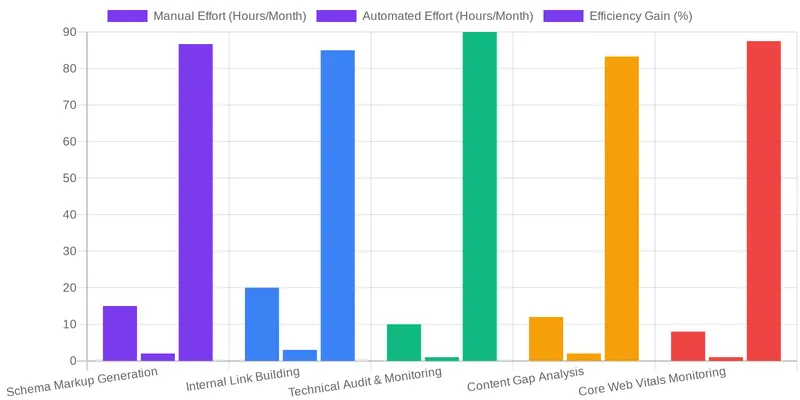
Implementing advanced SEO automation offers significant advantages for marketing agencies. Foremost among these is enhanced efficiency. Automated processes reduce the time spent on repetitive tasks, freeing up agency personnel to focus on strategic planning, client communication, and creative problem-solving. This leads to higher productivity and the ability to manage more clients without proportional increases in staffing.
Scalability is another key benefit. Agencies can apply sophisticated SEO strategies across a large number of client websites with consistency. This ensures that every client receives a high standard of optimization, regardless of the agency’s workload. Automated systems also minimize human error, leading to more reliable and accurate SEO implementations.
Ultimately, these efficiencies translate into improved client results and higher ROI. By leveraging tools that build robust topical authority and optimize for search engine understanding, agencies can achieve better rankings, increased organic traffic, and higher conversion rates for their clients. This strengthens client retention and positions the agency as a leader in delivering measurable value.
Call to Action for Specialized Services
Elevate your agency’s SEO capabilities and deliver unparalleled results for your clients, especially in the competitive medical and aesthetic sectors. Abdurrahman Şimşek specializes in holistic SEO strategies and semantic engineering, leveraging Ruxi Data infrastructure to build dominant topical authority. If your agency seeks to implement advanced wordpress seo automation and achieve superior organic growth, connect with an expert.
Unlock the full potential of your client’s online presence with tailored strategies designed for the YMYL landscape. Visit abdurrahmansimsek.com to explore how specialized SEO solutions can transform your agency’s offerings.
Conclusion
The evolution of WordPress SEO automation presents a transformative opportunity for marketing agencies. Moving beyond basic plugins to embrace advanced semantic engineering and AI-driven tools like Ruxi Data allows for unprecedented efficiency and depth in optimization. This strategic shift enables agencies to build robust topical authority, reduce search engine Cost of Retrieval, and deliver superior, scalable results for their clients. By integrating these sophisticated automation capabilities, agencies can solidify their position as leaders in a competitive digital landscape, ensuring long-term organic success and client satisfaction. Explore advanced strategies at abdurrahmansimsek.com.
Frequently Asked Questions
Why do agencies need advanced wordpress seo automation beyond basic plugins?
Basic plugins offer foundational SEO, but agencies managing multiple high-growth clients require more comprehensive solutions. Advanced wordpress seo automation, like Ruxi Data, handles complex tasks such as dynamic schema generation, real-time SERP analysis, and multi-model AI content creation at scale, which basic plugins cannot.
How does Ruxi Data integrate with WordPress for comprehensive SEO automation?
Ruxi Data acts as an end-to-end infrastructure, generating E-E-A-T compliant content, semantic HTML, and schema markup, then directly publishing to WordPress. This comprehensive SEO automation also integrates IndexNow and Google Index monitoring for instant indexing, streamlining the entire process.
What specific technical SEO tasks can be automated on WordPress for agencies?
Agencies can automate schema markup generation (e.g., Article, FAQ, HowTo), internal linking, content refreshes, IndexNow submissions, and Google Indexing API calls. This advanced automation frees up valuable time for strategic work, enhancing overall SEO efficiency and accuracy.
Can WordPress effectively manage large-scale content automation for agencies?
Yes, with the right infrastructure, WordPress can effectively manage large-scale content automation. Ruxi Data is specifically designed to handle high-volume content generation and publishing on WordPress, ensuring agencies can scale their content operations without compromising quality or technical perfection.
How does advanced wordpress seo automation impact client reporting?
By automating data collection, content generation, and publishing, agencies can focus on analyzing performance and delivering data-driven insights. This leads to more efficient and impactful client reporting, demonstrating clear ROI from your wordpress seo automation efforts and strengthening client relationships.
What role does site speed optimization play in advanced wordpress seo automation?
Site speed is a critical ranking factor and user experience signal, making it essential for competitive SEO. Advanced wordpress seo automation can help identify and address speed bottlenecks, ensure optimized image delivery, and improve Core Web Vitals, contributing significantly to better search rankings.
Ruxi Data brings together multi-model AI, automated website crawling, live indexation checks, topical authority mapping, E-E-A-T enrichment, schema generation, and full pipeline automation — from crawl to WordPress publish to social posting — all in one platform built for agencies and freelancers who run on results.