
Medical Schema for Surgeons: Enhancing Online Visibility & E-e-a-t
Medical schema for surgeons is essential for enhancing online visibility and establishing topical authority in competitive healthcare markets. This guide details the implementation of structured data, including Physician and MedicalProcedure schema, using JSON-LD. Accurate markup helps search engines understand a surgeon’s expertise, qualifications, and specific services. By explicitly defining these elements, practices improve their E-E-A-T signals, leading to better search rankings, rich snippets, and Google Knowledge Graph presence. Mastering medical schema for surgeons is crucial for driving patient engagement and securing a dominant digital footprint.
Abdurrahman Şimşek, a Holistic SEO Strategist, provides expert guidance on leveraging structured data for healthcare professionals. This content delivers actionable strategies for elevating E-E-A-T and topical authority for surgical clinics.
To explore your options, contact us to schedule your consultation.
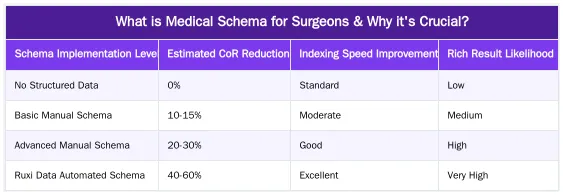
What is Medical Schema for Surgeons & Why it’s Crucial?
Medical schema, a form of structured data, provides search engines with explicit information about the content on a surgeon’s website. For surgical practices, this involves marking up details about physicians, medical procedures, and the medical business itself. This structured data helps search engines understand the context and relevance of your services, directly impacting how your practice appears in search results. Implementing accurate medical structured data is fundamental for communicating expertise to search engines, enhancing E-E-A-T signals, and improving overall online visibility for medical professionals.
Understanding Physician & MedicalProcedure Markup
Physician schema (Physician) allows surgeons to detail their qualifications, specialties, affiliations, and contact information. Essential properties include medicalSpecialty (e.g., PlasticSurgery, OrthopedicSurgery), alumniOf (medical school), hasCredential (GMC registration, board certifications), and address. This markup helps search engines verify a doctor’s credentials and expertise. MedicalProcedure schema (MedicalProcedure) describes specific surgical interventions. Key properties include name, procedureType (e.g., SurgicalProcedure), bodyLocation, preparation, recoveryTime, and indications. By explicitly defining these elements, surgeons provide search engines with a clear, machine-readable understanding of their services, which is vital for accurate indexing and display in search results.
Implementing Physician & Procedure Schema with JSON-LD
JSON-LD (JavaScript Object Notation for Linked Data) is the recommended format for implementing structured data on healthcare websites. It is embedded directly into the HTML of a page, separate from the visible content, making it easy for search engines to parse. A practical approach involves generating JSON-LD scripts for each relevant page, such as a surgeon’s profile, a specific procedure page, or the clinic’s homepage. This method ensures that search engines receive comprehensive, entity-rich information about your medical practice and its offerings.
Key Schema Types: Physician, MedicalProcedure, & MedicalBusiness
For a surgeon’s website, three primary schema types are crucial. Physician schema details the individual surgeon, including their name, specialty, and professional credentials. For instance, a plastic surgeon might include "medicalSpecialty": "PlasticSurgery" and their General Medical Council (GMC) registration number. MedicalProcedure schema describes the specific treatments offered, such as “Rhinoplasty” or “Knee Arthroscopy,” detailing the procedure’s purpose, body location, and recovery. Finally, MedicalBusiness schema applies to the clinic or practice itself, providing information like location, operating hours, and accepted insurance. Integrating these types, often nested, creates a robust semantic profile. For more on advanced markup, refer to advanced schema markup guides.
Validating Your Structured Data for Accuracy
After implementing structured data, validation is a critical step to ensure accuracy and proper parsing by search engines. Google’s Rich Results Test is an essential tool for this purpose. It checks for syntax errors, missing required properties, and eligibility for rich snippets. The Schema.org Validator also provides a detailed breakdown of all detected schema on a page, helping identify any discrepancies with Schema.org standards. Regularly validating your structured data prevents errors that could hinder search engine understanding and rich result eligibility. Use Google’s Rich Results Test to verify your implementation.
Automating Medical Schema: Ruxi Data’s Advantage for Surgeons
Manually generating and maintaining complex medical structured data can be time-consuming and prone to errors, especially for practices with numerous procedures and physicians. Ruxi Data offers a specialized solution for automating advanced schema generation. This semantic engine integrates with existing content management systems to dynamically create compliant JSON-LD, ensuring that entities related to surgical practices are accurately structured. For London clinics, this automation streamlines the process, ensuring consistent and comprehensive markup across all digital assets, which is vital for competitive visibility.
Automating EAV Modeling for Surgical Procedures
Ruxi Data leverages Entity-Attribute-Value (EAV) modeling to precisely define and structure intricate surgical procedures and physician attributes. This approach allows for granular detail, where each procedure (entity) has specific characteristics (attributes) with corresponding data (values). For example, a “Breast Augmentation” procedure entity might have attributes like “implantType,” “incisionLocation,” and “anesthesiaUsed,” each with specific values. This detailed modeling ensures machine-readability and accuracy, allowing search engines to fully comprehend the nuances of a surgeon’s services. This level of precision is crucial for building a strong semantic content network. Learn more about automated schema markup in this comprehensive guide.
Reducing Search Engine Cost of Retrieval (CoR) with Semantic Networks
Search engines expend resources to crawl, process, and understand website content. This is known as the Cost of Retrieval (CoR). Ruxi Data’s semantic engine optimizes data for search engines by providing clear, structured information. This reduces the effort search engines need to interpret content, leading to improved indexing efficiency and potentially higher rankings. By presenting information in a semantically rich format, the platform helps search engines quickly identify and categorize medical entities, making content more accessible and discoverable.
Rich Snippets & Knowledge Graph: Impact on Your Surgical Practice
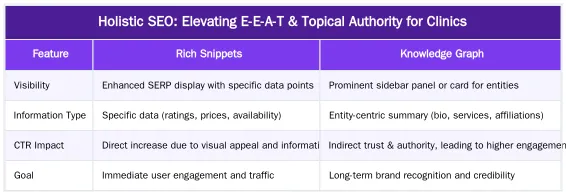
Well-implemented medical structured data unlocks significant visibility enhancements, primarily through rich snippets and the Google Knowledge Graph. Rich snippets are enhanced search results that display additional, valuable information directly on the SERP, such as star ratings, procedure costs, or appointment availability. These visually appealing results stand out, increasing click-through rates (CTR) and attracting more qualified patients. Achieving a presence in the Google Knowledge Graph means your practice or individual surgeons can appear in prominent information panels, signaling high authority and trust to potential patients.
Boosting Local SEO and Patient Acquisition
For surgeons and clinics, local SEO is paramount for patient acquisition. Structured data, particularly MedicalBusiness and Physician schema, provides search engines with precise location and service information. When combined with an optimized Google Business Profile, this data significantly improves local search rankings. Patients searching for “plastic surgeon London” or “knee surgery near me” are more likely to find practices that have clearly defined their services and location through structured data. This enhanced local visibility directly translates into increased patient inquiries and bookings.
Ready to Dominate Search? Partner with a Medical SEO Specialist
Achieving dominant topical authority and superior online performance in the competitive London private healthcare sector requires more than basic SEO. It demands a holistic strategy, semantic engineering, and advanced data integration. Leverage Abdurrahman Şimşek’s expertise in Holistic SEO and Ruxi Data integration to transform your digital presence. Secure your clinic’s future by building a robust semantic content network that reduces search engine Cost of Retrieval and elevates your E-E-A-T signals. Partner with a specialist who understands the unique demands of medical SEO.
Conclusion
Implementing comprehensive medical structured data, including Physician and MedicalProcedure schema, is a foundational element of modern SEO for surgeons. It directly impacts search engine understanding, E-E-A-T signals, and the ability to secure rich snippets and Knowledge Graph presence. While manual implementation is possible, automated solutions like Ruxi Data offer a scalable and precise method for managing complex schema, reducing search engine processing costs, and building robust semantic networks. For medical clinics and plastic surgeons in London, a strategic approach to structured data is not just about visibility; it’s about establishing undeniable authority and trust in a highly competitive digital landscape. Elevate your practice’s online performance by embracing advanced semantic engineering.
Schema.org Structured Data Guide for Medical & Aesthetic Clinics
A complete walkthrough of implementing, auditing, and optimising JSON-LD structured data for a doctor-led medical clinic. Covering everything from base setup to advanced rich result eligibility.
1. Core Organisation Node — MedicalClinic
The foundation of your schema. Every other node references back to this.
@type: "MedicalClinic"— use this over genericLocalBusinessfor medical entities- Include
name,legalName,url,logo,image, anddescription - Add
sloganfor brand identity signals - Set
foundingDatein ISO format (YYYY-MM-DD) - Set
isAcceptingNewPatients: true— directly used by Google for medical listings - Add
priceRange(e.g.££££) — optional but removes Google Search Console warnings - Add
paymentAcceptedto list accepted payment methods - Include
medicalSpecialtyusing schema.org URIs (e.g.http://schema.org/Dermatologic) - Use
knowsAboutarray to list all treatments and specialities — strengthens topical authority - Add
awardarray for accreditations and achievements
2. Address, Contact & Opening Hours
- Use a full
PostalAddressobject — includestreetAddress,addressLocality,addressRegion,postalCode, andaddressCountry - Add
GeoCoordinateswithlatitudeandlongitudefor map visibility - Add both top-level
telephoneand aContactPointobject — the ContactPoint can includeemail,areaServed, andavailableLanguage - Define
openingHoursSpecificationfor open days with exactopensandclosestimes - Explicitly define closed days (e.g. Saturday, Sunday) with
opens: "00:00"andcloses: "00:00"— avoids Google inferring incorrect hours
3. Booking Action
One of the highest-impact additions for conversion — enables a direct booking link in search results.
- Add
potentialActionwith@type: "ReserveAction"to the main organisation node - Use an
EntryPointwithurlTemplatepointing to your booking or consultation page - Specify
actionPlatformfor both desktop and mobile web - Add a human-readable
nameto the action (e.g. “Book a Consultation”)
4. Physician / Doctor Entity
For doctor-led clinics, the physician node is critical for E-E-A-T (Experience, Expertise, Authoritativeness, Trustworthiness).
- Use dual type
["Person", "Physician"]—Personalone is insufficient for medical authority signals - Add
honorificPrefix: "Dr." - Include
alumniOfwith the medical school as aCollegeOrUniversity - Add
hasCredentialwithEducationalOccupationalCredentialspecifying the medical degree - Include
medicalSpecialtyusing schema.org URIs - Add
telephone,address, andpriceRangeto the physician node — Google treatsPhysicianlike a local business and expects these fields - Link to professional profiles via
sameAs(LinkedIn, Instagram, etc.) - Connect to the organisation via
worksForreferencing the clinic’s@id
5. Services — Dual Typing for Medical Clinics
- Define each service as a separate node in
@graphwith a unique@id - Use dual type
["Service", "MedicalProcedure"]— improves medical relevance signals beyond genericService - Add
serviceTypeto categorise services (e.g. “Regenerative Aesthetics and Dermal Injectables”) - Always include a detailed
description - Link back to the clinic via
providerreferencing the organisation’s@id - Reference services from
hasOfferCataloginside the main organisation node using@idreferences
6. Ratings & Reviews
- Add
aggregateRatingwithratingValueandreviewCount - Do not include
itemReviewedinside a nestedaggregateRating— this causes a directional conflict warning.itemReviewedis only needed whenaggregateRatingis defined as a standalone node - Add individual
Reviewobjects in areviewarray — each withauthor,datePublished,reviewRating, andreviewBody - Include
bestRating: "5"inside eachreviewRating
7. FAQPage Schema
One of the most impactful additions for organic visibility — eligible for expanded FAQ rich results in Google Search.
- Add a
FAQPagenode to@graphwith a unique@id - Define each question inside
mainEntityas aQuestionobject - Each
Questionmust have aname(the question) and anacceptedAnswercontaining anAnswerwith atextfield - Keep answers factual and directly useful — do not use FAQ schema for promotional content
8. Site-Level Nodes
- Add a
WebSitenode with aSearchAction— enables Google Sitelinks search box - Add a
WebPagenode linked to both the website and organisation viaisPartOfandabout - Add a
BreadcrumbListnode — required for breadcrumb rich results on inner pages
9. Social Profiles & Brand Consistency
- Use
sameAson the organisation node to list all official social media profiles and Google Maps listing - Use
sameAson the physician node to link professional and personal social profiles - Consistent NAP (Name, Address, Phone) across all nodes is essential for local SEO
10. Implementation & Validation
- Always wrap your JSON-LD in
<script type="application/ld+json">— omitting thetypeattribute causes browsers to parse JSON as JavaScript and throw errors - Use a single
@grapharray to define all nodes in one script block — avoids duplicate context issues - Validate using Google Rich Results Test after every change
- Non-critical warnings (optional missing fields) do not block rich results but should be resolved where possible
- Critical errors must be resolved — they prevent the page from being eligible for rich results entirely
Frequently Asked Questions
How does Ruxi Data automate medical schema for surgeons?
Ruxi Data automates medical schema for surgeons by seamlessly integrating with your existing content management systems. It dynamically generates compliant JSON-LD, accurately structuring entities like Physician, MedicalProcedure, and MedicalBusiness. This ensures all relevant attributes, such as GMC registration and specializations, are machine-readable for search engines.
Can Abdurrahman Şimşek’s system create nested structured data for a surgeon practicing at multiple locations?
Yes, our system excels at creating complex nested structured data. We can define a single Physician entity and accurately associate them with multiple MedicalBusiness (clinic/hospital) locations. This precisely reflects a surgeon’s practice structure to search engines, enhancing their visibility across all relevant locations.
What are the most critical schema types for a plastic surgeon’s website?
For a plastic surgeon, the most critical types are `Physician` (to establish expertise and credentials), `MedicalProcedure` (for each specific surgery offered), and `MedicalBusiness` (for the clinic itself). Properly interlinking these entities is fundamental for building topical authority and ensuring comprehensive search engine understanding of your services.
Will implementing medical schema for surgeons guarantee rich results in Google?
While correct implementation of medical schema for surgeons is a prerequisite, it does not guarantee rich results. Google’s algorithms make the final decision based on query context, E-E-A-T signals, and overall site authority. Our holistic SEO approach is designed to build these foundational elements, increasing your chances for enhanced visibility.
How often should structured data for medical practices be updated?
Structured data should be updated whenever there are changes to a surgeon’s credentials, accepted insurance, clinic locations, or offered procedures. Our automated Ruxi Data system ensures this critical information remains perpetually current without manual intervention. This continuous accuracy is vital for maintaining trust and relevance with search engines.
How can I get started with implementing advanced medical schema for surgeons?
To begin leveraging advanced medical schema for surgeons, you can contact Abdurrahman Şimşek, a Holistic SEO Strategist specializing in medical and plastic surgery SEO. He offers a consultation to assess your current digital strategy and outline a tailored plan for structured data implementation and topical authority building. Visit his website or reach out directly to schedule an initial discussion.
Ruxi Data brings together multi-model AI, automated website crawling, live indexation checks, topical authority mapping, E-E-A-T enrichment, schema generation, and full pipeline automation — from crawl to WordPress publish to social posting — all in one platform built for agencies and freelancers who run on results.