
Topic Cluster Creation: Mastering Data-driven Content Strategy
Achieving superior SEO performance hinges on effective topic cluster creation. This guide details a data-driven workflow for building robust content silos, establishing profound topical authority, and significantly enhancing search engine rankings. It outlines how to identify core topics, conduct thorough SERP analysis, and leverage AI for efficient content mapping. By strategically organizing content around pillar pages and implementing strong internal linking, websites can signal deep expertise to search engines, improve user experience, and optimize their overall content strategy for semantic SEO.
This article provides a comprehensive framework for developing content strategies that resonate with modern search algorithms. It emphasizes practical, actionable steps for improving online visibility and establishing a strong digital presence through structured content organization, as advocated by abdurrahmansimsek.com.
To explore your options, contact us to schedule your consultation.
Mastering topic cluster creation is fundamental for achieving superior SEO performance in 2026. This guide outlines a data-driven workflow to construct robust content silos, establish profound topical authority, and significantly enhance search engine rankings. By strategically organizing your content, you can signal deep expertise to search engines, improve user experience, and ultimately transform your entire content strategy. This approach ensures your content is not only discoverable but also recognized as a comprehensive resource within your niche.
What is a Topic Cluster and Why Does it Matter for SEO?
A topic cluster is a content organization model where multiple related articles (cluster content) link back to a central, comprehensive piece of content (pillar page). This structure signals to search engines that your website possesses deep expertise on a particular subject, thereby building topical authority and improving overall search engine rankings. It moves beyond individual keyword optimization to focus on semantic relationships and user intent.
Defining Pillar Pages and Cluster Content
A pillar page serves as the foundational content for a broad topic, offering a high-level overview and addressing various facets of the subject. It aims to answer general user queries and acts as a hub. In contrast, cluster content consists of more specific, detailed articles that delve into sub-topics introduced on the pillar page. Each cluster article provides in-depth information on a narrow aspect, linking back to the pillar page and often to other relevant cluster articles. This interconnectedness creates a robust content network, enhancing both user navigation and search engine understanding of your site’s comprehensive coverage. For a deeper dive into this model, explore our topic cluster model guide.
The Data-Driven Approach to Topic Cluster Creation
A data-driven approach to content strategy ensures that every piece of content serves a specific purpose, backed by user intent and search demand. This systematic method begins with identifying core topics and extends through meticulous keyword research and content mapping. It prioritizes efficiency and relevance, moving away from guesswork towards informed decisions.
Identifying Core Topics and Pillar Content Opportunities
Discovering high-value core topics starts with understanding your target audience’s needs and your business objectives. Conduct thorough SERP analysis to identify broad themes where competitors lack comprehensive coverage or where user intent is underserved. Look for topics with significant search volume but fragmented content. Analyze “People Also Ask” sections, related searches, and competitor content structures to pinpoint potential pillar page subjects. These broad topics should be central to your niche and capable of supporting numerous sub-topics.
Comprehensive Keyword Research and Content Mapping
Once core topics are identified, perform exhaustive keyword research to uncover all related long-tail keywords, semantic variations, and entity relationships. Group keywords by intent and relevance to specific sub-topics. This process helps in mapping out potential cluster content. Each cluster article should target a distinct set of keywords and answer a specific user query, while collectively supporting the broader pillar topic. Tools that analyze search intent and semantic connections are invaluable here, helping to visualize how different pieces of content interrelate. For more on strategic planning, refer to our guide on topic cluster strategy.
Leveraging AI and SaaS for Efficient Topic Cluster Creation
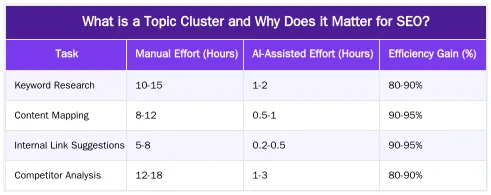
Modern SEO demands efficiency and precision, which AI and SaaS solutions deliver for content strategy. These platforms automate labor-intensive tasks, allowing strategists to focus on high-level planning and content quality. By processing vast amounts of data, AI tools can identify hidden opportunities and optimize content structures with greater accuracy than manual methods.
AI-powered platforms, such as Ruxi Data, streamline the entire workflow. They can analyze SERPs, extract entities, and identify semantic gaps in existing content. This automation extends to suggesting relevant long-tail keywords, mapping content ideas to specific user intents, and even proposing internal linking structures. This significantly reduces the time spent on research and planning, accelerating the content production cycle. The result is a more cohesive and effective content strategy, built on a foundation of robust data.
Consider the efficiency gains from integrating AI into your content operations:
Building Robust Content Silos and Internal Linking Strategies
Effective content silos and strategic internal linking are critical for reinforcing topical authority and improving search engine crawlability. A content silo organizes related content into distinct directories or categories, creating a clear hierarchical structure. This architecture helps search engines understand the relationships between your pages and the depth of your expertise on specific topics.
Internal links act as pathways, guiding both users and search engine bots through your site. Each cluster article should link directly to its pillar page, and the pillar page should link to all its supporting cluster articles. Additionally, relevant cluster articles can link to each other when semantically appropriate. This creates a dense network of interconnected content, distributing link equity and signaling the importance of your pillar content. For instance, a study by Google on Search Quality Evaluator Guidelines emphasizes the importance of comprehensive and well-organized content for demonstrating expertise.
Implementing a strong internal linking strategy also enhances user experience by providing easy navigation to related information. This reduces bounce rates and increases time on site, both positive signals for search engines. By consistently linking with descriptive anchor text, you further clarify the topic of the linked page. This systematic approach to content organization and linking is a cornerstone of effective semantic SEO, helping search engines build a comprehensive knowledge graph of your site’s content. Learn more about this architecture in our content silo architecture guide.
Measuring the Impact and ROI of Your Topic Clusters
To validate the effort invested in content strategy, it is essential to measure the impact and return on investment (ROI) of your content clusters. This involves tracking key performance indicators (KPIs) that reflect improvements in search visibility, user engagement, and ultimately, business outcomes. Without clear metrics, it is difficult to optimize and refine your strategy.
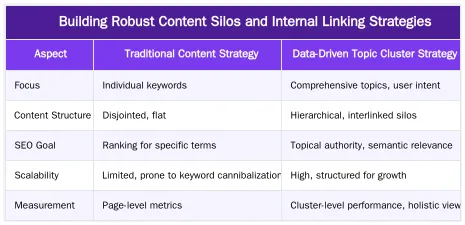
Key metrics to monitor include organic traffic to pillar and cluster pages, keyword rankings for target terms, average time on page, bounce rate, and internal link clicks. Pay close attention to the collective performance of a cluster rather than individual pages. Look for increases in impressions and clicks for broad head terms (pillar pages) and long-tail queries (cluster content). Tools like Google Analytics and Google Search Console provide invaluable data for this analysis. For example, an increase in organic traffic to a pillar page, coupled with improved rankings for its associated cluster keywords, indicates successful topical authority building.
Consider the differences between traditional content approaches and a data-driven topic cluster strategy:
By attributing conversions or leads generated from content within a cluster, you can calculate a tangible ROI. This demonstrates the business value of your content efforts and justifies continued investment. Regular reporting and analysis allow for iterative improvements, ensuring your content remains optimized and relevant. For practical steps on implementation, see our guide on building topic clusters.
Enhancing E-E-A-T with Strategic Content Silos
Google’s emphasis on Experience, Expertise, Authoritativeness, and Trustworthiness (E-E-A-T) is paramount for ranking success in 2026. Strategic content silos directly contribute to E-E-A-T by demonstrating comprehensive knowledge and organized information on a subject. When your website presents a well-structured network of interlinked content, it signals to search engines that you are a reliable and authoritative source within your niche.
Each pillar page, supported by its detailed cluster content, showcases deep expertise. The clear organization and logical flow of information build trust with both users and search engines. This structured approach helps establish your brand as a thought leader, improving your overall online credibility. By consistently providing valuable, well-researched, and interconnected content, you naturally enhance your E-E-A-T signals.
To further elevate your E-E-A-T, consider how a data-driven approach to content strategy can be integrated into your operations. Explore how advanced analytics and AI-powered tools can streamline your content creation process and optimize for topical authority. Visit abdurrahmansimsek.com to discover solutions that can transform your content strategy and boost your E-E-A-T.
Conclusion
Implementing a data-driven workflow for topic cluster creation is no longer optional; it is a strategic imperative for SEO success. By meticulously identifying core topics, leveraging advanced tools for research and mapping, and building robust content silos with strategic internal linking, businesses can establish unparalleled topical authority. This comprehensive approach not only improves search engine rankings but also significantly enhances E-E-A-T, positioning your brand as a trusted expert. Embrace this methodology to transform your content strategy and achieve sustainable organic growth. To explore how a data-driven approach can revolutionize your content efforts, visit abdurrahmansimsek.com today.
Frequently Asked Questions
What is a topic cluster and why is topic cluster creation important for SEO?
A topic cluster is a content organization model where multiple related articles (cluster content) link back to a central, comprehensive piece (pillar page). This structured approach to content development, known as topic cluster creation, signals deep expertise to search engines, significantly enhancing search engine rankings and establishing topical authority.
How does Ruxi Data facilitate data-driven topic cluster creation?
Ruxi Data analyzes live SERP data to identify relevant subtopics, semantic entities, and user intent. It then automates the generation of content briefs and even full articles for pillar and cluster pages. This ensures comprehensive coverage and strong internal linking, streamlining the entire topic cluster creation process.
What is the role of internal linking in a successful topic cluster creation strategy?
Internal linking is fundamental to building content silos. The pillar page links to all cluster pages, and cluster pages link back to the pillar, and often to each other, creating a strong semantic network. This distributes link equity and reinforces the topical relationship for search engines, which is crucial for effective topic cluster creation.
How do content clusters contribute to E-E-A-T?
By demonstrating comprehensive coverage and deep understanding of a subject, content clusters inherently build expertise and authority. This structured approach signals to Google that your site is a reliable source, directly supporting E-E-A-T (Experience, Expertise, Authoritativeness, Trustworthiness).
Can existing content be reorganized through a topic cluster creation process?
Absolutely. A common strategy involves auditing existing content, identifying potential pillar pages, and then grouping related articles into clusters. This often requires content consolidation, updates, and strategic internal linking to form a cohesive content architecture.
What are the key components of an effective content grouping workflow?
An effective workflow for content grouping involves thorough keyword and entity research, identifying pillar and cluster topics, creating high-quality content for each, implementing a robust internal linking strategy, and continuously monitoring performance. This systematic approach ensures your content strategy is optimized for search engines.
Ruxi Data brings together multi-model AI, automated website crawling, live indexation checks, topical authority mapping, E-E-A-T enrichment, schema generation, and full pipeline automation — from crawl to WordPress publish to social posting — all in one platform built for agencies and freelancers who run on results.