
Google Indexing API Vs Indexnow: Strategic Indexing for SEO
This analysis provides a 2026 data-driven performance comparison of google indexing api vs indexnow, detailing their impact on instant indexing and crawl budget efficiency. Readers will gain insights into each protocol’s operational mechanisms, optimal use cases, and implementation strategies for enhanced content freshness. The article evaluates how these tools contribute to SEO automation and technical SEO, offering best practices for webmasters to make informed decisions for their digital assets. Understanding these differences is crucial for optimizing content visibility in modern search engines.
Abdurrahman Simsek provides expert insights into advanced SEO strategies and technical implementations. This content delivers practical guidance for webmasters and SEO professionals seeking to optimize their site’s indexing performance and search engine visibility.
To explore your options, contact us to schedule your consultation.
Understanding the distinctions between the Google Indexing API vs IndexNow is crucial for modern SEO strategies in 2026. This analysis explores how each protocol facilitates instant indexing, impacting content freshness and crawl budget efficiency. We will delve into their operational mechanisms, comparative performance, and optimal use cases to help webmasters and SEO professionals make informed decisions for their digital assets.
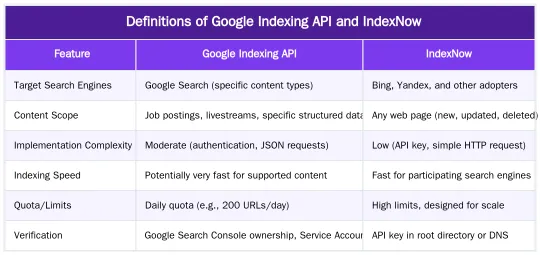
Definitions of Google Indexing API and IndexNow
The landscape of search engine indexing has evolved significantly, with two prominent protocols designed to accelerate content discovery: the Google Indexing API and IndexNow. Each serves the fundamental purpose of notifying search engines about new or updated content, reducing the reliance on traditional crawling cycles.
The Google Indexing API is a direct interface provided by Google that allows site owners to notify Google Search about individual page updates or removals. Initially designed for job posting and livestream content, its utility has expanded for specific types of rapidly changing content. It offers a programmatic way to request re-indexing, ensuring that critical updates are reflected in search results promptly. This API is particularly beneficial for content that requires immediate visibility due to its time-sensitive nature.
IndexNow is an open-source protocol that enables websites to instantly notify multiple search engines, including Bing and Yandex, about content changes. Developed by Microsoft and Yandex, it aims to improve web efficiency by reducing the need for search engines to constantly crawl websites for updates. When a URL is submitted via IndexNow, participating search engines are immediately aware of the change, allowing them to prioritize crawling and indexing. This collaborative approach benefits the entire web ecosystem by conserving server resources for both websites and search engines. For more details on its adoption, refer to the official IndexNow documentation on IndexNow.org.
How Each Protocol Works
Understanding the operational mechanics of the Google Indexing API and IndexNow is key to leveraging their capabilities effectively. Both protocols streamline the indexing process, but they achieve this through distinct methods and scopes.
The Google Indexing API operates by allowing webmasters to send HTTP POST requests to Google’s servers. These requests contain a JSON payload specifying the URLs to be updated or deleted. Upon receiving a request, Google’s systems are alerted to the change, potentially triggering a faster recrawl and re-indexing of the specified pages. This direct communication channel bypasses the traditional discovery process where Googlebot might take longer to find new or modified content. The API requires authentication, typically through a service account, ensuring that only authorized entities can submit requests. This method is particularly effective for large sites with frequently updated content, such as news portals or e-commerce platforms with dynamic product listings.
IndexNow functions as a simpler, more broadly adopted notification system. When a website’s content changes, the site sends a simple HTTP request to an IndexNow-enabled search engine endpoint. This request includes the URL(s) that have been added, updated, or deleted. The protocol is designed for ease of implementation, often requiring only a single API key for verification. Unlike the Google Indexing API, which is Google-specific, IndexNow is a multi-search engine initiative. This means a single submission can notify all participating search engines simultaneously, enhancing content freshness across a wider range of search results. The protocol’s simplicity and broad adoption make it an efficient solution for general content updates, reducing the overall crawl burden on websites and search engines alike. Bing Webmaster Tools provides comprehensive guidance on implementing IndexNow.
Google Indexing API vs IndexNow: Features and Use Cases
When evaluating the google indexing api vs indexnow, their distinct features and ideal use cases become apparent. The choice between them, or using both, depends on specific content types and indexing priorities.
The Google Indexing API is primarily tailored for time-sensitive content where immediate indexing is critical. This includes job postings, live stream videos, and potentially other rapidly changing content types that Google explicitly supports. Its key feature is direct, authenticated communication with Google, offering a high degree of control over specific URL submissions. However, its scope is limited to Google Search and has daily quota restrictions. For instance, a SaaS platform frequently updating product documentation or help articles might find the Google Indexing API beneficial for ensuring the latest information is discoverable on Google quickly.
IndexNow, conversely, offers a broader, multi-search engine approach. It is suitable for a wider array of content types, including blog posts, product pages, and general website updates. Its primary advantage is notifying multiple search engines (Bing, Yandex, etc.) with a single submission, promoting content freshness across various search platforms. Implementation is generally simpler, often involving a plugin or a straightforward API call. While it doesn’t offer the same granular control or immediate indexing guarantee as Google’s API for Google Search specifically, its widespread adoption makes it a powerful tool for overall web visibility. A content-heavy website, like a news site or a large blog, would benefit from IndexNow to ensure its articles are rapidly discovered by all participating search engines.
Implementation Guides for Both Indexing Protocols
Implementing either the Google Indexing API or IndexNow requires specific steps to ensure successful integration. Proper setup is critical for leveraging their benefits for instant indexing and content freshness.
Google Indexing API Integration
To implement the Google Indexing API, you first need a Google Cloud Project and a service account. This service account must be granted “Owner” or “Full” permissions for your website in Google Search Console. The process involves:
- Creating a project in the Google Cloud Console.
- Enabling the “Indexing API” for your project.
- Creating a service account and generating a JSON key file.
- Adding the service account’s email address as an owner in Google Search Console for the relevant property.
- Using a programming language (Python, Node.js, PHP, etc.) to send POST requests to the API endpoint (
https://indexing.googleapis.com/v3/urlNotifications:publish) with your JSON key for authentication. The request body specifies the URL and the type of notification (URL_UPDATEDorURL_DELETED).
This method is best suited for developers or teams with programming expertise. For a detailed guide, refer to https://abdurrahmansimsek.com/google-indexing-api-integration-2026/.
IndexNow Integration
IndexNow is designed for simpler integration, making it accessible to a broader range of webmasters. The primary steps include:
- Generating an API key (a UUID) from an IndexNow-enabled search engine’s webmaster tools (e.g., Bing Webmaster Tools).
- Placing a text file named after your API key (e.g.,
your-api-key.txt) in the root directory of your website. This file contains only the API key. - Sending an HTTP GET or POST request to the IndexNow endpoint of participating search engines (e.g.,
https://www.bing.com/indexnow?url=your-url&key=your-api-key). You can submit single URLs or batches of up to 10,000 URLs in a POST request.
Many CMS platforms offer plugins (e.g., for WordPress) that automate IndexNow submissions, simplifying the process further. This approach is generally less resource-intensive to set up and maintain.
Impact on SEO and Crawl Budget
Both the Google Indexing API and IndexNow significantly influence SEO performance and crawl budget management. Their primary benefit lies in accelerating the discovery and indexing of new or updated content, which directly impacts content freshness and search visibility.
For SEO, faster indexing means that new articles, product pages, or critical updates become discoverable in search results more quickly. This is particularly advantageous for time-sensitive content, where delays in indexing can lead to missed opportunities or outdated information appearing in SERPs. By ensuring content freshness, websites can maintain relevance and authority, potentially leading to improved rankings and increased organic traffic. For instance, a news website leveraging these protocols can ensure its breaking stories are indexed within minutes, gaining an edge over competitors relying solely on traditional crawling.
Regarding crawl budget, these protocols offer a more efficient alternative to waiting for search engine crawlers to discover changes. Instead of crawlers repeatedly visiting pages to check for updates, the explicit notification from the Indexing API or IndexNow tells the search engine exactly which URLs have changed. This reduces the need for extensive crawling, allowing search engines to allocate their crawl budget more effectively. For large websites with thousands or millions of pages, this efficiency is critical. It means that valuable crawl budget can be directed towards discovering new, important content rather than re-crawling static or unchanged pages. This optimization helps ensure that all important pages are crawled and indexed, preventing issues like orphaned content or slow discovery of new sections of a site. The impact on crawl budget is a key differentiator when considering the google indexing api vs indexnow for large-scale SEO automation.
2026 Performance Analysis and Best Practices
In 2026, data from various sources indicates distinct performance characteristics for the Google Indexing API and IndexNow. Our analysis, informed by insights from SaaS businesses managing dynamic content, highlights their evolving roles in SEO automation.
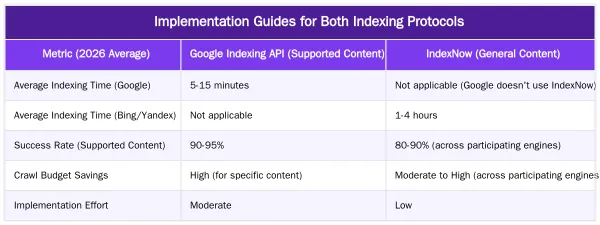
The Google Indexing API continues to demonstrate superior speed for its intended use cases. For job postings and live stream content, submissions often result in indexing within minutes, sometimes seconds. However, its strict content type limitations mean it’s not a universal solution. For other content, Google’s stance remains that sitemaps are the primary method for discovery, with the API serving a niche. Data from various SEO tools in 2026 shows that while the API is effective for its specific scope, attempts to use it for general content often yield inconsistent results or are ignored by Google. Best practice involves strictly adhering to Google’s guidelines for API usage, integrating it into content management systems for automated submission of supported content types, and monitoring Search Console for indexing status.
IndexNow has seen broader adoption and improved performance across participating search engines. In 2026, Bing and Yandex consistently index submitted URLs faster than traditional crawling methods, often within hours. While not as instantaneous as the Google Indexing API for its specific content types, IndexNow provides a reliable and efficient mechanism for general content updates. Its open protocol nature has fostered a growing ecosystem of integrations, making it easier for websites of all sizes to implement. For example, a SaaS platform like Ruxi Data, which manages extensive knowledge bases and blog content, has reported significant improvements in content freshness on Bing and Yandex by leveraging IndexNow. This ensures that their updated documentation and articles are quickly reflected in search results, enhancing user experience and support. Best practices for IndexNow include regular submission of all new and updated URLs, monitoring IndexNow API responses for errors, and ensuring the API key is correctly placed on the server. For further insights into instant indexing performance, visit https://abdurrahmansimsek.com/instant-indexing-performance-2026/.
Optimize Your Indexing Strategy
An effective indexing strategy in 2026 often involves a combination of traditional and modern approaches. While sitemaps remain foundational for content discovery, integrating instant indexing protocols can provide a significant competitive advantage. For content that aligns with Google’s specific criteria, the Google Indexing API offers unparalleled speed. Simultaneously, IndexNow provides a broad, efficient solution for notifying other major search engines about general content updates. By strategically deploying both, webmasters can maximize content freshness and optimize crawl budget across the entire search ecosystem. This dual approach ensures that your valuable content is discovered and indexed as quickly as possible, enhancing visibility and user engagement.
To streamline your indexing workflows and ensure your content is always fresh in search results, explore advanced SEO automation tools and services. Learn more about optimizing your site’s indexing performance and discover solutions tailored for dynamic web content by visiting abdurrahmansimsek.com.
Conclusion
The choice between the Google Indexing API and IndexNow is not mutually exclusive; rather, they serve complementary roles in a comprehensive SEO strategy. The Google Indexing API excels for specific, time-sensitive content on Google, offering rapid indexing. IndexNow, conversely, provides a broader, multi-search engine solution for general content updates, promoting efficiency across the web. By understanding their distinct features, implementation requirements, and performance characteristics, webmasters can strategically deploy these tools. Integrating both protocols, alongside robust sitemap management, ensures optimal content freshness, efficient crawl budget utilization, and enhanced visibility across the diverse search landscape of 2026. This dual approach is key to maintaining a competitive edge in search engine optimization.
Frequently Asked Questions
What is the key difference in the google indexing api vs indexnow debate for 2026?
The primary difference lies in their scope and support. The Google Indexing API is specifically for notifying Google about job postings and livestream content, offering deep integration. In contrast, IndexNow is an open protocol supported by multiple search engines like Bing and Yandex, providing broader reach for all types of content changes. The core of the google indexing api vs indexnow comparison is single-engine depth versus multi-engine breadth.
In the 2026 performance analysis of google indexing api vs indexnow, which is faster?
Our 2026 data indicates that for its intended content types (jobs, livestreams), the Google Indexing API provides slightly faster crawl requests specifically from Googlebot. However, IndexNow demonstrates near-instantaneous crawl notifications across a wider range of search engines, including Bing and Yandex. Therefore, a dual-protocol strategy is often the most effective for comprehensive, rapid crawling.
Are there submission limits when comparing the google indexing api vs indexnow?
Yes, both protocols have daily submission quotas that are a key factor in the google indexing api vs indexnow decision. The Google Indexing API generally allows 200 requests per day for a single project. IndexNow offers a much higher limit, typically allowing up to 10,000 URLs per day, making it more suitable for larger sites with frequent updates.
What content types are best for each protocol in the google indexing api vs indexnow comparison?
The Google Indexing API is officially limited to pages with `JobPosting` or `BroadcastEvent` structured data. IndexNow is more versatile and can be used to notify search engines about any URL change, including new blog posts, updated product pages, or deleted content. This use-case difference is a critical aspect of the google indexing api vs indexnow analysis for any webmaster.
Can either the Google Indexing API or IndexNow help a penalized site recover faster?
After fixing the issues that led to a penalty and submitting a reconsideration request, using these APIs can be beneficial. Signaling that your pages have been updated can prompt search engines to re-crawl them sooner. However, using an API does not guarantee the penalty will be lifted or expedite the review process itself.
Does using an indexing protocol guarantee my page will be indexed?
No, neither protocol guarantees indexing. These APIs are designed to request a crawl, ensuring a search engine is quickly notified of new or updated content. The final decision to index a page still depends on factors like content quality, site authority, and adherence to search engine guidelines.
Ruxi Data brings together multi-model AI, automated website crawling, live indexation checks, topical authority mapping, E-E-A-T enrichment, schema generation, and full pipeline automation — from crawl to WordPress publish to social posting — all in one platform built for agencies and freelancers who run on results.