
Eeat Content Automation: Building YMYL Trust Signals Efficiently
Eeat content automation streamlines the process of establishing critical E-E-A-T signals for Your Money or Your Life (YMYL) websites in 2026. This article details how an automated workflow efficiently builds author authority and content quality, crucial for meeting Google’s evolving guidelines. Readers will learn to implement technical E-E-A-T elements like medical schema markup and leverage AI for semantic SEO, ensuring robust trust signals. Mastering eeat content automation is essential for maintaining search visibility and user confidence in high-stakes content categories.
This content provides actionable strategies for implementing advanced E-E-A-T workflows. It focuses on practical applications for YMYL sites, leveraging current SEO best practices to enhance credibility and search engine performance. The insights presented aim to guide businesses in navigating complex content quality requirements.
To explore your options, contact us to schedule your consultation.
Implementing eeat content automation is essential for Your Money or Your Life (YMYL) websites seeking to build trust and authority in 2026. As Google’s algorithms prioritize content quality and verifiable expertise, manual E-E-A-T efforts are becoming unsustainable. This guide details how an automated content workflow can efficiently establish and amplify critical trust signals, ensuring your YMYL site meets evolving search engine and user expectations. Understanding and applying these automated strategies is key to maintaining search visibility and user confidence.
What is E-E-A-T and Why is it Crucial for YMYL Sites in 2026?
E-E-A-T, standing for Experience, Expertise, Authoritativeness, and Trustworthiness, represents Google’s framework for evaluating content quality and creator credibility. YMYL, or Your Money or Your Life, refers to content categories that could significantly impact a user’s health, financial stability, or safety if inaccurate. These include medical advice, financial guidance, legal information, and public safety content. For YMYL sites, strong E-E-A-T is paramount because misinformation can lead to severe user harm. Google’s algorithms, particularly in 2026, increasingly prioritize content from demonstrably credible sources, making E-E-A-T a foundational element for search engine visibility and user trust in these sensitive domains.
Google’s emphasis on E-E-A-T has steadily intensified, evolving from a general guideline to a core algorithmic component. This trend is particularly pronounced for YMYL content, where the stakes are highest. Sites that fail to demonstrate clear E-E-A-T signals risk lower rankings, reduced organic traffic, and diminished user confidence. As search engines become more sophisticated in understanding content quality and source credibility, proactive E-E-A-T strategies are no longer optional but essential for survival and growth in competitive YMYL niches.
Deconstructing E-E-A-T: The Pillars of Trust for High-Stakes Content
E-E-A-T is a multifaceted concept, with each component contributing to a site’s overall credibility. Understanding these individual pillars is crucial for developing targeted strategies, especially within the sensitive YMYL landscape. The interplay between these elements forms a robust signal of quality for both users and search engines.
Understanding Each E-E-A-T Element
- Experience: This refers to the creator’s direct, first-hand experience with the topic. For YMYL content, this could mean a doctor sharing insights from clinical practice, a financial advisor discussing real-world investment scenarios, or a legal expert detailing case outcomes. It moves beyond theoretical knowledge to practical application.
- Expertise: Expertise signifies a high level of knowledge or skill in a particular field. This is often demonstrated through formal education, professional certifications, years of practice, or significant contributions to a subject. For a medical site, this means content written or reviewed by board-certified physicians. For a financial site, it implies certified financial planners.
- Authoritativeness: Authoritativeness is the recognition of a person or website as a go-to source for a specific topic. This is built through consistent, high-quality content, mentions from other reputable sources, academic citations, and a strong professional reputation. A site’s authority grows when it is frequently referenced by other experts in its field.
- Trustworthiness: Trustworthiness encompasses the legitimacy, accuracy, and safety of the website and its content. This involves transparent policies, secure website infrastructure (HTTPS), accurate and verifiable information, clear editorial guidelines, and a positive user reputation. For YMYL sites, trustworthiness is paramount, as users rely on the information for critical decisions.
These four elements do not operate in isolation. A highly experienced individual might lack broad authoritativeness if their work isn’t widely recognized. Conversely, a site with strong technical trustworthiness might publish content lacking true expertise. Google evaluates these signals holistically to determine a site’s overall E-E-A-T standing, particularly for content that impacts users’ lives.
Automating E-E-A-T: Streamlining Trust Signals for YMYL Content
In 2026, the scale and complexity of YMYL content necessitate automated approaches to E-E-A-T. Manual processes for verifying author credentials, updating schema, and ensuring content accuracy are time-consuming and prone to error. Automated content workflows allow sites to systematically embed and signal E-E-A-T across vast content libraries, ensuring consistency and compliance with evolving search engine guidelines.
Key Strategies for Automated E-E-A-T Building
- Automated Author Profile Management: Systems can automatically pull and update author credentials (e.g., medical licenses, academic degrees, professional affiliations) from verified databases. This ensures author bios are always current and reflect the highest level of expertise. Tools can also link author profiles to external professional networks like LinkedIn or ORCID, strengthening perceived authority.
- Systematic Content Verification: Automated tools can cross-reference factual claims within content against established, authoritative sources (e.g., government health organizations, peer-reviewed journals). This helps flag potential inaccuracies before publication, enhancing trustworthiness. For YMYL content, this is a critical step in maintaining accuracy.
- Schema Markup Generation: Automated platforms can generate and implement complex schema markup (e.g., Person, Organization, MedicalCondition, Article) at scale. This structured data explicitly communicates E-E-A-T signals to search engines, detailing author expertise, review processes, and content type. This is a core component of effective automated E-E-A-T signals.
- Content Freshness and Review Scheduling: Automation can schedule regular content reviews and updates, particularly for YMYL topics where information changes rapidly. This ensures content remains accurate and relevant, contributing to ongoing trustworthiness and experience signals.
- Internal Linking for Authority Flow: Automated systems can analyze content clusters and suggest or implement strategic internal links. This helps distribute authority across related expert content, reinforcing the site’s overall authoritativeness on specific topics.
By integrating these automated strategies, YMYL sites can build and maintain a robust E-E-A-T foundation more efficiently than traditional manual methods. This proactive approach is vital for navigating the competitive and algorithmically demanding landscape of 2026.
Technical E-E-A-T Implementation: Schema, Knowledge Graph, and Beyond in 2026
Technical implementation of E-E-A-T signals is crucial for YMYL sites. Structured data, particularly schema markup, provides search engines with explicit information about content, authors, and the organization behind them. In 2026, advanced schema and integration with the Knowledge Graph are key differentiators for demonstrating credibility.
Leveraging Advanced Schema Markup
For YMYL content, generic schema is insufficient. Specialized schema types are necessary to convey specific E-E-A-T signals:
- Medical Schema Markup: For health-related content, using MedicalCondition, MedicalWebPage, or Drug schema types allows for detailed descriptions of health topics, symptoms, treatments, and medications. Crucially, it enables linking to medical professionals (Physician, MedicalOrganization) with their credentials.
- Author and Reviewer Schema: Implementing Person schema for authors and reviewers, detailing their academic degrees, professional affiliations, and “sameAs” links to their official profiles (e.g., ORCID, PubMed, professional society pages), directly signals expertise and authority. The “reviewedBy” property within Article or WebPage schema indicates expert oversight.
- Organization Schema: For the overarching YMYL entity, Organization schema should include official names, contact information, “sameAs” links to official social profiles, and “knowsAbout” properties to indicate areas of expertise.
Automated tools can generate and validate this complex schema, ensuring it is correctly implemented across all relevant pages. This reduces manual errors and ensures consistent signaling of E-E-A-T to search engines. For a deeper dive into these technical aspects, consider exploring resources on technical E-E-A-T for YMYL in 2026.
Integrating with the Knowledge Graph
The Google Knowledge Graph is a vast repository of entities and their relationships. For YMYL sites, being recognized as an entity within the Knowledge Graph significantly boosts authoritativeness and trustworthiness. This involves:
- Consistent Entity Recognition: Ensuring consistent naming conventions for your organization, authors, and key topics across your site and external web.
- Wikipedia and Wikidata Presence: While not directly controllable, a Wikipedia or Wikidata entry for your organization or key experts signals significant public recognition and contributes to Knowledge Graph inclusion.
- Structured Data Alignment: Schema markup helps Google understand your entities and their attributes, making it easier for them to be integrated into the Knowledge Graph.
By systematically implementing advanced schema and fostering entity recognition, YMYL sites can build a robust technical foundation for E-E-A-T, directly influencing how Google perceives and ranks their content.
The Role of AI and Machine Learning in E-E-A-T Content Automation
Artificial Intelligence (AI) and Machine Learning (ML) are transforming E-E-A-T content automation for YMYL sites in 2026. These technologies enable unprecedented efficiency and accuracy in demonstrating credibility at scale. Their application spans content creation, verification, and optimization, making them indispensable for modern SEO strategies.
AI-powered tools can assist in generating initial content drafts, ensuring they adhere to factual accuracy and specific style guidelines. While human oversight remains critical for YMYL topics, AI can handle repetitive tasks, freeing up expert time for review and refinement. For instance, AI can analyze vast datasets to identify emerging trends or potential misinformation, allowing content creators to address topics with current, verified information.
Machine learning algorithms are particularly adept at content verification. They can compare claims within an article against a curated database of authoritative sources, flagging inconsistencies or outdated information. This automated fact-checking process significantly enhances the trustworthiness of YMYL content. Furthermore, ML models can analyze user engagement signals to identify content areas that may require additional expert input or clarification, helping to refine the experience aspect of E-E-A-T.
Beyond content generation and verification, AI and ML contribute to the technical aspects of E-E-A-T. They can automate the generation of complex schema markup, ensuring all relevant E-E-A-T signals are correctly embedded. AI can also monitor changes in Google’s guidelines and suggest real-time adjustments to content or technical implementation, ensuring continuous compliance. This integration of AI and ML into the content workflow streamlines the entire process of building and maintaining E-E-A-T, making it more scalable and resilient against algorithmic shifts.
Measuring and Iterating E-E-A-T Performance
Effective E-E-A-T strategies require continuous measurement and iteration. In 2026, YMYL sites must track specific metrics to understand the impact of their efforts and identify areas for improvement. This data-driven approach ensures that automated E-E-A-T workflows are optimized for maximum effect.
Key performance indicators (KPIs) for E-E-A-T include:
- Organic Search Rankings: Monitor keyword positions, especially for high-value YMYL terms. Improvements often correlate with stronger E-E-A-T signals.
- Click-Through Rates (CTR): Higher CTRs for E-E-A-T-rich snippets (e.g., those showing author photos or review stars) indicate increased user trust.
- User Engagement Metrics: Longer dwell times, lower bounce rates, and higher conversion rates suggest users find the content valuable and trustworthy.
- Brand Mentions and Citations: Track mentions from authoritative external sources, which directly contribute to authoritativeness.
- Schema Validation Scores: Regularly check schema implementation for errors using tools like Google’s Rich Results Test.
- Knowledge Graph Presence: Monitor if your organization or key experts appear in Google’s Knowledge Panels.
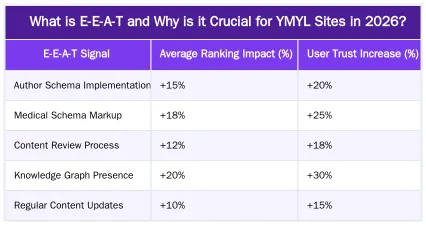
Iteration involves analyzing these metrics to refine strategies. If author schema is implemented but CTR remains low, the author bio might need enhancement. If rankings for a specific medical condition are stagnant, the content may require further expert review or updated sources. This continuous feedback loop is essential for maintaining and improving E-E-A-T in a dynamic search environment.
The Benefits of a Robust E-E-A-T Strategy for YMYL Sites
Investing in a robust E-E-A-T strategy, particularly through automated content workflows, yields significant benefits for YMYL sites in 2026. These advantages extend beyond search rankings to encompass user trust, brand reputation, and long-term algorithmic resilience.
Firstly, improved search visibility is a direct outcome. Google’s algorithms are designed to surface the most credible and trustworthy information for YMYL queries. Sites demonstrating strong E-E-A-T are more likely to rank higher, capture featured snippets, and appear in prominent search results. This leads to increased organic traffic and a greater reach for critical information.
Secondly, enhanced user trust is a fundamental benefit. When users perceive a site as authoritative and trustworthy, they are more likely to engage with its content, follow its advice, and return for future information. For YMYL topics, this trust is paramount, as it directly influences user decisions regarding health, finance, or legal matters. A transparent display of E-E-A-T signals builds confidence and fosters a loyal audience.
Thirdly, a strong E-E-A-T foundation provides algorithmic resilience. As Google continually refines its ranking factors, sites with deeply embedded trust signals are better positioned to withstand updates. They are less susceptible to volatility because their core value proposition—credible, expert-backed information—aligns directly with Google’s mission to provide high-quality results. This long-term stability is invaluable for YMYL sites operating in sensitive niches.
Finally, a comprehensive E-E-A-T strategy contributes to overall brand reputation. Being recognized as a leading authority in a YMYL field attracts partnerships, media mentions, and professional recognition. This positive feedback loop further reinforces authoritativeness and trustworthiness, creating a virtuous cycle of growth and influence. The strategic implementation of E-E-A-T for YMYL in 2026 is a cornerstone of sustainable digital success.
Implementing E-E-A-T Automation with Ruxi Data
Achieving comprehensive E-E-A-T automation for YMYL sites requires specialized tools capable of handling complex data and evolving guidelines. Ruxi Data offers a robust SaaS solution designed to streamline these critical processes. Our platform integrates advanced schema generation, author profile management, and content verification into a cohesive workflow. This allows YMYL organizations to systematically embed and signal E-E-A-T across their digital properties, ensuring compliance and maximizing search visibility. By leveraging Ruxi Data, you can transform your content strategy from manual efforts to an efficient, scalable system that builds and maintains trust with both users and search engines. Discover how to enhance your site’s credibility and performance. Learn more about Ruxi Data’s E-E-A-T automation solutions.
Conclusion
Building E-E-A-T trust for YMYL sites is a continuous and evolving imperative, especially in 2026. Automated content workflows provide the necessary efficiency and precision to meet Google’s stringent quality standards and user expectations. By systematically implementing advanced schema, managing author authority, and leveraging AI for content verification, YMYL sites can significantly enhance their credibility. This proactive approach ensures not only improved search rankings but also fosters deeper user trust and long-term algorithmic resilience. Embrace the future of E-E-A-T with automated solutions to secure your site’s authority and impact.
Frequently Asked Questions
What does E-E-A-T stand for and why is it vital for YMYL sites?
E-E-A-T stands for Experience, Expertise, Authoritativeness, and Trustworthiness. For Your Money or Your Life (YMYL) sites, such as those in health or finance, E-E-A-T is critical because inaccurate information can significantly harm users. Google prioritizes content from highly credible sources in these sensitive areas to ensure user safety and provide reliable information.
How can Ruxi Data facilitate eeat content automation for YMYL content?
Ruxi Data leverages advanced AI models to analyze SERP intelligence for E-E-A-T factors, generating content that aligns with expert sources. This approach streamlines the creation of relevant schema markup, explicitly signaling expertise and trust to Google. Effective eeat content automation ensures YMYL sites meet stringent quality requirements and maintain search visibility.
What specific schema markup helps build E-E-A-T for YMYL, especially with automated workflows?
Author Schema, Organization Schema, and Medical/Local Business Schema are crucial for enhancing E-E-A-T signals. These markups provide structured data about the content creator, the organization, and their credentials. Automating the generation of this schema significantly enhances trust signals for YMYL content by clearly communicating expertise to search engines.
How does topical authority contribute to E-E-A-T for YMYL sites, and how can automation support this?
Building deep topical authority demonstrates comprehensive expertise in a subject area, establishing a site as an authoritative source, which is a core component of E-E-A-T. Automated content workflows can systematically identify and fill topical gaps, ensuring exhaustive coverage and strengthening this authority. This strategic approach helps a site become a go-to resource for its niche.
Can AI-generated content meet E-E-A-T standards for YMYL through eeat content automation?
Yes, when guided by live data and expert oversight. Ruxi Data’s multi-model AI system integrates real-time SERP data and E-E-A-T guidelines, ensuring generated content is factually accurate and well-referenced. This intelligent approach to eeat content automation helps achieve high E-E-A-T standards for sensitive topics, making it a viable solution for YMYL sites.
What is the role of external citations and backlinks in E-E-A-T, and how does eeat content automation enhance their integration?
High-quality external citations to authoritative sources and backlinks from reputable websites serve as strong trust signals, validating the accuracy and authority of your content. They reinforce E-E-A-T in Google’s eyes by demonstrating external validation. Implementing these through an efficient eeat content automation strategy enhances overall site credibility and search performance by ensuring proper referencing and outreach.
Ruxi Data brings together multi-model AI, automated website crawling, live indexation checks, topical authority mapping, E-E-A-T enrichment, schema generation, and full pipeline automation — from crawl to WordPress publish to social posting — all in one platform built for agencies and freelancers who run on results.