
Multi Model AI Content: Elevating Quality & SEO Performance
In 2026, multi model ai content strategies are essential for superior SEO and content quality. This approach leverages specialized AI models, like GPT-4o, Claude 3, and Gemini 1.5 Pro, for distinct tasks within agentic workflows, moving beyond the limitations of single-model generation. By orchestrating multiple models, content achieves enhanced natural language processing, greater factual accuracy, and creative depth. This methodology ensures content is more authoritative and engaging, driving higher search engine rankings and meeting sophisticated audience demands.
This article provides a factual analysis of AI model comparison and content generation workflows. It details the strategic selection of models, cost-benefit considerations, and practical implementation for achieving high-quality AI content.
To explore your options, contact us to schedule your consultation.
In 2026, the landscape of AI-powered content generation has evolved, with a multi model ai content approach emerging as the definitive strategy for superior SEO performance. This article will explore why combining specialized AI models outranks single-model content, detailing the benefits, practical implementation, and how this advanced methodology delivers enhanced quality and efficiency. Understanding this shift is crucial for content creators and marketers aiming to maintain a competitive edge and achieve higher search engine rankings.
What is a Multi-Model AI Approach for Content Creation?
A multi-model AI approach for content creation involves leveraging several distinct large language models (LLMs) and specialized AI tools, each chosen for its particular strengths, to complete different stages or aspects of content generation. Instead of relying on a single, general-purpose AI, this strategy orchestrates multiple models to perform tasks where they excel, resulting in a more refined and effective final output. This methodology acknowledges that no single AI model is optimal for every content task.
Beyond Single-Model Limitations: The Need for Specialization
Relying on a single AI model for all content tasks often leads to generic outputs, a lack of nuance, and inconsistent quality across diverse content types. A single model, while versatile, may struggle with deep data analysis, highly creative prose, or precise structural outlining simultaneously. This “one size fits all” limitation means content might lack the depth, originality, or factual accuracy required to rank highly in 2026. Specialized models, however, can address these specific weaknesses, contributing to a more robust and authoritative content piece.
Beyond the Hype: How Multi-Model AI Elevates Content Quality
A multi-model strategy significantly enhances content quality by combining the unique capabilities of various AI models. This synergy allows for superior natural language processing, more comprehensive research, greater creative expression, and robust logical structuring. The result is content that is more human-like, authoritative, and engaging, capable of meeting the sophisticated demands of modern search engines and discerning audiences. By distributing tasks, each model can operate within its optimal performance zone.
Specialized Strengths: Matching Models to Content Tasks
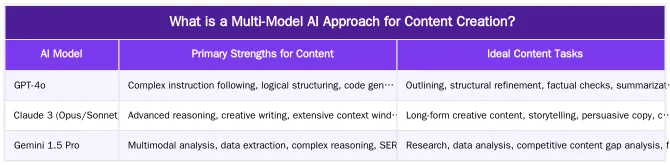
Different AI models possess distinct strengths that can be strategically applied to content tasks. For instance, models like Google’s Gemini 1.5 Pro excel at data analysis, complex reasoning, and deconstructing search engine results pages (SERPs) to identify key entities and user intent. Anthropic’s Claude 3 family, known for its extensive context window and nuanced understanding, is adept at creative long-form writing, generating compelling narratives, and maintaining a consistent tone. OpenAI’s GPT-4o, with its strong general knowledge and instruction following, is often utilized for structural outlining, ensuring logical coherence, and refining initial drafts. This deliberate matching of model to task ensures each component of the content benefits from specialized expertise.
Agentic Workflows: Orchestrating AI Models for Superior Content Generation
Agentic workflows represent a sophisticated evolution in AI content generation, moving beyond simple prompt-response interactions. In this paradigm, a central orchestrator, often another AI or a human-designed system, assigns specific roles and tasks to different AI models. For example, one AI agent might be tasked with initial research and data extraction using Gemini 1.5 Pro, feeding its findings to another agent using Claude 3 for drafting creative sections. A third agent, powered by GPT-4o, could then refine the structure, check for factual consistency, and optimize for readability. This iterative, multi-step process mimics a team of human experts collaborating on a project, ensuring each stage benefits from specialized AI capabilities. This approach is detailed further in resources like Multi-Model AI SEO Workflow.
These workflows can incorporate feedback loops, where an editing agent reviews the output of a drafting agent and requests revisions, leading to continuous improvement. This level of orchestration significantly reduces manual intervention while elevating the quality and complexity of the generated content. The ability to break down a large content task into smaller, manageable sub-tasks for specialized AI agents is a hallmark of effective agentic design, leading to more coherent and high-performing content.
Strategic Model Selection: GPT-4o, Claude 3, and Gemini 1.5 Pro in Action
Choosing the right AI model for a specific task is fundamental to a successful multi-model strategy. Each leading model in 2026 offers distinct advantages. GPT-4o excels at complex instruction following, code generation, and maintaining structural integrity in long-form content. Claude 3 models, particularly Opus, are renowned for their advanced reasoning, creative writing capabilities, and handling extensive context windows, making them ideal for nuanced storytelling or deep dives into complex topics. Gemini 1.5 Pro stands out for its multimodal capabilities, excelling at processing and analyzing vast amounts of data, including video and audio, and performing sophisticated data extraction from web pages for competitive analysis. Understanding these nuances allows for precise task allocation.
For instance, when developing an authoritative article, Gemini 1.5 Pro might first analyze competitor content and identify key data points. Claude 3 could then draft the main body, focusing on engaging prose and creative explanations. Finally, GPT-4o could review the entire piece, ensuring logical flow, optimizing for target keywords, and refining the introduction and conclusion. This layered approach ensures that the content benefits from the best features of each model. For further insights into model capabilities, resources like Wikipedia’s entry on Large Language Models provide a comprehensive overview.
Optimizing for SEO: How Multi-Model AI Drives Higher Rankings
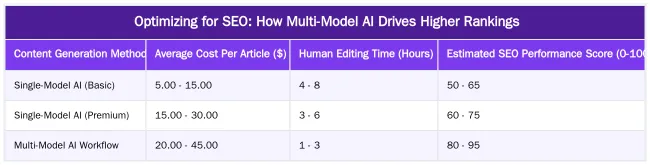
The superior quality generated by a multi-AI approach directly translates into enhanced SEO performance. Search engines prioritize content that is comprehensive, authoritative, and highly relevant to user intent. By leveraging models specialized in research, data analysis, and natural language generation, content can achieve greater depth and accuracy. This leads to higher engagement metrics, such as longer dwell times and lower bounce rates, which are strong signals to search algorithms. Furthermore, the ability to generate nuanced, entity-rich content helps in covering a broader semantic field, improving topical authority.
An integrated AI content generation strategy allows for the creation of content that not only answers specific queries but also anticipates related user needs, fostering a more complete and satisfying user experience. This holistic approach to content creation, where different AI models contribute their best to various SEO elements—from keyword research and content structure to readability and factual accuracy—is critical for outranking single-model outputs. For more on scaling content with AI, refer to Scaling Content Production with AI Workflows.
Cost-Benefit Analysis of Multi-Model AI Content Workflows
Implementing a multi model ai content strategy involves a careful cost-benefit analysis. While using multiple APIs might seem more expensive upfront, the gains in quality, efficiency, and ultimately, SEO performance, often justify the investment. The cost per token varies between models, and strategic allocation ensures that the most expensive models are used only for tasks where their unique capabilities are indispensable. For example, using a cheaper, faster model for initial brainstorming and a premium model for final refinement can optimize costs. Furthermore, the reduction in human editing time due to higher initial AI quality represents significant savings.
API latency and integration challenges are practical considerations. Orchestrating multiple models requires robust integration frameworks to manage sequential or parallel API calls efficiently. While latency can add to overall generation time, the ability to parallelize certain tasks or use faster models for initial steps can mitigate this. The long-term benefits of higher organic traffic, improved conversion rates, and reduced content decay often outweigh these operational costs. A well-designed multi-model system can achieve a higher return on investment (ROI) compared to single-model reliance, which may produce lower-quality content requiring extensive human intervention.
Practical Implementation: Best Practices for Adopting a Multi-Model Strategy
Adopting a multi-model strategy requires careful planning and execution. Start by clearly defining your content objectives and identifying the specific tasks involved in your content generation workflow. Map these tasks to the strengths of available AI models (e.g., Gemini for data, Claude for creativity, GPT-4o for structure). Develop robust agentic workflows that automate the handoff between models, ensuring seamless integration and data flow. Monitoring API usage and costs is essential to optimize resource allocation and prevent unexpected expenses.
Regularly evaluate the performance of your multi-model system. A/B test different model combinations and workflow configurations to identify the most effective setups for various content types. Invest in tools or platforms that facilitate multi-model orchestration and provide analytics on output quality and efficiency. Continuous refinement based on performance data and evolving AI capabilities will ensure your strategy remains competitive. For insights into leveraging SERP data with AI, explore AI Content at Scale with SERP Data.
Consider starting with a pilot project, focusing on a specific content type or niche, to refine your workflows before scaling. Training your team on the nuances of prompt engineering for different models and understanding their respective limitations is also crucial for maximizing output quality and minimizing errors. This iterative approach allows for gradual adoption and optimization.
Conclusion
In 2026, the shift towards a multi-model AI approach for content generation is not merely an advantage but a necessity for achieving superior SEO outcomes. By strategically combining the specialized strengths of models like GPT-4o, Claude 3, and Gemini 1.5 Pro within intelligent agentic workflows, businesses can produce content that is more accurate, creative, and engaging than single-model alternatives. This advanced methodology drives higher rankings, improves user engagement, and delivers a significant competitive edge. Embrace the future of AI content to elevate your digital presence. Discover how to implement these advanced strategies and optimize your content workflows by visiting abdurrahmansimsek.com.
Frequently Asked Questions
What is the core advantage of a multi-model AI content system?
The core advantage of a multi-model AI content system is leveraging the specialized strengths of different AI models for specific tasks. This allows for superior data analysis, nuanced creative writing, and robust structural logic, producing content that significantly outperforms output from any single model. This strategic combination ensures optimal quality and relevance.
How does a multi-model approach improve SEO performance?
A multi-model approach significantly enhances SEO performance by generating more comprehensive, accurate, and semantically rich content that precisely aligns with search intent. By strategically deploying various models for analysis, writing, and structuring, the resulting articles are more authoritative and better recognized by search engine algorithms. This leads to higher rankings and increased organic visibility.
Does using multiple AI models increase the cost of content generation?
Not necessarily. A well-designed multi-model AI content workflow intelligently routes tasks to the most cost-effective model capable of performing them efficiently. Less complex tasks can be handled by smaller, faster models, while more powerful models are reserved for critical generation steps, optimizing overall expenditure. This ensures high-quality output without unnecessary cost escalation.
Can I choose which AI model to use for my content?
Yes, platforms supporting a multi-model approach typically offer extensive customization. Users can select preferred models for entire workflows or design sophisticated agentic workflows, assigning specific models like GPT-4o, Claude, or Gemini to distinct stages of the content creation process. This flexibility ensures tailored content generation.
How does Ruxi Data keep up with the latest AI models?
Ruxi Data maintains a model-agnostic approach, continuously integrating the latest and most powerful large language models as they become available. This commitment ensures users always have access to state-of-the-art technology for their multi model ai content strategies. It eliminates the need for users to rebuild their workflows to leverage new advancements.
Why is a multi-model AI approach considered superior to single-model content in 2026?
A multi-model AI approach is superior because it overcomes the limitations of single models by combining specialized strengths. While one model might excel at data analysis, another might be better for creative writing or structural coherence. This synergistic combination results in content that is more accurate, comprehensive, and engaging, aligning better with complex search intent and user needs in the evolving digital landscape.
Ruxi Data brings together multi-model AI, automated website crawling, live indexation checks, topical authority mapping, E-E-A-T enrichment, schema generation, and full pipeline automation — from crawl to WordPress publish to social posting — all in one platform built for agencies and freelancers who run on results.