
Topic Cluster Model: Achieve Topical Authority and SEO Growth
The topic cluster model is a data-driven SEO strategy that organizes website content around broad subjects, moving beyond individual keywords to build comprehensive topical authority. This framework involves a central pillar page supported by interconnected cluster content, signaling deep expertise to search engines. Implementing a topic cluster model enhances semantic SEO, improves internal linking, and boosts E-E-A-T, leading to higher rankings and increased organic traffic. Readers will learn a practical, step-by-step guide for building and measuring topic clusters, leveraging a hub-and-spoke approach for sustained digital growth. This strategy is crucial for modern search engine algorithms prioritizing topical relevance.
This article provides a data-driven framework for implementing the topic cluster model, drawing on best practices for modern SEO. It emphasizes practical steps to achieve topical authority, aligning with the expertise in digital strategy and content optimization offered by abdurrahmansimsek.com.
To explore your options, contact us to schedule your consultation.
The topic cluster model has revolutionized how SEO professionals approach content strategy, moving beyond individual keywords to build comprehensive topical authority. This data-driven framework organizes content around a central pillar page, supported by interconnected cluster content, signaling deep expertise to search engines. This guide will explore what a topic cluster model is, its profound impact on search engine rankings and E-E-A-T, and provide a practical, data-driven framework for its successful implementation in 2026.
What is a Topic Cluster Model and Why is it Essential for Modern SEO?
A topic cluster model is an advanced SEO content strategy that organizes a website’s content around broad subject areas rather than individual keywords. It consists of a central, comprehensive “pillar page” that broadly covers a core topic, supported by multiple “cluster pages” that delve into specific subtopics in detail. These pages are interconnected through a robust internal linking structure, signaling to search engines the site’s comprehensive authority on the overarching subject.
This model is essential for modern SEO because it aligns with how search engines like Google now understand and rank content. Instead of just matching keywords, algorithms prioritize topical relevance and expertise. By demonstrating deep knowledge across an entire subject, a topic cluster model significantly enhances a website’s E-E-A-T (Experience, Expertise, Authoritativeness, Trustworthiness), leading to improved rankings, increased organic traffic, and better user engagement. It moves beyond keyword stuffing to create a valuable, interconnected knowledge base.
How Topic Clusters Drive SEO Success: The Hub-and-Spoke Approach
The topic cluster model operates on a “hub-and-spoke” principle, where the pillar page acts as the central hub, and the cluster content serves as the spokes. Each spoke (cluster page) explores a specific aspect of the hub topic in depth, linking back to the pillar page. Conversely, the pillar page links out to all supporting cluster pages. This systematic interlinking creates a strong content silo, making it easier for search engine crawlers to understand the semantic relationships between your content pieces.
This structure significantly improves semantic SEO by clearly defining the topical scope of your website. When Google’s algorithms encounter this interconnected web of content, they recognize the site as a comprehensive resource for the entire subject, not just isolated keywords. This deep topical relevance directly impacts E-E-A-T, as it signals to search engines that your site possesses extensive knowledge and authority. Furthermore, the enhanced internal linking distributes link equity more effectively, boosting the ranking potential of both pillar and cluster pages, and improving user experience by guiding visitors through related content.
Pillar Pages vs. Cluster Content: Understanding the Synergy
Understanding the distinct roles of pillar pages and cluster content is fundamental to a successful topic cluster model. While both are crucial, they serve different purposes and work in synergy to establish topical authority.
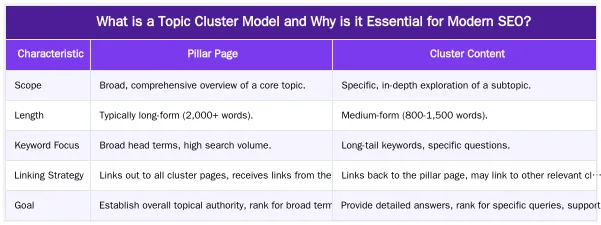
The synergy lies in their mutual support: the pillar page provides the foundational knowledge, while cluster pages offer granular detail, reinforcing the pillar’s authority. For a deeper dive into pillar page strategy, explore our guide on Pillar Page SEO Strategy.
Building Your Topic Cluster: A Practical Step-by-Step Guide
Implementing a topic cluster model requires a structured, data-driven approach. This guide outlines the essential steps to build effective content clusters that drive SEO success. The process begins with thorough research and extends through strategic content creation and linking.
Identifying Core Topics and Subtopics Through Keyword Clustering
The foundation of any successful topic cluster is identifying relevant core topics and their supporting subtopics. Start by brainstorming broad themes central to your business or niche. Then, use advanced keyword research tools to uncover related keywords, phrases, and user questions. The key here is keyword clustering: grouping semantically related keywords together. Tools can help identify search queries that share user intent, allowing you to map them to potential pillar pages or cluster content. SERP analysis is crucial at this stage to understand the existing content landscape and identify opportunities for comprehensive coverage. This data-driven approach ensures your clusters address actual user needs and search intent. For more detailed guidance, see our article on Building Topic Clusters.
Crafting an Effective Internal Linking Strategy for Topical Relevance
Internal linking is the backbone of the topic cluster model. Every cluster page must link back to its central pillar page, and the pillar page must link out to all its supporting cluster pages. This creates a clear, navigable structure for both users and search engine bots. When implementing internal links, focus on using descriptive and relevant anchor text that accurately reflects the content of the linked page. Avoid generic phrases like “click here.” This strategic linking strengthens your content silos, ensuring that link equity flows effectively throughout the cluster and reinforces the topical relevance of your pillar page. A well-executed internal linking strategy is paramount for signaling comprehensive authority to search engines. Learn more about creating robust content silos with our Content Silo Architecture Guide.
Leveraging AI for Topic Cluster Automation: The Ruxi Data Advantage
In 2026, the manual process of building topic clusters can be significantly enhanced and streamlined through artificial intelligence. AI platforms are transforming how SEO professionals approach content strategy, offering unprecedented efficiency and accuracy. These tools automate the laborious tasks of keyword research, SERP analysis, and content mapping, allowing strategists to focus on content quality and strategic oversight. The integration of AI into the topic cluster model workflow is a game-changer for achieving topical authority at scale.
Platforms like Ruxi Data exemplify this advancement. By leveraging sophisticated algorithms, Ruxi Data can analyze vast amounts of search data, identify emerging trends, and pinpoint precise content gaps that human analysis might miss. This capability ensures that your topic clusters are not only comprehensive but also highly optimized for current search engine demands. Such tools are becoming indispensable for businesses aiming to establish and maintain a competitive edge in complex digital landscapes. For further reading on AI’s role in content strategy, consider resources from industry leaders like Search Engine Journal.
Automating Content Gap Analysis and Cluster Generation
One of the most powerful applications of AI in SEO is its ability to automate content gap analysis. Ruxi Data, for instance, can scan live SERP data for a given topic, identifying all semantically related subtopics, common user questions, and competitor content. This comprehensive analysis reveals exactly where your existing content falls short and what new cluster pages are needed to achieve complete topical coverage. The platform then goes a step further by suggesting optimal pillar and cluster structures, effectively providing a blueprint for your topic cluster model. This automation drastically reduces the time and effort traditionally required, ensuring that your content strategy is always data-driven and aligned with user intent. It transforms the complex task of building extensive knowledge graphs into an efficient, repeatable process. Explore the full workflow of this strategy at Topic Cluster Strategy Workflow.
Measuring the ROI of Your Topic Cluster Strategy: Key Metrics and Expectations
Measuring the return on investment (ROI) for a topic cluster model is crucial for demonstrating its value and refining your content strategy. Unlike individual keyword tracking, ROI for clusters involves a holistic view of performance across interconnected content. Key performance indicators (KPIs) extend beyond simple rankings to encompass broader engagement and conversion metrics.
Expect to see gradual but significant improvements in organic traffic to both pillar and cluster pages as topical authority builds. Keyword ranking improvements will often manifest first for long-tail keywords within cluster content, eventually lifting the pillar page for broader head terms. Increased user engagement, such as higher dwell time and reduced bounce rates, indicates that users are finding comprehensive answers within your content ecosystem. Ultimately, the goal is an uplift in conversion rates, as more qualified traffic discovers your offerings through well-structured, authoritative content. While results vary, a well-executed strategy can yield substantial gains over 6-12 months.
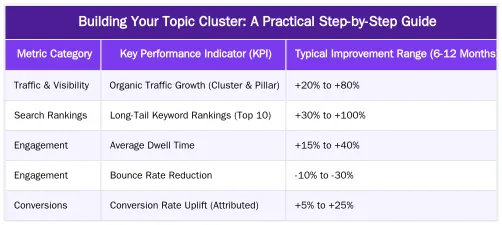
Tracking these metrics consistently provides clear insights into the effectiveness of your content efforts and helps justify further investment in your content strategy. For more on SEO analytics, refer to trusted sources like Moz’s guide on SEO metrics.
Conclusion
The topic cluster model represents a paradigm shift in SEO, moving from keyword-centric tactics to a holistic, topic-based content strategy. By focusing on comprehensive coverage and semantic relationships, this model significantly enhances a website’s E-E-A-T, improves internal linking, and provides a superior user experience. Implementing a data-driven framework, leveraging AI for automation, and diligently measuring ROI are key to its success. As search engines continue to prioritize topical authority, adopting this model is not just beneficial but essential for long-term organic growth. Begin your journey to establishing unparalleled topical authority and elevate your digital presence by visiting abdurrahmansimsek.com.
Frequently Asked Questions
What is a topic cluster model and why is it essential for modern SEO?
A topic cluster model is an advanced SEO content strategy that organizes content around a central pillar page, supported by interconnected cluster content. This framework signals deep expertise to search engines, moving beyond individual keywords to build comprehensive topical authority. It’s essential for modern SEO because it aligns with how search engines understand user intent and evaluate E-E-A-T.
How does the Ruxi Data platform automate the creation of a topic cluster model?
Ruxi Data analyzes live SERP data for your primary keyword to identify all semantically related subtopics and user questions. It then generates a complete pillar and cluster content structure, including titles and headings, providing a data-driven blueprint for establishing topical authority. This automation significantly streamlines the process of implementing a robust topic cluster model.
What is the ideal number of cluster pages for one pillar page in a topic cluster model?
Data suggests a range of 8 to 22 cluster pages provides comprehensive coverage for a given topic within a topic cluster model. The exact number depends on the breadth and depth of the subject matter. This range ensures you cover the topic in sufficient detail to be seen as an authority by Google.
How should I internally link between my pillar and cluster pages?
Every cluster page must link up to the central pillar page using contextually relevant anchor text. The pillar page should, in turn, link out to each of the individual cluster pages. This creates a semantically connected and organized site architecture, crucial for the success of a topic cluster model.
Can a single piece of content belong to more than one topic cluster?
While a piece of content should have one primary cluster it belongs to, it can be contextually linked from other relevant clusters. However, its core focus and primary internal links should align with its designated pillar page to maintain a clean silo structure. This ensures clarity for search engines and users within your overall content strategy.
How long does it take to see results from implementing a topic cluster model?
Initial ranking improvements can be seen within 3-4 months as Google crawls and understands the new semantic structure created by your topic cluster model. Significant gains in organic traffic and authority typically materialize within 6-9 months. The exact timeline depends on factors like domain authority, content quality, and competitive landscape.
Ruxi Data brings together multi-model AI, automated website crawling, live indexation checks, topical authority mapping, E-E-A-T enrichment, schema generation, and full pipeline automation — from crawl to WordPress publish to social posting — all in one platform built for agencies and freelancers who run on results.