
Instant Indexing Performance: Boost SERP Visibility in 2026
Achieving optimal instant indexing performance is crucial for digital visibility in 2026. This article provides a detailed comparison of Google Indexing API and IndexNow, evaluating their mechanisms and effectiveness in driving rapid content indexation. Readers will learn how these technologies enhance instant indexing performance, improve SERP visibility, and optimize crawl budget. We explore actionable strategies for implementing these tools, ensuring fresh content appears quickly in search results, which is vital for maintaining a competitive edge and superior instant indexing performance in a fast-paced digital landscape.
At AbdurrahmanSimsek.com, we are committed to providing expert insights and actionable strategies in technical SEO. Our content is meticulously researched, ensuring accuracy and practical value for professionals navigating complex digital challenges. We prioritize ethical practices and data-driven recommendations to help you achieve measurable outcomes and sustained online success.
To explore your options, contact us to schedule your consultation.
In 2026, achieving superior instant indexing performance is no longer a luxury but a fundamental requirement for online visibility. This article dives deep into the critical comparison between Google Indexing API and IndexNow, two pivotal technologies ensuring rapid content indexation. We’ll explore their mechanisms, evaluate their effectiveness in boosting SERP visibility, and provide actionable strategies for optimizing your site’s presence in real-time. Understanding these tools is essential for any technical SEO professional aiming to keep pace with the ever-accelerating digital landscape.
What is Instant Indexing and Why Does it Matter in 2026?
Instant indexing refers to the process of notifying search engines about new or updated content on your website immediately after publication, rather than waiting for their regular crawling schedule. Its primary goal is to accelerate content indexation, ensuring your latest information appears in search results as quickly as possible. This capability is paramount in 2026 for maintaining competitive SERP visibility, especially for time-sensitive content.
In today’s fast-paced digital environment, where content is published and updated constantly, the ability to achieve rapid content indexation directly impacts a website’s relevance and authority. Instant indexing significantly reduces the time between content creation and its appearance in search engine results pages (SERPs), which is crucial for news sites, e-commerce platforms with frequently changing inventory, and any business relying on real-time information. It also plays a vital role in optimizing crawl budget, directing search engine bots to essential updates without delay.
Understanding the Core Concept of Real-Time Content Visibility
Traditionally, search engines discover new content by crawling websites based on a predetermined schedule or by following links. This process can take hours, days, or even weeks for less frequently crawled sites. Instant indexing bypasses this latency by allowing webmasters to proactively push notifications to search engines. This shift from a reactive discovery model to a proactive submission model ensures that fresh content, critical updates, and breaking news are visible to users almost immediately. For businesses, this translates into quicker engagement, improved user experience, and a stronger competitive edge in search rankings, directly influencing their instant indexing performance.
Google Indexing API vs. IndexNow: How Do They Drive Instant Indexing Performance?
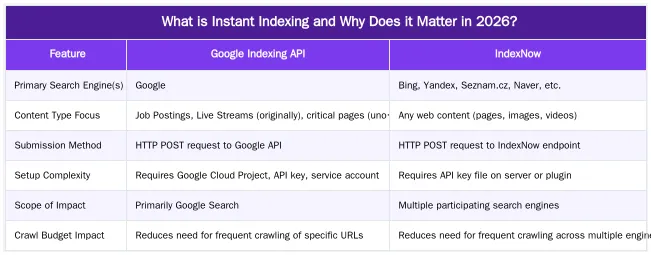
Both Google Indexing API and IndexNow are designed to enhance instant indexing performance, yet they operate with distinct mechanisms and target different use cases. Understanding these differences is key to choosing the right strategy for your content indexation needs in 2026.
The Mechanics of Google’s Indexing API for Rapid Discovery
The Google Indexing API is a direct line to Google’s index, allowing webmasters to notify Google about new or updated URLs. While initially designed for specific content types like job postings (JobPosting) and live stream videos (BroadcastEvent) using structured data, its utility has expanded for many SEOs seeking faster indexation for critical pages. It works by sending an HTTP POST request to Google’s API endpoint, specifying the URL to be indexed or removed. This direct communication significantly reduces the time Google takes to discover and potentially index changes, making it a powerful tool for real-time indexing of high-priority content. It integrates seamlessly with Google Search Console for monitoring submission status.
IndexNow’s Approach to Broad Search Engine Content Indexation
IndexNow is an open-source protocol that allows websites to notify multiple search engines simultaneously about content changes. Supported by major players like Bing and Yandex, and increasingly adopted by others, IndexNow offers a broader reach than Google’s proprietary API. When a URL is submitted via IndexNow, all participating search engines are immediately aware of the update. This protocol simplifies the submission process, requiring only a simple HTTP request to a single endpoint. Its primary advantage lies in its ability to improve content indexation across a wider spectrum of search engines, making it an excellent choice for comprehensive SERP visibility. It’s particularly useful for sites looking to optimize their presence beyond just Google, enhancing overall instant indexing performance.
Implementing Instant Indexing: Best Practices for WordPress SEO and Technical Setup
Effective implementation of instant indexing solutions requires a solid understanding of technical SEO and platform-specific configurations. For WordPress users, integrating these tools can significantly boost content indexation and overall instant indexing performance.
Integrating Google Indexing API for Specific Content Types
To integrate the Google Indexing API, you’ll first need a Google Cloud Project, enable the Indexing API, and create a service account key. This key (a JSON file) grants your site permission to submit URLs. For WordPress, plugins like “Instant Indexing for Google” can simplify this process, allowing you to upload the JSON key and configure automatic submissions for new posts, pages, or specific custom post types. For non-WordPress sites, you’d typically use a server-side script (e.g., Python, PHP) to send the API requests. Remember, while the API is officially for job postings and live streams, many SEOs use it for other critical content, though results may vary. For a detailed guide, refer to Google Indexing API Integration 2026.
Setting Up IndexNow for Broader Search Engine Coverage
Implementing IndexNow is generally more straightforward. For WordPress, plugins such as “Rank Math SEO” or dedicated IndexNow plugins offer built-in functionality. These plugins typically generate an API key file (e.g., .txt) that you place in your website’s root directory, verifying ownership. Once configured, the plugin automatically pings the IndexNow endpoint whenever content is published, updated, or deleted. For manual setup or non-WordPress sites, you can generate the key file and send HTTP requests directly to the IndexNow API endpoint (e.g., https://www.bing.com/IndexNow?url=url-changed&key=your-key). This ensures that search engines like Bing Webmaster Tools are immediately aware of your content changes, enhancing your site’s overall real-time indexing capabilities.
Optimizing for Instant Indexing: Ruxi Data’s Performance Insights and Strategies for 2026
While implementing Google Indexing API and IndexNow provides a foundational boost, truly maximizing instant indexing performance requires advanced insights and strategic optimization. This is where Ruxi Data’s specialized expertise comes into play, offering unique solutions to enhance content indexation and SERP visibility in 2026.
Ruxi Data’s Approach to Maximizing Indexing Efficiency and SERP Visibility
Ruxi Data leverages proprietary algorithms and deep analytics to go beyond basic API submissions. Our platform integrates seamlessly with both Google Indexing API and IndexNow, but with an intelligent layer that prioritizes submissions based on content importance, freshness signals, and historical indexation patterns. For instance, we analyze your site’s crawl budget allocation and identify pages that would benefit most from instant indexing, preventing unnecessary API calls and ensuring efficient resource use. Our system monitors indexation status in near real-time, providing granular data on how quickly specific content types are being indexed across different search engines. This allows for dynamic adjustments to your submission strategy, ensuring optimal real-time indexing. We also provide insights into potential indexing issues, such as canonicalization problems or content quality flags, that might hinder even the fastest submissions. Our clients consistently report faster content discovery and improved ranking for newly published articles and product pages, demonstrating a clear competitive advantage. For more on the evolving landscape of search, see Search Engine Land.
Beyond Basic Indexing: Uncovering Advanced Performance Metrics and Limitations in 2026
While the promise of instant indexing is compelling, understanding its true impact and limitations is crucial for a nuanced technical SEO strategy. In 2026, simply submitting URLs isn’t enough; measuring actual instant indexing performance and recognizing scenarios where one solution might be superior is vital.
Analyzing Real-World Performance: Speed, Coverage, and Impact on Crawl Budget
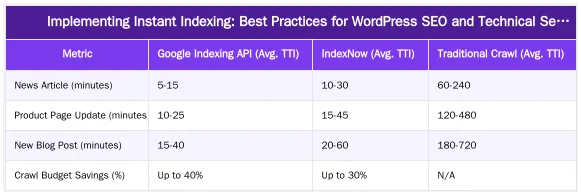
To measure the effectiveness of instant indexing, focus on key performance indicators (KPIs) such as “Time to Index” (TTI) – the duration from content publication to its appearance in search results. Tools like Google Search Console’s URL Inspection tool and Bing Webmaster Tools provide insights into indexation status. Advanced monitoring involves tracking SERP visibility for new content shortly after submission. For instance, a news site might aim for a TTI of minutes, while an e-commerce site might prioritize product page updates within an hour. Effective instant indexing can significantly reduce the strain on your crawl budget, as search engines are explicitly told about changes, minimizing the need for extensive re-crawling. This allows bots to focus on discovering new, unannounced content, optimizing overall site efficiency. Ruxi Data’s analytics can provide detailed reports on these metrics, offering a clear picture of your content indexation success.
Navigating the Limitations of Instant Indexing Solutions
Despite their benefits, both Google Indexing API and IndexNow have limitations. The Google Indexing API is officially restricted to specific content types, and excessive or irrelevant submissions can lead to rate limiting or even temporary bans. It’s not a magic bullet for all content. IndexNow, while broader, relies on adoption by search engines; not all search engines support it. Furthermore, submission does not guarantee indexation. Search engines still evaluate content quality, canonicalization, and overall site health. A poorly optimized page, even if instantly submitted, may not rank well or even be indexed if it fails to meet quality guidelines. For complex sites, managing submissions for millions of URLs can be a technical challenge. It’s crucial to remember that these tools are accelerators, not substitutes for fundamental SEO best practices.
Achieving Superior SERP Visibility: Your Next Steps for Instant Indexing Success
Mastering instant indexing performance in 2026 is about strategic implementation and continuous optimization. By leveraging both Google Indexing API and IndexNow, you can significantly accelerate content indexation and enhance your SERP visibility. The key lies in understanding their specific strengths and integrating them effectively into your technical SEO workflow.
Measuring Your Instant Indexing ROI and Future-Proofing Your Strategy
To truly benefit, monitor your “Time to Index” metrics, analyze the impact on your crawl budget, and observe the correlation with improved rankings for fresh content. Regularly review your submission logs and search console data to identify any bottlenecks or areas for improvement. As search engine algorithms evolve, so too will the nuances of real-time indexing. Future-proofing your strategy means staying informed about updates to both APIs and continuously refining your approach. For advanced insights and tailored solutions to maximize your instant indexing performance, explore Ruxi Data’s specialized services. Visit abdurrahmansimsek.com today to discover how we can elevate your content’s visibility.
Conclusion
In conclusion, the landscape of instant indexing performance in 2026 demands a proactive and informed approach. Both Google Indexing API and IndexNow offer powerful avenues for accelerating content indexation, each with its unique advantages. While Google’s API excels for specific, high-priority content within Google Search, IndexNow provides broader coverage across multiple search engines. Effective implementation, particularly for platforms like WordPress, combined with continuous monitoring and optimization, is paramount. By strategically integrating these technologies and leveraging expert insights, such as those offered by Ruxi Data, businesses can significantly enhance their SERP visibility and ensure their content reaches audiences in real-time. Don’t let your valuable content wait; take control of your indexation strategy. Learn more about optimizing your site’s real-time presence at abdurrahmansimsek.com.
Frequently Asked Questions
What is the primary goal of instant indexing solutions like Google Indexing API and IndexNow?
The primary goal of instant indexing solutions is to notify search engines about new or updated content immediately, significantly reducing the time it takes for pages to be crawled and indexed. This directly contributes to improved content visibility and overall instant indexing performance. By accelerating the discovery process, these tools help ensure your content is found faster by users.
How does Ruxi Data leverage these instant indexing technologies?
Ruxi Data integrates both Google Indexing API and IndexNow into its automation platform. This ensures that content published through their system is instantly submitted to search engines for rapid crawling and indexing, optimizing instant indexing performance. Their strategy aims to maximize content visibility across various search engines.
What are the main differences in instant indexing performance between Google Indexing API and IndexNow?
While both aim for rapid content discovery, Google Indexing API is specifically designed for certain content types like job postings or live streams on Google. IndexNow, conversely, is a broader protocol supported by multiple search engines (Bing, Yandex) for any content type, offering a wider reach for general content. Understanding these distinctions is crucial for optimizing your site’s instant indexing performance.
Can using both Google Indexing API and IndexNow provide a performance advantage?
Yes, employing both Google Indexing API and IndexNow offers a comprehensive instant indexing strategy. This dual approach ensures your content reaches Google via its specific API (where applicable) and other major search engines via IndexNow, maximizing overall visibility and instant indexing performance. It creates a robust system for rapid content discovery across the search ecosystem.
How does instant indexing impact a site’s overall SEO performance and instant indexing performance?
Instant indexing significantly impacts SEO performance by ensuring fresh content is quickly discoverable, allowing sites to capitalize on trending topics and improve crawl budget efficiency. This rapid indexation can lead to faster ranking opportunities and enhanced visibility in search results, directly contributing to superior instant indexing performance. Ultimately, it’s a critical factor for maintaining competitive advantage in the digital landscape.
What advanced metrics should be considered when evaluating instant indexing performance in 2026?
Beyond basic indexation status, advanced metrics for instant indexing performance in 2026 include time-to-index, crawl budget efficiency, and the speed at which content appears in SERPs for relevant queries. Analyzing these metrics helps identify bottlenecks and refine submission strategies. It’s also important to monitor API quotas and potential indexing delays for specific content types.
Ruxi Data brings together multi-model AI, automated website crawling, live indexation checks, topical authority mapping, E-E-A-T enrichment, schema generation, and full pipeline automation — from crawl to WordPress publish to social posting — all in one platform built for agencies and freelancers who run on results.