
Content Pruning for SEO: Optimize for AI Overviews & Authority
Content pruning for SEO is a strategic process for optimizing website performance and AI visibility by identifying and removing or consolidating underperforming content. This guide explains how content pruning for SEO enhances topical authority, improves crawl efficiency, and signals higher quality to search engines and AI models. Readers will learn to diagnose thin content, address keyword cannibalization, and implement semantic consolidation strategies to boost their chances of appearing in AI Overviews. Effective content pruning for SEO is crucial for maintaining relevance and achieving prominent search placement in the evolving digital landscape.
Leveraging abdurrahmansimsek.com’s expertise, this guide provides actionable strategies grounded in data-driven insights. We are committed to delivering high-quality, ethical SEO practices that drive measurable outcomes and enhance your digital presence. Trust our proven methodologies to navigate the complexities of content optimization effectively.
To explore your options, contact us to schedule your consultation.
In the evolving landscape of search, content pruning for SEO has become a critical strategy, especially with the rise of AI Overviews. This guide will demystify content pruning, explain its profound impact on your site’s performance and AI visibility, and provide actionable steps to optimize your content strategy. By strategically removing or consolidating underperforming pages, you can enhance topical authority, improve crawl efficiency, and signal higher quality to both search engines and advanced AI models. This approach is essential for maintaining relevance and achieving prominent placement in 2026’s search results.
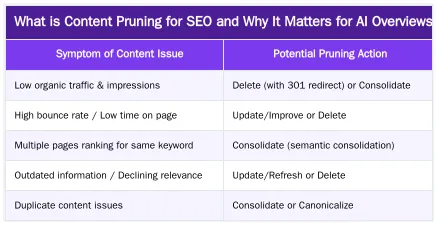
What is Content Pruning for SEO and Why It Matters for AI Overviews?
Content pruning for SEO is the strategic process of identifying and removing, updating, or consolidating outdated, low-quality, or redundant content from your website. This practice significantly improves overall site performance by enhancing content quality, relevance, and semantic clarity, which are crucial factors for visibility in AI Overviews.
What is Content Pruning in SEO?
Content pruning in SEO involves a systematic review of your website’s content inventory. The goal is to identify pages that no longer serve a purpose, attract traffic, or provide value to users. These might include old news articles, duplicate content, or pages with minimal information. By eliminating or improving such content, you streamline your site, improve crawl budget efficiency, and concentrate authority on your most valuable pages. This focused approach helps search engines understand your site’s core topics more effectively.
The Rise of AI Overviews: A New Imperative for Content Quality
With the increasing prominence of AI Overviews in search results, the demand for high-quality, relevant, and semantically clear content has never been greater. AI models, like those powering Google’s AI Overviews, prioritize authoritative and concise information that directly answers user queries. Content pruning helps present a cleaner, more authoritative site to these AI models. By removing noise and consolidating related topics, you improve your chances of having your content understood and featured as a definitive answer, directly impacting your visibility and organic traffic in 2026.
Identifying Underperforming Content: Signs You Need to Prune
The first step in effective content pruning for SEO is accurately diagnosing which content is underperforming. This diagnostic phase relies on analyzing various data points to pinpoint pages that are detrimental to your site’s overall health and search performance. Recognizing these signs early can prevent long-term SEO issues and prepare your site for AI-driven search.
Diagnosing Thin Content and Low User Engagement
Thin content refers to pages that offer little to no unique value, depth, or information to the user. These pages often have low word counts, lack comprehensive details, or are simply placeholders. You can identify thin content by reviewing page length and assessing its informational value. Simultaneously, look for signs of low user engagement using tools like Google Analytics. Metrics such as a high bounce rate, low average time on page, and low click-through rate (CTR) indicate that users are not finding what they expect or are quickly leaving the page. These signals tell search engines that the content may not be satisfying user intent.
Unmasking Keyword Cannibalization and Content Decay
Keyword cannibalization occurs when multiple pages on your site target the same or very similar keywords, causing them to compete against each other in search results. This dilutes your authority and confuses search engines about which page is most relevant. You can spot this by analyzing keyword rankings in Google Search Console, looking for instances where different URLs rank for the same query. Content decay, on the other hand, refers to content that was once valuable but has become outdated, inaccurate, or less relevant over time, leading to declining performance. Regularly auditing your content for freshness and accuracy is crucial. Google provides guidance on managing duplicate content, which often overlaps with cannibalization issues. Learn more about Google’s stance on duplicate content.
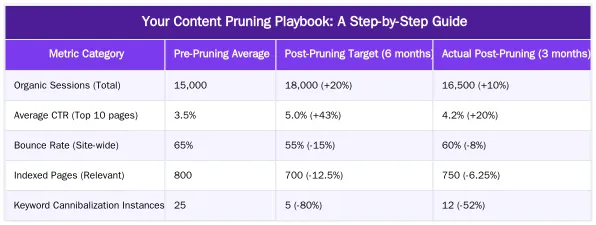
Your Content Pruning Playbook: A Step-by-Step Guide
Once you’ve identified underperforming content, the next phase involves executing a strategic content pruning for SEO plan. This requires a systematic approach, from auditing your entire content inventory to making informed decisions about each page. A well-executed pruning strategy can significantly enhance your site’s SEO performance and user experience.
Conducting a Comprehensive Content Audit
A content audit is the foundation of any successful pruning initiative. Start by creating a complete inventory of all pages on your website. Tools like Screaming Frog, Google Search Console, and Google Analytics are invaluable here. For each page, collect key metrics: organic traffic, impressions, CTR, bounce rate, time on page, backlinks, and keyword rankings. Categorize your content based on performance and potential value. This data-driven approach allows you to objectively assess which pages are assets and which are liabilities. Prioritize pages that consume crawl budget without contributing to your SEO goals.
Strategic Actions: Delete, Redirect, or Consolidate?
After auditing, you’ll categorize content into three primary action groups:
- Delete (with 410 or 301 Redirect): If a page is truly low-quality, irrelevant, or offers no value, it’s a candidate for deletion. Use a 410 (Gone) status code for content that should never return. For pages with some residual link equity or a related, valuable page, implement a 301 redirect to the most relevant existing page. This preserves any equity and guides users and search engines to better content.
- Consolidate: When you have multiple pages covering similar topics or targeting overlapping keywords (keyword cannibalization), consider consolidating them into one comprehensive, authoritative resource. This strengthens topical relevance and creates a single, powerful page that is more likely to rank well and be understood by AI Overviews. Ensure you implement 301 redirects from the consolidated pages to the new, improved one.
- Update/Improve: For content that has potential but is outdated or lacks depth, the best action is to refresh and enhance it. Add new information, improve readability, update statistics, and expand on key concepts. This breathes new life into existing assets without the need for deletion or complex redirects.
Understanding when to use a 301 redirect is crucial for maintaining SEO value. Google’s documentation on 301 redirects provides essential technical guidance.
Leveraging Data for Smarter Pruning: An Expert Approach
Effective content pruning for SEO moves beyond manual analysis to embrace sophisticated data-driven strategies. At AbdurrahmanSimsek.com, we understand that leveraging advanced analytics is key to optimizing content for both traditional search and the nuances of AI Overviews. Our approach, often powered by tools like Ruxi Data, ensures precision and efficiency in content management.
Connecting Google Search Console to Pruning Decisions
Google Search Console (GSC) is an indispensable tool for content pruning. It provides direct insights into how Google sees your site. Key metrics to analyze include:
- Impressions and Clicks: Identify pages with high impressions but low clicks, indicating a potential mismatch between title/description and content, or simply low user interest.
- Queries: Discover the actual search terms users are employing. This helps uncover keyword cannibalization where multiple pages rank for the same query.
- Index Coverage: Spot pages that are not indexed or have indexing issues, which might be candidates for removal or improvement.
- Core Web Vitals: Poor performance here can signal a need to improve content quality or technical aspects, sometimes leading to pruning decisions.
For large websites, manually sifting through GSC data can be overwhelming. This is where automated data analysis, such as that offered by Ruxi Data, becomes invaluable. It can quickly identify patterns, flag underperforming content, and suggest optimal pruning actions, saving significant time and resources.
The Power of Semantic Consolidation for Topical Authority
Semantic consolidation is a cornerstone of advanced content pruning. Instead of merely deleting pages, this strategy focuses on merging semantically related content into a single, comprehensive resource. This process strengthens your site’s topical authority by creating a definitive hub of information on a specific subject. For AI Overviews, which prioritize deep understanding and authoritative sources, semantic consolidation is particularly powerful. It signals to AI models that your site is a credible and exhaustive source for a given topic, increasing the likelihood of your content being chosen for AI-generated summaries. This aligns perfectly with our broader strategies for optimizing semantic HTML for AI Overviews, ensuring your content is not just present, but profoundly understood.
How Does Content Pruning Boost Your AI Overview Visibility?
The strategic implementation of content pruning for SEO offers significant advantages in the era of AI Overviews. By refining your content landscape, you directly enhance how AI models perceive and utilize your site’s information, leading to improved visibility and authority in search results.
Improving Topical Relevance and Authority for AI Models
AI Overviews are designed to provide concise, authoritative answers by synthesizing information from highly relevant and trustworthy sources. When you prune your content, you eliminate redundant or low-quality pages that dilute your site’s focus. This process allows your remaining, high-quality content to stand out, clearly signaling your expertise on specific topics. By consolidating fragmented information into comprehensive guides, you build stronger topical relevance and authority. AI models can then more easily identify your site as a go-to resource for specific queries, increasing the probability of your content being featured. This is a critical aspect of optimizing for AI Overviews in 2026, as AI prioritizes clarity and depth.
Enhancing User Engagement Signals and Site Quality
Content pruning indirectly boosts AI Overview visibility by improving crucial user engagement signals. When users land on high-quality, relevant pages, they are more likely to spend more time on your site, interact with content, and have a lower bounce rate. These positive user engagement signals indicate to search engines and AI models that your content is valuable and satisfying. A cleaner, more focused website also benefits from an improved crawl budget, allowing search engine bots to efficiently discover and index your most important pages. This overall enhancement in site quality and user experience contributes to a stronger E-E-A-T (Experience, Expertise, Authoritativeness, Trustworthiness) profile, a key factor for ranking well and being selected for AI Overviews. For more on the technical aspects, consider our insights on AI Overviews and technical SEO in 2026.
“In an AI-driven search landscape, content quality isn’t just about keywords; it’s about semantic clarity, topical depth, and user satisfaction. Pruning is the art of refining your digital garden to yield the most potent information.” – Abdurrahman Simsek
Measuring Success: Tracking the Impact of Your Pruning Efforts
After implementing a content pruning for SEO strategy, it’s crucial to monitor its impact. Measuring success allows you to validate your efforts, identify areas for further optimization, and demonstrate the ROI of your content strategy. This iterative process ensures continuous improvement and sustained performance in search results.
Key Metrics to Monitor Post-Pruning
To accurately assess the effectiveness of your content pruning, track the following key performance indicators (KPIs) over time:
- Organic Traffic: Look for an overall increase in organic traffic to your remaining, high-value pages. While some individual page traffic might decrease due to deletions, the aggregate site traffic should improve.
- Keyword Rankings: Monitor the ranking performance of your target keywords. You should see consolidated pages ranking higher and more consistently for their intended queries, reducing keyword cannibalization.
- Impressions and CTR: An increase in CTR for your high-performing pages indicates that your content is more relevant and appealing to users. Impressions might initially fluctuate, but overall quality impressions should rise.
- Bounce Rate and Time on Page: Improved engagement metrics on your remaining content signal that users are finding what they need and staying longer, indicating higher content quality.
- Index Coverage: Verify that your important pages are indexed and that the number of low-quality, unindexed pages has decreased.
- Crawl Budget Efficiency: While harder to directly measure, an improved crawl budget means search engines are spending more time on your valuable content.
Utilize tools like Google Analytics, Google Search Console, and third-party SEO platforms to track these metrics effectively. For deeper insights into user intent and how your content aligns with it, consider applying frameworks like those discussed in deconstructing SERP intent workflow.
Iterative Pruning: A Continuous Optimization Cycle
Content pruning is not a one-time task but an ongoing process. The digital landscape, user behavior, and AI capabilities are constantly evolving. Regular content audits, perhaps quarterly or bi-annually, are essential to maintain a healthy and high-performing website. This iterative approach allows you to adapt to new trends, address emerging content decay, and continuously refine your content strategy for optimal SEO and AI Overview visibility. By embedding pruning into your routine content management, you ensure your site remains agile and competitive.
Conclusion
In the dynamic world of SEO, particularly with the rise of AI Overviews, content pruning for SEO is no longer optional—it’s a strategic imperative. By systematically identifying, removing, and consolidating underperforming content, you not only enhance your site’s technical health and crawl budget but also significantly boost its topical authority and relevance for AI models. This leads to improved user engagement, higher rankings, and increased visibility in 2026’s search landscape. Embrace content pruning as a continuous optimization cycle to ensure your digital presence remains robust, authoritative, and perfectly aligned with the demands of modern search. Ready to transform your content strategy and dominate AI Overviews? Visit AbdurrahmanSimsek.com to explore our expert solutions.
Frequently Asked Questions
How does Ruxi Data help with content pruning for SEO?
Ruxi Data connects to your Google Search Console to identify pages with low impressions, low CTR, and high keyword cannibalization. It flags this underperforming or redundant content, providing a data-driven basis for your content pruning for SEO decisions. This ensures you focus your efforts on content that truly needs attention, optimizing your site’s overall performance.
Why is content pruning for SEO important for Google’s AI Overviews?
AI Overviews synthesize information from clear, authoritative sources. By engaging in content pruning for SEO, you clarify to Google which page is the definitive source on a given topic, increasing its likelihood of being used as a citation in an AI-generated answer. This strategy enhances your site’s topical authority and relevance in the eyes of advanced AI models.
Can the platform suggest which pages to consolidate during content pruning?
Yes, our AI analyzes your content for semantic overlap. When it finds multiple pages competing for the same search intent, it will recommend consolidating them into a single, more comprehensive article. This process is a key part of effective content pruning for SEO, and the platform provides a list of 301 redirect mappings to preserve link equity.
What are the main benefits of performing content pruning for SEO?
The main benefits of performing content pruning for SEO include enhanced topical authority, improved crawl efficiency for search engines, and a clearer signal of quality to Google. By removing or consolidating weak content, you streamline your site, making it more relevant and authoritative for both users and AI Overviews.
What’s the biggest risk associated with content pruning?
The biggest risk with content pruning is inadvertently deleting a page that still holds value, such as strong backlinks or niche traffic. Ruxi Data mitigates this by integrating backlink data and traffic metrics into its recommendations. This ensures you make informed decisions, protecting your site’s existing SEO value while performing content pruning.
Does Ruxi Data help with the content update process after content pruning?
Yes. After identifying a page to keep and improve through content pruning, Ruxi Data can perform a new SERP analysis for its target keyword. It then provides recommendations for updating the content to be more comprehensive and authoritative, incorporating insights from the pages you’ve consolidated. This ensures your revitalized content is optimized for current search demands.
Ruxi Data brings together multi-model AI, automated website crawling, live indexation checks, topical authority mapping, E-E-A-T enrichment, schema generation, and full pipeline automation — from crawl to WordPress publish to social posting — all in one platform built for agencies and freelancers who run on results.