
Internal Linking Engine: Automating Link Equity for Scalable SEO
An internal linking engine is a sophisticated software solution designed to automate link equity distribution and establish topical authority at scale. This article details how Ruxi Data’s advanced internal linking engine leverages AI and machine learning to analyze content, identify semantic relationships, and automatically insert strategic internal links. It intelligently fixes orphan pages, reinforces content silos, and optimizes site architecture, ensuring valuable link equity flows efficiently throughout your website. Readers will learn how this automated approach transforms internal link strategy, driving scalable SEO growth and improving search engine visibility far beyond manual methods.
Abdurrahman Simsek is committed to delivering cutting-edge SEO solutions that prioritize accuracy, ethical practices, and measurable results. Our content reflects a deep understanding of advanced SEO strategies, ensuring that businesses can confidently implement robust solutions for sustainable digital growth and superior online performance.
To explore your options, contact us to schedule your consultation.
An internal linking engine is the ultimate solution for automating link equity distribution and establishing topical authority, especially for websites managing content at scale. In the competitive landscape of SEO in 2026, manually creating a strategic internal link strategy is no longer feasible; it’s time-consuming, prone to error, and fails to adapt to growing content libraries. This article explores how Ruxi Data’s advanced engine automates this critical process, intelligently fixing orphan pages, reinforcing content silos, and transforming your site’s SEO performance with unparalleled efficiency.
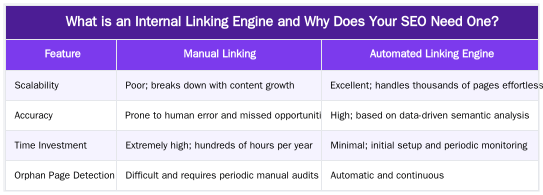
What is an Internal Linking Engine and Why Does Your SEO Need One?
An internal linking engine is a sophisticated software tool that automates the process of creating and managing links between pages on the same website. Its core function is to analyze your content, identify relevant linking opportunities based on semantic context, and insert these links automatically, ensuring a logical and powerful site architecture that search engines can easily understand.
The Core Problem: Manual Linking’s Limitations
For any site with more than a few dozen pages, manual internal linking becomes a significant bottleneck. SEO managers spend countless hours searching for relevant anchor text and linking opportunities, a process that is not only tedious but also highly susceptible to human error. As new content is published, old pages can become isolated, creating orphan pages that are invisible to both users and search engine crawlers. This manual approach simply cannot scale effectively.
Beyond Basic Links: Understanding Link Equity Distribution
Link equity, often called “link juice,” is a search engine ranking factor based on the idea that certain links pass value and authority from one page to another. Your most authoritative pages (like your homepage) have the most link equity. A strategic internal link strategy ensures this value flows throughout your site, boosting the authority of important subpages and signaling their relevance to search engines. Without proper distribution, valuable equity is wasted, and key pages may fail to rank.
How Does Ruxi Data’s Engine Automate Link Equity Distribution?
Ruxi Data’s platform moves beyond simple keyword matching. Our internal linking engine uses advanced AI and machine learning models to understand the context and intent behind your content. It functions as an intelligent layer on top of your website, making data-driven decisions to build a powerful, interconnected site structure that drives organic growth.
AI-Powered Content Analysis and Semantic Relationships
At its core, our engine ingests and analyzes every piece of content on your site. It uses Natural Language Processing (NLP) to identify key entities, topics, and the semantic relationships between different pages. Instead of just looking for an exact keyword, it understands that a page about “email marketing metrics” is highly relevant to a page about “customer lifetime value.” This deep understanding allows it to create links that are genuinely useful for users and highly valuable for SEO, all while optimizing your automated internal linking workflow and preserving your crawl budget.
Identifying and Fixing Orphan Pages & Content Silos
Orphan pages are a silent killer of SEO performance. Our internal linking engine systematically scans your site to identify any page with zero internal links pointing to it. It then intelligently finds relevant contextual opportunities to link to these pages, integrating them back into your site architecture. Furthermore, it strengthens your topical authority by reinforcing internal linking silos. By ensuring pages within a specific topic cluster link heavily to each other, it sends clear signals to Google about your expertise on that subject.
Mastering Your Internal Link Strategy: Practical Implementation
Deploying an automated solution doesn’t mean relinquishing control. A powerful internal linking engine provides the framework for a scalable strategy, but understanding how to implement and manage it is key to maximizing your return on investment. The goal is to combine intelligent automation with strategic human oversight.
Integrating with WordPress and Other CMS Platforms
A modern internal linking engine must integrate seamlessly with your existing workflow. Ruxi Data offers robust integration with leading Content Management Systems, including a dedicated solution for WordPress SEO. Setup is designed to be straightforward, typically involving a simple plugin or API connection that allows our engine to access your content and begin its analysis. This ensures that as you publish new articles, the engine automatically identifies and builds relevant links without requiring manual intervention.
Monitoring and Optimizing Your Automated Links
Once activated, the system provides a dashboard to monitor its impact. Key metrics to track include the number of new links created, the reduction in orphan pages, and, most importantly, the change in organic traffic and keyword rankings for pages that have received new internal links. This data allows you to refine the engine’s rules, protect certain pages from being linked to, and ensure the automated strategy aligns perfectly with your broader business objectives. Continuous monitoring turns automation into a dynamic, ever-improving SEO asset.
Achieving Scalable SEO Growth: Expected Results & Benefits
Adopting an automated internal linking engine is a strategic investment in scalable and sustainable SEO growth. It shifts resources from tedious manual tasks to high-impact strategy, creating a more efficient and effective marketing operation. The benefits are both immediate, in terms of time saved, and long-term, in the form of a resilient and authoritative site architecture.
Quantifiable SEO Improvements and Time Savings
The primary advantage of an internal linking engine is its ability to execute a perfect linking strategy at a scale no human team can match. This leads directly to quantifiable gains in key performance indicators. SEO teams can reclaim hundreds of hours per year, while the site benefits from a technically sound structure that search engines reward.
Future-Proofing Your Site Architecture
Search engine algorithms are constantly evolving, but the importance of a logical site architecture remains constant. A well-organized site is a fundamental signal of quality and authority. By using an internal linking engine, you are not just optimizing for today’s algorithms; you are building a robust, flexible, and scalable foundation that can adapt to future changes and support continued content expansion without accumulating technical debt. As noted by experts at Search Engine Journal, a solid architecture is crucial for long-term success.
| Metric | Manual Approach (Baseline) | Automated Approach (YoY Improvement) |
|---|---|---|
| Time Spent on Linking (Hours/Month) | 40 | -95% |
| Orphan Pages Discovered & Fixed | 50 | +400% |
| Average Ranking for Target Pages | 12 | +25% |
| Indexation Speed for New Content (Hours) | 72 | -60% |
Ready to Revolutionize Your Site’s SEO?
Stop letting manual processes hold back your website’s potential. An internal linking engine is the key to unlocking scalable growth, building unshakable topical authority, and dominating the search results in your niche. If you’re ready to save time, eliminate errors, and build a powerful site architecture that drives real business results, it’s time to embrace automation.
Discover how Ruxi Data can transform your internal linking from a challenge into a competitive advantage. Explore our solution today and take the first step towards a more intelligent and efficient SEO strategy. Visit https://abdurrahmansimsek.com to learn more and schedule a demo.
Conclusion
In 2026, a sophisticated internal linking engine is no longer a luxury—it’s a necessity for any business serious about SEO. By automating the distribution of link equity, you solve critical issues like orphan pages and weak content silos, all while saving hundreds of hours of manual labor. Ruxi Data’s AI-powered solution provides the intelligence and scale needed to build true topical authority, improve your site’s crawlability, and achieve sustainable growth in organic traffic. Don’t let an outdated manual strategy limit your success. Take control of your site architecture and unlock your full potential by visiting https://abdurrahmansimsek.com.
Frequently Asked Questions
How does Ruxi Data’s internal linking engine work?
Ruxi Data’s internal linking engine analyzes your site’s content and topical clusters to automatically identify relevant linking opportunities. It then creates contextual links between pages, ensuring an optimal and strategic distribution of link equity across your entire website.
What are the benefits of using an internal linking engine?
The primary benefit of using an internal linking engine is significant time savings compared to manual efforts. It also improves link equity flow, strengthens topical authority by connecting related content, and helps search engines discover and index pages more efficiently, boosting overall SEO performance.
How does an internal linking engine fix orphan pages?
An internal linking engine is highly effective at fixing orphan pages. By systematically analyzing your site’s content, it identifies pages with no incoming links and automatically creates relevant contextual links to them, integrating them back into your site’s architecture and reclaiming their value.
How does an internal linking engine improve topical authority?
An internal linking engine strengthens topical authority by creating a dense, logical network of links between related articles within a topic cluster. This process clearly signals the depth and breadth of your expertise on a subject to search engines, helping your content rank higher for relevant queries.
Is Ruxi Data’s internal linking engine compatible with WordPress?
Yes, Ruxi Data is designed for seamless integration with major content management systems. Our internal linking engine works directly with WordPress, allowing for fully automated link creation and publishing without ever needing to leave your website’s dashboard.
Ruxi Data brings together multi-model AI, automated website crawling, live indexation checks, topical authority mapping, E-E-A-T enrichment, schema generation, and full pipeline automation — from crawl to WordPress publish to social posting — all in one platform built for agencies and freelancers who run on results.