
Technical E-e-a-t: Enhancing YMYL Credibility With Automation
Implementing robust technical e-e-a-t strategies is critical for Your Money Your Life (YMYL) websites in 2026. This article details how structured data, including schema markup, builds essential trust signals and communicates expertise, authoritativeness, and trustworthiness to search engines. We explore the on-page elements that reinforce credibility beyond content, emphasizing the importance of a strong technical e-e-a-t framework for healthcare SEO and other high-stakes industries. Learn how automating technical e-e-a-t with platforms like Ruxi Data provides a decisive competitive advantage, ensuring compliance with YMYL guidelines and enhancing search visibility.
AbdurrahmanSimsek.com is dedicated to providing cutting-edge insights into digital trust and search engine optimization. Our commitment to ethical practices and data-driven strategies ensures clients achieve superior outcomes in complex digital landscapes. We empower businesses to navigate evolving search algorithms with confidence and integrity, building lasting online authority.
To explore your options, contact us to schedule your consultation.
Implementing a robust technical E-E-A-T strategy is no longer optional for Your Money Your Life (YMYL) websites in 2026; it is the foundation of digital trust and search visibility. This article demystifies the on-page signals that communicate expertise and authority to search engines. We will explore how structured data builds these crucial trust signals and reveal how automation with platforms like Ruxi Data can streamline this complex process, giving you a decisive competitive advantage in high-stakes industries like healthcare and finance.
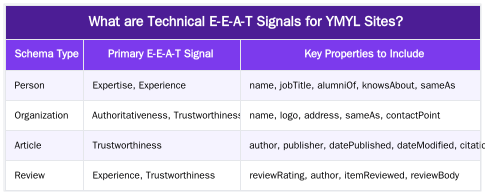
What are Technical E-E-A-T Signals for YMYL Sites?
Technical E-E-A-T signals are machine-readable on-page elements, primarily structured data like Schema markup and semantic HTML, that explicitly communicate a website’s Experience, Expertise, Authoritativeness, and Trustworthiness to search engines. For YMYL sites, where misinformation can cause significant harm, these signals provide verifiable context about authors, organizations, and content, directly reinforcing credibility beyond the written text.
While high-quality content is the cornerstone of E-E-A-T, search engines like Google rely on more than just words. They need structured, unambiguous data to understand the relationships between entities—the author who wrote the article, the organization that published it, and the facts it contains. This is where a strong technical e-e-a-t framework becomes indispensable.
Beyond Content: The On-Page Elements of Trust
Think of your content as a well-researched academic paper. The technical signals are the citations, the author’s credentials listed on the cover, and the publisher’s reputable name. They don’t change the content itself, but they provide the essential context that validates its claims. By using semantic HTML5 tags (like `
Why is Technical E-E-A-T Crucial for YMYL in 2026?
For YMYL websites—those covering topics like medical advice, financial planning, or legal information—the stakes are incredibly high. Google’s algorithms are designed to protect users from harmful, inaccurate, or deceptive content. As outlined in their Search Quality Rater Guidelines, E-E-A-T is a primary lens through which YMYL content is evaluated. In 2026, this evaluation is more technically sophisticated than ever.
A lack of clear, verifiable technical e-e-a-t signals can lead to suppressed rankings, reduced organic traffic, and a fundamental loss of user trust. Conversely, a site that clearly communicates its authority through structured data can see significant benefits, including higher search visibility for critical queries, improved click-through rates from rich results, and stronger user confidence, which ultimately drives conversions.
Navigating Google’s Evolving Trust Algorithms
Google’s Knowledge Graph and underlying AI systems are constantly improving their ability to connect entities and understand real-world authority. They no longer just index keywords; they build a comprehensive understanding of who is providing the information and why they should be trusted. A robust technical e-e-a-t strategy is how you feed this system the right information. It’s a non-negotiable part of a modern YMYL SEO strategy for 2026, ensuring your site is recognized not just as relevant, but as a truly authoritative source.
Implementing Key Schema Markup for Enhanced E-E-A-T
Schema markup is a shared vocabulary that webmasters can add to their HTML to help search engines understand their content more effectively. For YMYL sites, specific Schema types are vital for building a strong foundation of technical e-e-a-t. Implementing these correctly helps Google connect the dots between your content, your experts, and your organization.
Key types include:
- Person Schema: Identifies the author, detailing their credentials, affiliations, and links to other authoritative profiles (e.g., LinkedIn, official bio page). This directly signals Expertise and Experience.
- Organization Schema: Provides details about the publishing entity, including its official name, logo, address, and social profiles. This builds Authoritativeness and Trustworthiness.
- Article Schema: Specifies properties of the content itself, such as `author`, `publisher`, `datePublished`, and `dateModified`, providing clear context and transparency.
- MedicalEntity Schema: For healthcare SEO, this can be used to mark up information about conditions, treatments, and drugs, linking them to established knowledge bases.
Connecting the Dots for Google’s Knowledge Graph
When implemented together, these Schema types create a web of interconnected data. Google can see that an article, reviewed by a specific expert (Person Schema), was published by a reputable institution (Organization Schema). This layered context is far more powerful than a simple author byline. It’s how you prove your credibility at a machine level, which is essential for topics where trust is paramount, such as when using FAQ Schema for YMYL trust.
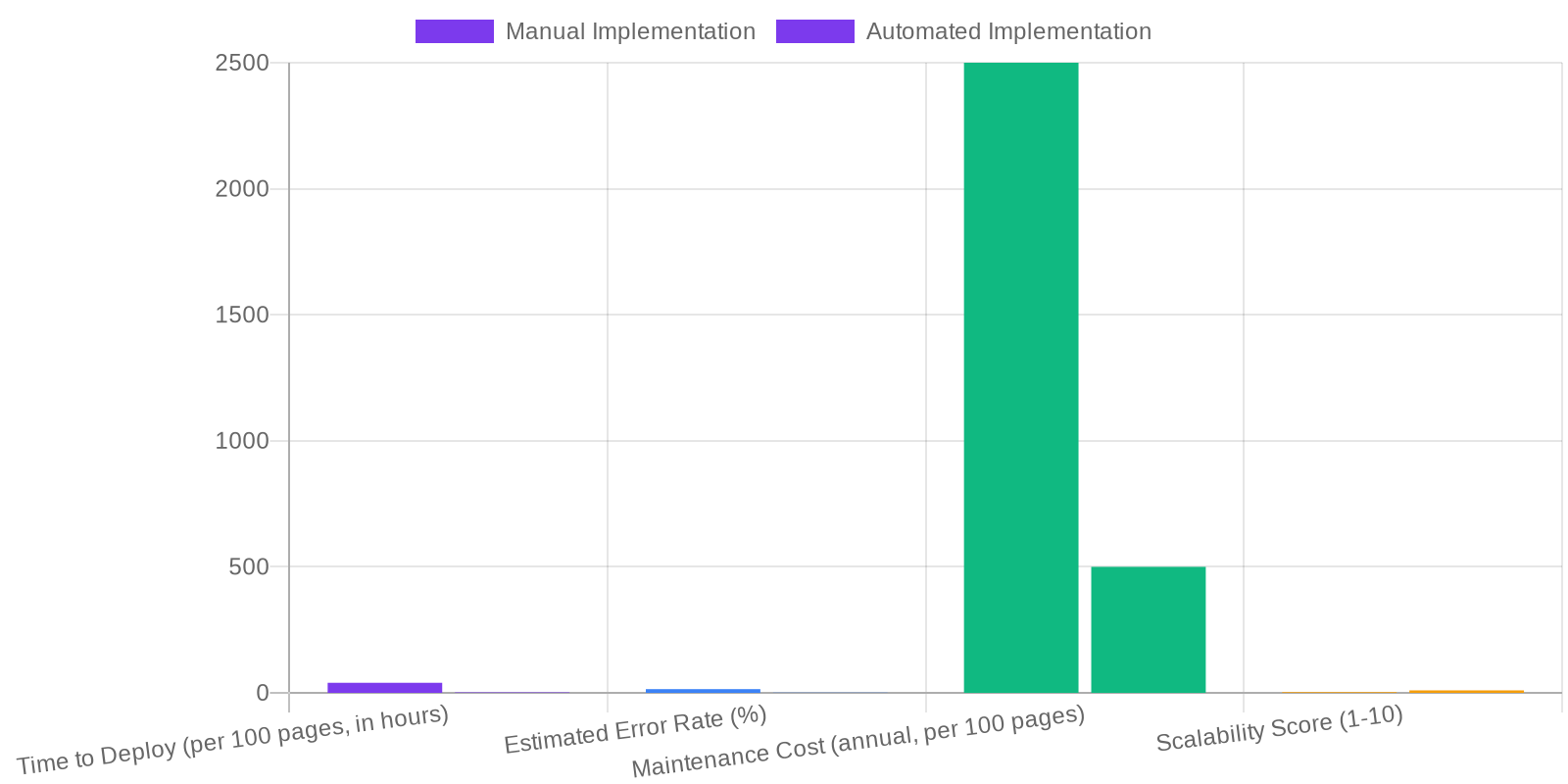
The Automation Advantage: Manual vs. Automated Technical E-E-A-T
Implementing comprehensive structured data across a large YMYL site can be a monumental task. Manual implementation is often slow, prone to human error, and difficult to scale. A single syntax error in a JSON-LD script can invalidate the markup, rendering it useless to search engines. As content is updated, authors change, and business details evolve, keeping this data accurate becomes a constant maintenance challenge.
This is where automation provides a transformative advantage. Automated solutions can parse content, identify key entities (like authors, medical terms, or financial products), and generate compliant, interconnected Schema markup dynamically. This ensures that your technical e-e-a-t signals are always accurate, consistent, and deployed at scale across thousands of pages without manual intervention.
Scaling Trust Signals Across Your Entire Site
For a YMYL website with hundreds or thousands of articles, automation is the only practical way to maintain a robust technical e-e-a-t framework. It moves structured data from a one-off project to an integrated, always-on system that adapts to your content strategy. This approach not only saves countless development hours but also minimizes the risk of costly errors that could undermine your site’s credibility with search engines.
How Ruxi Data Streamlines Technical E-E-A-T for YMYL
Ruxi Data is a SaaS platform specifically designed to address the challenges of implementing technical e-e-a-t at scale. It leverages advanced Natural Language Processing (NLP) and AI to automate the creation and management of the structured data that YMYL sites need to thrive. By integrating with your content management system (CMS), Ruxi Data acts as an intelligent layer that translates your content’s inherent authority into the precise language of search engines.
The platform automatically identifies authors and connects them to their credentials, recognizes organizations and their details, and structures article information according to best practices defined by sources like Schema.org. This ensures that every piece of content you publish is supported by a complete and accurate set of machine-readable trust signals, a core component of E-E-A-T content automation.
From Raw Content to Machine-Readable Trust
The workflow is seamless. As you publish an article, Ruxi Data analyzes the text and metadata. It identifies the author’s name and cross-references it with a central database of expert profiles to generate comprehensive `Person` Schema. It pulls publisher information to create `Organization` Schema and wraps the entire piece in perfectly formatted `Article` Schema. This automated process ensures that your technical e-e-a-t is not an afterthought but an integral part of your publishing pipeline, building a powerful, consistent signal of trustworthiness across your entire digital presence.
Future-Proofing Your YMYL Site with Automated E-E-A-T
The digital landscape is in constant flux, and Google’s algorithms will only become more adept at identifying and rewarding genuine authority. Relying on manual, static methods for your technical e-e-a-t is a reactive strategy that will inevitably fall behind. Automation is the key to future-proofing your YMYL site.
By adopting an automated approach, you ensure your site can instantly adapt to new Schema types, evolving best practices, and more sophisticated algorithmic requirements. This proactive stance on trust and transparency is your best defense against future updates and your strongest asset in building a lasting, authoritative presence. Investing in automated E-E-A-T signals is an investment in the long-term health and success of your website.
Conclusion
In 2026, excelling in YMYL categories requires more than just great content—it demands unimpeachable, machine-readable proof of your credibility. A sophisticated technical e-e-a-t strategy, built on a foundation of comprehensive Schema markup, is the critical link between your real-world authority and your performance in search. While manual implementation is possible, it is not scalable or sustainable. Automation platforms like Ruxi Data offer the only viable path to deploying and maintaining these essential trust signals with the accuracy, consistency, and efficiency required to win. To build a truly resilient and authoritative YMYL site, explore how automation can transform your SEO strategy today. Visit https://abdurrahmansimsek.com to learn more.
Frequently Asked Questions
What is technical E-E-A-T and why is it important for YMYL sites?
Technical E-E-A-T refers to the use of machine-readable signals, like structured data and semantic HTML, to communicate a site’s expertise, experience, authoritativeness, and trustworthiness to search engines. For YMYL (Your Money or Your Life) sites, these signals are critical because they help Google verify the credibility of content that can impact a user’s well-being. A strong foundation in technical E-E-A-T is essential for visibility and user trust in high-stakes niches.
What are the most important types of Schema markup for technical E-E-A-T?
For a robust technical E-E-A-T strategy, several Schema types are vital. Person Schema is crucial for identifying authors and their credentials, while Organization Schema establishes the publisher’s identity and authority. Additionally, Article Schema, complete with author and publisher details, directly tells search engines who is responsible for the content, reinforcing its trustworthiness.
How does automation help with implementing technical E-E-A-T signals?
Automation platforms like Ruxi Data streamline the implementation of technical E-E-A-T by consistently generating the correct Schema markup and semantic HTML structure for every piece of content. This process eliminates human error and ensures that crucial trust signals, such as author details and publisher information, are applied correctly and at scale. This saves significant time while strengthening your site’s authority signals.
Can Ruxi Data ensure content meets Google’s technical E-E-A-T guidelines?
Yes, Ruxi Data is specifically designed to generate content and the underlying code that aligns with Google’s E-E-A-T guidelines. It automates the creation of proper Schema markup and semantically structured content, which are core components of technical E-E-A-T. By integrating live data and focusing on topical authority, it helps build the necessary signals for expertise and trust.
Why is a strong technical E-E-A-T strategy crucial for healthcare and finance websites?
In YMYL sectors like healthcare and finance, misinformation can have severe consequences, so Google applies the strictest standards. A strong technical E-E-A-T strategy provides search engines with verifiable proof of your content’s credibility, authorship, and accuracy. This is essential for ranking highly and being seen as a trustworthy resource for users making critical life decisions.
Ruxi Data brings together multi-model AI, automated website crawling, live indexation checks, topical authority mapping, E-E-A-T enrichment, schema generation, and full pipeline automation — from crawl to WordPress publish to social posting — all in one platform built for agencies and freelancers who run on results.