
Topological Link Analysis: Optimize Internal Link Flow for SEO
Topological link analysis is a powerful SEO methodology that applies graph theory to visualize and optimize a website’s internal link structure. This guide teaches how to map your site’s link flow, understand link equity distribution, and identify structural inefficiencies like orphan pages. By mastering topological link analysis, you can strategically sculpt PageRank, enhance crawl depth, and build a robust site architecture. This advanced approach moves beyond basic link audits, revealing hidden opportunities to boost organic visibility and improve overall SEO performance.
Abdurrahman Simsek is committed to delivering advanced SEO strategies rooted in data-driven insights and ethical practices. Our expertise ensures clients achieve measurable outcomes, transforming complex technical challenges into significant organic growth. We prioritize clarity, accuracy, and actionable solutions to optimize your digital presence effectively.
To explore your options, contact us to schedule your consultation.
Topological link analysis transforms your understanding of internal linking, revealing hidden opportunities to optimize link equity and boost SEO performance. This advanced methodology applies graph theory to map your website’s entire internal link structure, identifying how authority flows and where inefficiencies exist. This comprehensive guide will walk you through visualizing your site’s link flow, understanding critical metrics, identifying structural inefficiencies like orphan pages, and implementing strategic optimizations for a more robust and search engine-friendly site architecture. By mastering topological link analysis, you can unlock significant organic visibility gains.
What is Topological Link Analysis in SEO?
Topological link analysis in SEO is a sophisticated method that uses principles from graph theory to understand and optimize the internal linking structure of a website. Its core purpose is to visualize and quantify how “link equity” (often referred to as PageRank) is distributed across all pages, revealing structural inefficiencies and opportunities for improvement. This analysis treats your website as a network, where pages are nodes and internal links are edges, allowing for a holistic view of information flow.
By mapping these connections, SEO professionals can identify critical pages, discover bottlenecks, and ensure that valuable link equity is flowing efficiently to the most important content. This approach moves beyond simple link counts, focusing on the quality, relevance, and strategic placement of every internal link within the site’s architecture. It’s a fundamental step towards building a robust and crawlable website that Google can easily understand and rank.
Beyond Basic Link Audits: A Deeper Dive
Traditional link audits often focus on identifying broken links, redirect chains, or basic link counts. While valuable, they typically miss the bigger picture of how the entire network functions. Topological link analysis, by contrast, emphasizes the interconnectedness of pages. It helps you understand not just if a link exists, but its strategic importance within the broader site architecture. This deeper dive allows for the identification of complex patterns, such as tightly knit content clusters or isolated sections, which are invisible to simpler auditing methods. It’s about understanding the entire ecosystem, not just individual components.
How Does Link Equity Flow Through Your Site?
Link equity, often conceptualized through Google’s original PageRank algorithm, is the theoretical “value” or “authority” passed from one page to another via hyperlinks. Within a website, internal links are the conduits for this equity, influencing how search engines perceive the importance of individual pages. An efficient internal linking structure ensures that high-equity pages can distribute their value strategically, bolstering the visibility of other relevant content. Understanding this flow is paramount for effective SEO.
Understanding PageRank, CheiRank, and Crawl Depth
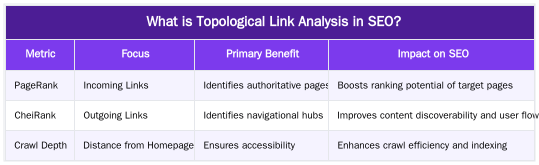
PageRank, while evolved, remains a foundational concept. It measures a page’s importance based on the quantity and quality of links pointing to it. Pages with more incoming links from important pages receive higher PageRank. CheiRank, a complementary metric, offers a different perspective by measuring a page’s importance based on its outgoing links. It identifies pages that act as significant “hubs” for navigation and information dissemination. While PageRank focuses on inbound authority, CheiRank highlights outbound influence, providing a more complete picture of a page’s role within the network. Both are crucial for assessing link flow efficiency.
Crawl depth refers to the number of clicks required to reach a page from the homepage. Pages buried deep within the site (high crawl depth) often receive less link equity and are crawled less frequently. Optimizing crawl depth ensures that important content is easily accessible to search engine spiders, facilitating efficient indexing and ranking. A balanced approach to these metrics is key to a healthy internal link profile.
The Impact of Site Architecture on Link Flow
A well-planned site architecture is the backbone of efficient link equity distribution. By organizing content into logical categories and subcategories, often referred to as content silos, you create clear pathways for link equity to flow. This structure not only improves crawlability for search engines but also enhances the user experience by making navigation intuitive. When related content is tightly linked within a silo, it reinforces topical authority, signaling to search engines the depth and relevance of your expertise in that area. This strategic organization is a cornerstone of effective topological link analysis.
Visualizing Your Internal Link Graph with Key Tools
Visualizing your website’s internal linking structure is a powerful step in topological link analysis. It transforms abstract data into an intuitive map, revealing patterns, clusters, and anomalies that are otherwise impossible to detect. Tools like Screaming Frog are essential for data extraction, while Gephi excels at graph visualization. By interpreting the visual output, you can pinpoint areas of strength and weakness, guiding your optimization efforts effectively.
Step-by-Step: Analyzing Your Website’s Link Structure
- Crawl Your Site: Use a tool like Screaming Frog SEO Spider to perform a comprehensive crawl. Export the “Internal Links” report, which lists source URL, target URL, and anchor text.
- Prepare Data for Gephi: The exported data needs to be formatted into two files: a “Nodes” file (all unique URLs) and an “Edges” file (the internal links, showing source and target). Ensure consistent URL formatting.
- Import into Gephi: Open Gephi and import your “Nodes” and “Edges” files. Gephi will construct a visual graph of your website.
- Apply Layout Algorithms: Experiment with Gephi’s layout algorithms (e.g., Force Atlas 2, Fruchterman Reingold) to arrange nodes (pages) and edges (links) in a meaningful way. Clusters of related pages will often emerge.
- Analyze Metrics: Calculate network metrics within Gephi, such as Degree (number of links to/from a page), Betweenness Centrality (how often a page lies on the shortest path between others), and Closeness Centrality (how quickly a page can reach other pages).
- Interpret Visual Output: Look for dense clusters (content silos), isolated nodes (orphan pages), and pages with unusually high or low link counts. The size and color of nodes can be mapped to metrics like PageRank or traffic to highlight important areas.
Identifying Orphan Pages and Link Flow Bottlenecks
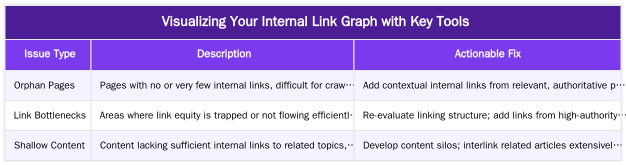
Topological visualization makes identifying critical issues straightforward. Orphan pages, for instance, appear as isolated nodes or nodes with very few incoming links, indicating they are difficult for search engines (and users) to discover. These pages often waste crawl budget and fail to rank. Similarly, link flow bottlenecks manifest as areas where link equity is trapped or cannot efficiently reach important target pages. This might be a highly linked page that doesn’t pass sufficient equity to its children, or a section of the site that lacks internal connections to the rest of the architecture. Addressing these issues is vital for improving overall site performance. For detailed workflows on fixing these, refer to our guide on fixing orphan pages.
Ruxi Data’s Advanced Link Flow Optimization Strategy
At Abdurrahman Simsek’s Ruxi Data, our approach to topological link analysis goes beyond conventional methods, leveraging a unique methodology for automated analysis and optimization. We understand that manual link audits are time-consuming and often miss the intricate dynamics of large websites. Our platform integrates advanced algorithms that not only visualize your link graph but also predict the impact of proposed changes, ensuring data-driven decisions.
Ruxi Data’s proprietary system automatically identifies critical link flow issues, such as suboptimal PageRank distribution, under-linked high-value content, and inefficient content silos. We utilize a blend of PageRank, CheiRank, and custom centrality metrics to provide a nuanced understanding of each page’s role. Our platform then generates actionable recommendations, including optimal internal linking suggestions, to redistribute link equity effectively. This automated process significantly reduces the time and effort required for complex internal linking strategies, allowing businesses to focus on content creation and broader SEO initiatives. Our expertise in internal linking strategy is built into the core of Ruxi Data.
By using Ruxi Data, clients gain a competitive edge through continuous monitoring and proactive optimization of their internal link architecture. This ensures that their most valuable content consistently receives the necessary link equity to rank higher and drive organic traffic, reflecting our commitment to cutting-edge SaaS SEO solutions.
Modern PageRank Sculpting and Link Flow Optimization in 2026
The concept of “PageRank sculpting” has evolved significantly since its early days. In 2026, it’s less about manipulating individual `nofollow` attributes and more about strategic internal linking to guide link equity naturally. Google’s algorithms are sophisticated; they understand the intent behind links. Modern link flow optimization focuses on creating logical, user-centric pathways that also benefit search engines. This means building robust internal linking silos and ensuring every page serves a clear purpose within the site’s overall architecture.
Effective link flow optimization in 2026 involves a holistic approach. It starts with a strong content strategy, where related topics are grouped and interlinked to build topical authority. Then, topological link analysis helps identify the most efficient paths for link equity. This includes ensuring that high-authority pages link to important, lower-authority pages that need a boost, and that navigational elements are designed to distribute equity broadly. The goal is to create a seamless experience for both users and crawlers, where valuable content is easily discoverable and appropriately weighted.
Furthermore, regular auditing and iterative adjustments are crucial. As content grows and evolves, the internal link graph changes. Continuous monitoring with advanced tools ensures that the site architecture remains optimized, preventing the formation of new orphan pages or link flow bottlenecks. This proactive management is key to sustained SEO performance in a dynamic search landscape.
Actionable Workflows: Fixing Common Link Flow Issues
Once topological link analysis has identified issues, implementing fixes requires structured workflows. For orphan pages, the primary goal is to integrate them into the main site architecture. This involves identifying relevant parent pages or content clusters and adding contextual internal links. For example, a blog post about “advanced SEO tactics” might link to an orphan page detailing “CheiRank applications.” This not only passes link equity but also improves user navigation and topical relevance. Prioritize linking to high-value orphan pages first, such as those with existing external backlinks or high search potential.
For link flow bottlenecks, the strategy involves re-evaluating the linking structure around the bottleneck area. If a critical page is not receiving enough equity, ensure it’s linked from high-authority, relevant pages. Conversely, if a page is hoarding equity without passing it on effectively, consider adding more contextual links from it to other important pages within its content silo. Automated internal linking solutions, such as those offered by Ruxi Data, can significantly streamline this process by suggesting and implementing relevant links at scale, based on semantic analysis and link equity distribution models. This ensures continuous optimization without manual oversight.
Benefits and ROI of Topological Link Analysis
Implementing topological link analysis yields significant benefits and a strong return on investment for any website. By optimizing internal link flow, you directly enhance organic visibility. Pages that were previously under-linked gain authority, leading to improved rankings and increased organic traffic. This translates into higher conversion rates and revenue, especially for e-commerce sites or SaaS platforms.
Beyond rankings, a well-optimized internal linking structure improves user experience. Visitors can navigate your site more intuitively, finding related content easily, which reduces bounce rates and increases time on site. For search engines, better link flow means more efficient crawling and indexing, ensuring that all valuable content is discovered and understood. This leads to a more resilient site architecture, less susceptible to algorithm updates, and a stronger foundation for future growth. Investing in this advanced analysis is an investment in long-term SEO success.
Ready to transform your website’s SEO performance? Discover how Ruxi Data’s advanced topological link analysis can unlock your site’s full potential. Visit abdurrahmansimsek.com to learn more and schedule a demo.
Conclusion
Topological link analysis is no longer an optional SEO tactic; it’s a critical strategy for maximizing your website’s organic potential in 2026. By applying graph theory to visualize and understand your internal link flow, you gain unparalleled insights into how link equity is distributed and where improvements are needed. From identifying and fixing orphan pages to strategically sculpting PageRank and building robust content silos, this advanced approach ensures your site is both user-friendly and search engine-optimized.
Embracing topological link analysis leads to improved crawl efficiency, enhanced organic visibility, and a superior user experience. Don’t let hidden link flow issues hold your website back. Take control of your site’s architecture and unlock its full ranking power. Explore how Abdurrahman Simsek’s Ruxi Data can provide the tools and expertise for your advanced internal linking needs at abdurrahmansimsek.com.
Frequently Asked Questions
What is involved in performing a topological link analysis?
A topological link analysis involves crawling an entire website to map its complete internal link graph. Network analysis algorithms are then used to calculate metrics like PageRank flow and crawl depth for every URL. This process reveals the site’s true architecture and how link equity is distributed.
How does topological link analysis help find orphan pages?
By creating a complete map of all internal links, a topological link analysis can easily identify orphan pages. Any URL found through a sitemap or server logs that has zero incoming internal links is flagged as an orphan. This allows you to reintegrate these valuable pages back into your site architecture.
What is the main benefit of visualizing a topological link analysis?
Visualization makes complex link data easy to understand, instantly revealing structural problems that are hidden in spreadsheets. You can see where link equity is trapped, identify pages that are too deep in the site structure, and confirm that important pages receive sufficient link authority.
Can a topological link analysis suggest new internal linking opportunities?
Yes, a key outcome of a topological link analysis is identifying strategic linking opportunities. By understanding page authority and semantic context, the analysis can recommend relevant internal links from powerful pages to new or under-linked content, effectively strengthening your topic clusters.
How often should you perform this type of analysis?
It is recommended to perform a full analysis at least quarterly to assess your site’s structure after significant content changes. However, continuous monitoring can also be configured to track how new content and linking adjustments impact your link equity flow over time.
Ruxi Data brings together multi-model AI, automated website crawling, live indexation checks, topical authority mapping, E-E-A-T enrichment, schema generation, and full pipeline automation — from crawl to WordPress publish to social posting — all in one platform built for agencies and freelancers who run on results.