
Knowledge Graph and E-e-a-t: Mastering Entity SEO for Trust
Mastering the knowledge graph and E-E-A-T is crucial for modern SEO, enabling businesses to build authoritativeness and trust. This article explains how Google uses entities to understand content, providing practical entity SEO tactics. Readers will learn to implement structured data, demonstrate genuine experience, and enhance trust signals. By strategically aligning with the knowledge graph and E-E-A-T principles, brands can significantly improve online visibility and establish themselves as trusted authorities, especially for YMYL content. Understanding the interplay between the knowledge graph and E-E-A-T directly impacts search performance and user perception.
Abdurrahman Simsek is dedicated to providing actionable, data-driven SEO strategies that prioritize quality, ethical practices, and measurable outcomes. Our insights are designed to empower businesses to navigate complex search algorithms and build lasting digital authority, fostering trust with both search engines and audiences.
To explore your options, contact us to schedule your consultation.
Mastering the synergy between the knowledge graph and E-E-A-T is paramount for modern SEO success. This article delves into how Google leverages entities to understand content, and how businesses can strategically build authoritativeness and trust. We will explore practical entity SEO tactics, from structured data implementation to advanced strategies for demonstrating genuine experience. By understanding and applying these principles, you can significantly enhance your online visibility and establish your brand as a trusted authority in your niche, ultimately driving better search performance.
Understanding the Knowledge Graph and E-E-A-T for SEO
In the evolving landscape of search, Google’s ability to understand context and relationships is driven by its Knowledge Graph. This vast semantic network connects real-world entities—people, places, organizations, and concepts—allowing Google to move beyond simple keyword matching to grasp the true meaning behind queries. Simultaneously, E-E-A-T (Experience, Expertise, Authoritativeness, Trustworthiness) serves as Google’s framework for evaluating the quality and reliability of content and its creators. Together, the knowledge graph and E-E-A-T form the bedrock of modern SEO, signaling to search engines that your content is not only relevant but also credible and trustworthy.
The Knowledge Graph is not merely a database; it’s a dynamic system that continually learns and expands, influencing everything from featured snippets to local search results. For businesses, being recognized as an entity within this graph is crucial for visibility and reputation. E-E-A-T, as detailed in Google’s Search Quality Rater Guidelines, provides a human-centric lens through which content quality is assessed. High E-E-A-T signals that your brand and its content are reliable sources of information, directly impacting rankings, especially for sensitive topics. Understanding this interplay is the first step in building a robust E-E-A-T strategy that resonates with both algorithms and users.
By focusing on entity SEO, you actively contribute to Google’s understanding of your brand and its associated concepts. This involves consistent messaging, clear identification of your organization and authors, and demonstrating genuine value. The goal is to establish your digital presence as a recognized and authoritative entity, thereby enhancing your overall search performance and user trust. This holistic approach ensures that your content not only ranks but also truly serves your audience.
How Google Uses Entities to Understand Content
Google uses entities to move beyond keyword matching, understanding the underlying concepts and relationships within content. This semantic approach allows the search engine to provide more accurate and contextually relevant results to user queries.
- Entity Recognition: Google identifies specific entities (e.g., “Elon Musk,” “Tesla,” “electric vehicles”) within content, rather than just individual words. This helps disambiguate terms and understand the core subjects.
- Contextual Understanding: By recognizing entities and their relationships, Google builds a richer context around content. For instance, if “Apple” is mentioned alongside “iPhone” and “Tim Cook,” Google understands it refers to the technology company, not the fruit.
- Information Synthesis: Entities enable Google to synthesize information from various sources. If multiple authoritative sources discuss the same entity, Google can consolidate this information to form a comprehensive understanding, which is then reflected in search results and Knowledge Panels.
- Query Interpretation: When a user searches, Google maps their query to known entities. This allows it to understand the user’s true intent, even if the query is vague or uses synonyms, leading to more precise search results.
- Ranking Signals: The presence of well-defined, relevant entities, especially those linked to authoritative sources, can act as a strong ranking signal, indicating the depth and quality of the content.
This entity-centric approach is fundamental to modern search, ensuring that Google delivers not just pages with matching words, but pages with matching meaning and authority.
Practical Steps for Implementing Entity SEO
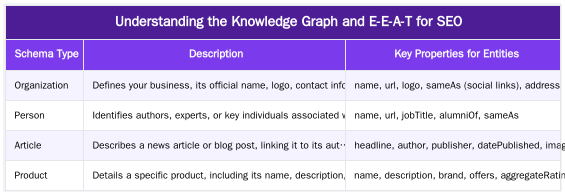
Implementing effective entity SEO involves a multi-faceted approach, focusing on how Google perceives and connects your brand and content to the broader web. A foundational step is the strategic use of structured data, which explicitly tells search engines about the entities on your pages. This includes Organization schema for your business, Author schema for content creators, and Article schema for blog posts. Properly implemented schema helps Google accurately identify and categorize your brand, products, and expertise.
Beyond structured data, actively managing your Knowledge Panel is vital. If your brand or key personnel have a Knowledge Panel, ensure its information is accurate and up-to-date. This often involves consistent branding across all online properties, maintaining a strong Wikipedia presence (if applicable), and linking your official social profiles. Optimizing your Brand SERP (Search Engine Results Page) is another critical component. When someone searches for your brand name, the results should reflect your desired narrative, showcasing positive reviews, official channels, and authoritative mentions. This builds trust and reinforces your entity’s authority.
Content creation itself must be entity-aware. Reference other authoritative entities in your niche, link to relevant internal pages, and ensure your content comprehensively covers topics, addressing related entities naturally. For SaaS businesses, this could involve linking product features to specific industry problems or integrating with the Google Knowledge Graph API for advanced data management. By consistently applying these practical steps, you solidify your brand’s presence within the Knowledge Graph, enhancing its recognition and authority.
Structured Data Types for Entity Recognition
The Critical Role of E-E-A-T for YMYL Content
For “Your Money or Your Life” (YMYL) content, the importance of E-E-A-T (Experience, Expertise, Authoritativeness, Trustworthiness) cannot be overstated. YMYL topics, such as financial advice, medical information, legal guidance, or public safety, have a direct and significant impact on a person’s health, happiness, or financial stability. Consequently, Google holds YMYL content to an exceptionally high standard, demanding irrefutable proof of E-E-A-T from both the content creator and the website publisher.
Google’s Quality Rater Guidelines explicitly emphasize that low E-E-A-T for YMYL content can lead to severe ranking penalties, as it could potentially harm users. This means that merely being knowledgeable is insufficient; you must demonstrate verifiable expertise, a track record of experience, and a widely recognized authoritativeness in your field. Most critically, the content must be utterly trustworthy, backed by facts, evidence, and transparent sourcing. For example, a medical article should be written by a certified doctor, not just someone with an interest in health.
To build E-E-A-T for YMYL content, focus on showcasing credentials, linking to academic or professional profiles, and citing reputable sources. Ensure your website has clear contact information, a robust privacy policy, and transparent editorial processes. For SaaS companies operating in YMYL spaces (e.g., financial planning software, health tech), this means highlighting certifications, regulatory compliance, and the expertise of your team members. Neglecting E-E-A-T in YMYL categories is a critical error that can severely limit your visibility and impact. Learn more about E-E-A-T for YMYL in 2026.
Automating Entity SEO for SaaS Businesses
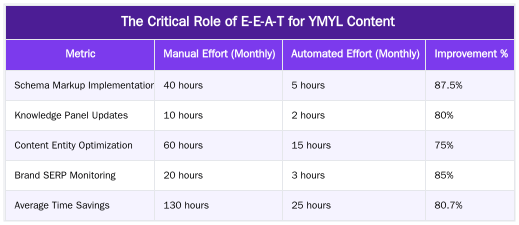
For SaaS businesses, scaling entity SEO and demonstrating a strong knowledge graph and E-E-A-T profile can be significantly streamlined through automation. Manual implementation of schema markup or consistent entity referencing across vast product documentation and content libraries is often impractical. Automation allows for consistent, error-free application of entity-rich data, ensuring Google accurately understands your product, features, and expertise.
One key area for automation is structured data generation. SaaS platforms can dynamically generate schema markup for product pages, feature descriptions, and support articles based on existing database information. This ensures that every piece of content clearly defines its associated entities (e.g., software application, organization, person) and their relationships. Furthermore, integrating with APIs can help monitor and update your brand’s presence in the Knowledge Graph, ensuring consistency across various data points Google might reference.
Content creation workflows can also be enhanced. Tools can analyze content for entity coverage, suggesting related entities to include for comprehensive topic modeling. This ensures that your content not only uses the focus keyword but also naturally incorporates a cluster of semantically related terms, signaling depth and authority. By automating these processes, SaaS companies can efficiently build a robust entity footprint, enhancing their perceived expertise and trustworthiness without overwhelming internal resources. Explore how to automate E-E-A-T content for maximum impact.
ROI of Automated Entity SEO for SaaS
Measuring the ROI of Entity SEO and E-E-A-T Efforts
Quantifying the return on investment (ROI) for entity SEO and E-E-A-T initiatives is crucial for demonstrating their value. While not always a direct, immediate financial metric, the impact can be observed through several key performance indicators. Look for improvements in organic visibility for entity-related queries, indicating Google’s enhanced understanding of your brand. Monitor your Knowledge Panel visibility and accuracy, as this directly reflects your entity’s recognition. Track changes in your Brand SERP, noting increased prominence of official channels and positive mentions.
Furthermore, analyze click-through rates (CTR) for search results that feature rich snippets or Knowledge Panel integration, as these often benefit from strong E-E-A-T signals. Increased brand mentions across the web, particularly from authoritative sources, also signify growing authoritativeness. Ultimately, these efforts contribute to higher rankings, increased organic traffic, and enhanced brand trust, which translates into improved conversion rates and customer loyalty. To truly measure the impact of your knowledge graph and E-E-A-T strategy, consider partnering with experts who can provide deep insights and actionable data.
Ready to transform your brand’s authority and search performance? Visit abdurrahmansimsek.com to learn how our specialized entity SEO and E-E-A-T strategies can drive measurable results for your business.
Conclusion
The symbiotic relationship between the knowledge graph and E-E-A-T is no longer an advanced SEO concept but a fundamental requirement for online success. By strategically implementing entity SEO, leveraging structured data, and consistently demonstrating genuine experience, expertise, authoritativeness, and trustworthiness, businesses can significantly enhance their visibility and credibility in Google’s eyes. This holistic approach not only improves rankings but also builds lasting trust with your audience, particularly for critical YMYL content. Embracing entity-centric strategies is essential for any brand aiming to dominate its niche in 2026 and beyond.
Unlock the full potential of your digital presence and establish your brand as an undeniable authority. Discover how our tailored solutions can elevate your knowledge graph and E-E-A-T profile. Visit abdurrahmansimsek.com today to get started.
Frequently Asked Questions
What is the connection between the knowledge graph and E-E-A-T?
The Knowledge Graph is Google’s database of real-world entities and their relationships. When Google can verify your brand or author as a distinct entity with connections to other authoritative sources, it directly strengthens your Authority and Trustworthiness signals. This verification is a core component of the relationship between the knowledge graph and E-E-A-T.
How can entity SEO improve my site’s knowledge graph and E-E-A-T signals?
Entity SEO uses structured data to explicitly define your brand, authors, and services as entities for search engines. This helps Google connect your website to its database, solidifying your expertise and authority on specific topics. Consistently applying entity SEO is a fundamental strategy for improving your standing in the knowledge graph and E-E-A-T framework.
What is the most effective tactic for authoritativeness in the context of the knowledge graph and E-E-A-T?
Earning mentions, citations, and links from other established, authoritative entities in your industry is the most effective tactic. These external validations act as powerful votes of confidence that Google uses to verify your authority. This off-page strategy is crucial for building a strong profile within the knowledge graph and E-E-A-T system.
Can a small business build a presence in the Knowledge Graph to improve E-E-A-T?
Yes. Small businesses can establish themselves as entities by creating a complete Google Business Profile and ensuring name, address, and phone number (NAP) information is consistent across the web. Using structured data on your website and earning local citations also helps Google recognize your business, strengthening its E-E-A-T signals.
Why is entity optimization especially important for YMYL topics?
For “Your Money or Your Life” (YMYL) topics, Google’s standards for E-E-A-T are extremely high. Entity optimization is critical because it unambiguously identifies the expert author and the responsible organization behind the content. This clarity is non-negotiable for establishing the level of trust required for high-stakes YMYL queries.
Ruxi Data brings together multi-model AI, automated website crawling, live indexation checks, topical authority mapping, E-E-A-T enrichment, schema generation, and full pipeline automation — from crawl to WordPress publish to social posting — all in one platform built for agencies and freelancers who run on results.