
Topic Cluster ROI: Attributing Revenue to Content Strategy
Mastering topic cluster roi analysis is essential for accurately attributing revenue to your content strategy. This guide details how to measure topic cluster roi by moving beyond vanity metrics to demonstrate tangible business impact. Readers will learn to implement advanced attribution models, configure Google Analytics 4 (GA4) for conversion tracking, and integrate CRM data for a holistic view. Understanding topic cluster roi enables data-driven optimization of content marketing efforts, proving its financial worth through improved lead generation and conversion rates.
AbdurrahmanSimsek.com is committed to providing expert, data-driven insights for optimizing digital strategies. Our content prioritizes accuracy, ethical practices, and actionable advice, empowering businesses to achieve measurable results and maximize their content marketing investments with confidence.
To explore your options, contact us to schedule your consultation.
Uncovering the true value of your content strategy hinges on mastering topic cluster ROI analysis. This guide will equip you with the knowledge and practical steps to accurately attribute revenue to your topic clusters, moving beyond vanity metrics to demonstrate tangible business impact. By understanding how to measure the financial return of your interconnected content, you can make data-driven decisions that optimize your content marketing efforts and prove its worth to stakeholders. We will explore advanced attribution, GA4 implementation, and CRM integration to provide a holistic view of your content’s performance.
What is Topic Cluster ROI and Why Does it Matter?
Topic cluster ROI represents the measurable financial return generated from a strategically linked group of content assets centered around a core pillar topic. Unlike general content marketing ROI, which might track individual blog posts, topic cluster ROI assesses the collective performance of an entire content ecosystem designed to establish topical authority and guide users through a specific journey. This holistic approach allows businesses, particularly in the SaaS sector, to understand the cumulative impact of their interconnected content on lead generation, conversions, and ultimately, revenue.
Measuring topic cluster ROI is crucial for demonstrating the tangible business value of your content strategy. It moves beyond vanity metrics like page views or social shares, focusing instead on how content directly contributes to your bottom line. For SaaS companies, this means attributing sign-ups, demo requests, and subscription revenue to specific content clusters. By understanding which clusters drive the most value, you can optimize resource allocation, refine your content strategy, and prove the financial efficacy of your SEO and content marketing investments. It provides the data needed to justify further investment and scale successful content initiatives.
Setting Up Your Attribution Framework in GA4
Configuring Google Analytics 4 (GA4) correctly is fundamental for accurate topic cluster ROI measurement. GA4’s event-driven data model offers greater flexibility in tracking user interactions and understanding complex customer journeys. This section provides a practical guide to setting up your attribution framework, ensuring you capture the data necessary to evaluate your content’s financial impact.
Defining Conversion Goals and Events in GA4
In GA4, all user interactions are events. To measure ROI, you must identify which events signify valuable actions and mark them as conversions. For topic clusters, these might include:
- Form Submissions: Contact forms, lead magnet downloads, newsletter sign-ups.
- Demo Requests: Crucial for SaaS businesses, indicating high intent.
- Product Purchases/Subscriptions: Direct revenue generation.
- Key Engagement Milestones: E.g., viewing a specific number of pages within a cluster, spending a certain amount of time on key content.
To set these up, navigate to “Admin” > “Events” in GA4. You can either use existing recommended events (e.g., `generate_lead`, `purchase`) or create custom events. Once an event is created, toggle the “Mark as conversion” switch. This ensures GA4 tracks these critical actions for your topic cluster ROI analysis.
Exploring GA4’s Attribution Models for Content
GA4 offers various attribution models to assign credit to different touchpoints in a user’s journey. Understanding these is vital for accurately assessing your content’s contribution:
- Data-Driven Attribution (DDA): GA4’s default, using machine learning to distribute credit based on actual user data. It’s often the most accurate for complex journeys.
- Last Click: Assigns 100% credit to the final touchpoint before conversion. Simple but often undervalues early-stage content.
- First Click: Assigns 100% credit to the initial touchpoint. Useful for understanding awareness-driving content.
- Linear: Distributes credit equally across all touchpoints.
- Time Decay: Gives more credit to touchpoints closer in time to the conversion.
For topic clusters, DDA or models that consider multiple touchpoints (like linear or time decay) are generally more insightful than last-click, as content often plays an early or mid-journey role.
Beyond Last-Click: Advanced Attribution for Topic Clusters
Relying solely on last-click attribution can severely undervalue the true impact of your topic clusters. Content, especially educational and informational pieces, often serves as an early touchpoint, nurturing leads long before a conversion occurs. Advanced attribution models and data integration are essential for a comprehensive understanding of topic cluster ROI.
Tracking Assisted Conversions and User Journeys
Assisted conversions highlight touchpoints that contributed to a conversion but were not the final interaction. In GA4, you can explore these through “Advertising” > “Attribution” > “Conversion Paths.” This report reveals the sequences of channels and content pieces users engaged with before converting. By analyzing these paths, you can identify which articles within a cluster consistently appear as early or mid-journey touchpoints, even if another channel (like direct traffic or paid search) gets the last-click credit.
Mapping the customer journey through a cluster involves understanding how users navigate from pillar pages to sub-topic articles and vice-versa. GA4’s “Path Exploration” report (under “Explore” > “Path Exploration”) allows you to visualize these journeys. Look for common sequences where users engage with multiple pieces of content within a specific cluster before converting. This provides invaluable insight into how your content nurtures leads and contributes to the overall topic cluster ROI framework.
Integrating CRM Data for a Holistic View
For SaaS businesses, the ultimate measure of topic cluster ROI extends beyond website conversions to closed-won revenue. Integrating GA4 data with your Customer Relationship Management (CRM) system is paramount for this holistic view. This integration allows you to connect specific content engagement (e.g., a user reading a pillar page on “SaaS onboarding best practices”) with a lead record in your CRM. As that lead progresses through the sales funnel—from MQL to SQL to closed-won deal—you can attribute a portion of the final revenue back to the initial content touchpoints.
Tools like Salesforce, HubSpot, or custom integrations can link user IDs or email addresses (captured via forms) between GA4 and your CRM. This enables you to track the entire customer lifecycle, providing a clear line of sight from content consumption to revenue generation. This level of integration offers the most accurate picture of your content’s financial impact, moving beyond simple website metrics to demonstrate true business value.
Key Metrics and KPIs for Topic Cluster ROI Analysis
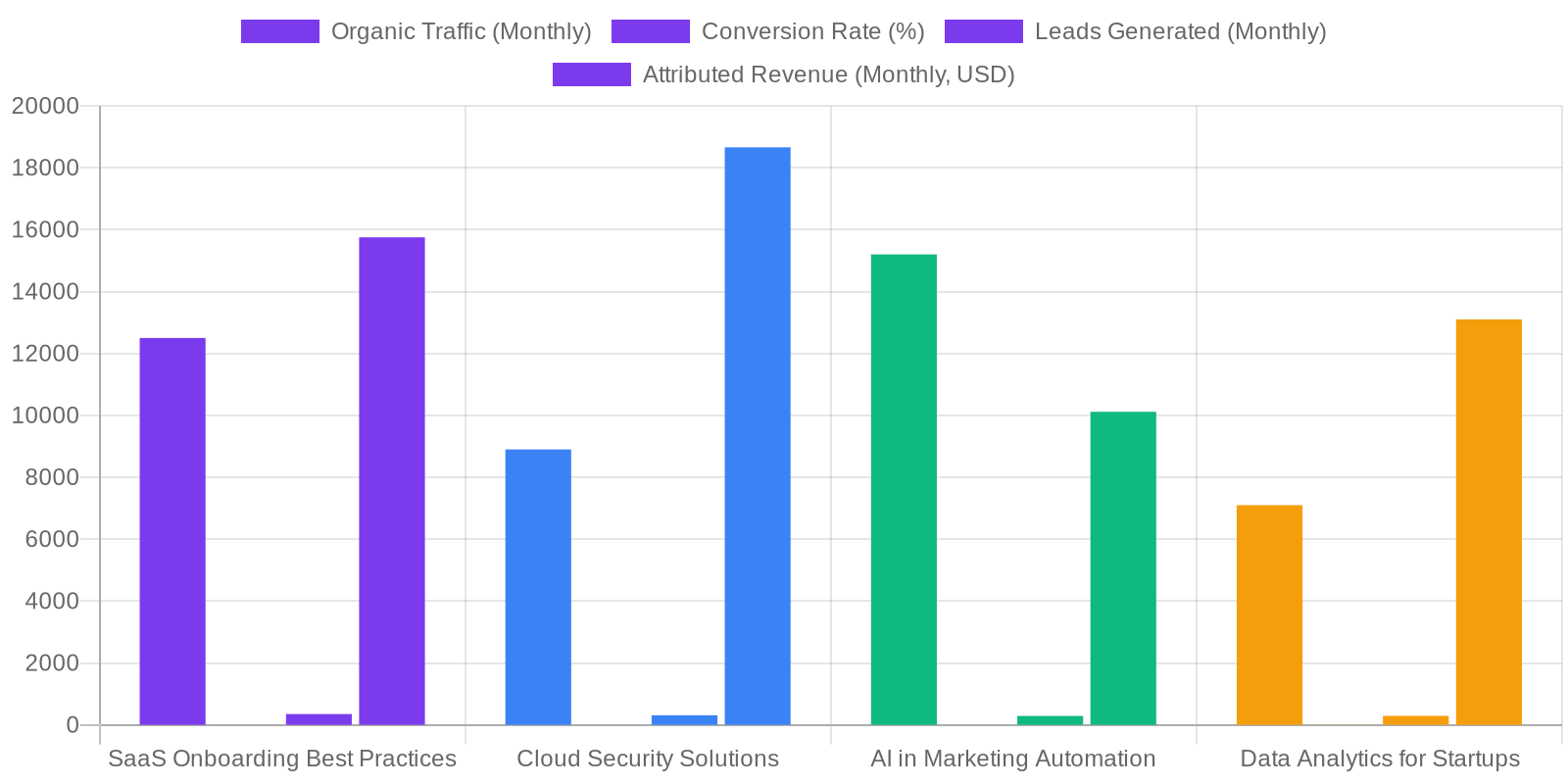
To accurately measure topic cluster ROI, it’s essential to track a combination of traffic, engagement, and conversion metrics. These Key Performance Indicators (KPIs) provide a comprehensive view of how your content clusters are performing financially and strategically. Focusing on these metrics allows you to move beyond superficial data and pinpoint the true value of your content investments.
Here are some critical metrics and KPIs:
- Organic Traffic to Cluster: Total visits to all pages within a cluster.
- Conversion Rate per Cluster: The percentage of users within a cluster who complete a defined conversion event (e.g., demo request, sign-up).
- Leads Generated per Cluster: The number of qualified leads attributed to a specific topic cluster.
- Revenue Attributed per Cluster: The actual revenue generated from leads or customers who engaged with a specific cluster, especially important with CRM integration.
- Cost per Acquisition (CPA) per Cluster: The total cost of creating and promoting a cluster divided by the number of conversions it generates.
- Return on Ad Spend (ROAS) for Promoted Content: If content within a cluster is promoted via paid channels, this measures the revenue generated against ad spend.
Analyzing these metrics in conjunction helps you understand not just what content is popular, but what content is profitable. For instance, a cluster with high organic traffic but low conversion rates might indicate a need for better calls-to-action or more targeted content. Conversely, a cluster with moderate traffic but high conversion rates is a strong performer that might warrant further investment. For a deeper dive into strategic content planning, refer to our insights on topic cluster strategy.
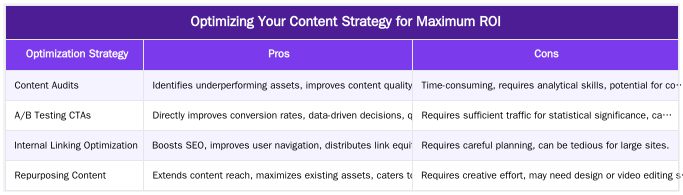
Optimizing Your Content Strategy for Maximum ROI
Measuring topic cluster ROI is only the first step; the real value comes from using that data to continuously optimize your content strategy. Iterative improvement based on performance insights ensures your content investments yield the highest possible returns. This involves a cycle of analysis, adjustment, and re-evaluation.
Key optimization strategies include:
- Content Audits: Regularly review all content within a cluster. Identify underperforming articles, update outdated information, or consolidate redundant pieces. Content that isn’t contributing to ROI should be improved, repurposed, or even removed.
- A/B Testing CTAs: Experiment with different calls-to-action (CTAs) on your pillar pages and supporting articles. Test variations in wording, placement, and design to see what drives higher conversion rates.
- Internal Linking Optimization: Strengthen internal links within your clusters to guide users more effectively through the customer journey and distribute link equity. Ensure pillar pages link to all relevant sub-topics and vice-versa.
- Repurposing and Updating: Transform high-performing content into new formats (e.g., blog post to infographic, webinar to e-book) to reach wider audiences and extend its lifecycle. Update evergreen content annually to maintain its relevance and accuracy.
- User Experience (UX) Enhancements: Improve page load times, mobile responsiveness, and overall readability. A better user experience encourages longer engagement and reduces bounce rates, indirectly boosting conversion potential.
By systematically applying these optimization techniques, you can refine your content clusters to better meet user needs, improve search engine visibility, and ultimately drive a higher topic cluster ROI. This proactive approach transforms your content strategy into a powerful, revenue-generating machine.
Conclusion
Mastering topic cluster ROI analysis is no longer optional; it’s a strategic imperative for any business serious about content marketing, especially in the competitive SaaS landscape. By moving beyond basic metrics and embracing advanced attribution models, GA4’s capabilities, and CRM integration, you can accurately quantify the financial impact of your content clusters. Building topical authority directly translates into trust and conversions, while continuous optimization ensures your content strategy remains a powerful revenue driver. Start implementing these strategies today to unlock the full potential of your content and demonstrate its undeniable value.
Ready to transform your content strategy into a measurable revenue engine? Explore our services and expertise to build high-performing topic clusters that deliver exceptional ROI.
Frequently Asked Questions
What is the first step in measuring topic cluster ROI?
The first step is to define your conversion goals, such as form submissions or demo requests, within Google Analytics 4. Each piece of content in your cluster should be designed to guide the user toward one of these goals. Properly configured goals are the foundation for calculating an accurate topic cluster ROI.
How does topical authority impact my topic cluster ROI?
Improving your topical authority directly increases your topic cluster ROI. As search engines recognize your expertise, your cluster pages rank higher for more keywords, attracting more qualified organic traffic. This increase in relevant visitors leads to more conversion opportunities and a better financial return on your content investment.
How do I attribute conversions correctly to calculate topic cluster ROI?
To accurately calculate topic cluster ROI, you must look beyond the last page a user visited before converting. Use advanced attribution models in GA4, like data-driven or position-based models. These show how different articles in your topic cluster “assisted” in the final conversion, giving you a more complete picture of your content’s value.
What is a practical way to report on the financial return of a topic cluster?
Create a custom report or a Looker Studio dashboard to visualize performance. Group all the URLs from a specific topic cluster and analyze their combined metrics, including users, sessions, and goal completions. By assigning a monetary value to each goal, you can calculate the total revenue generated by that cluster.
Besides revenue, what other KPIs indicate a positive return on a topic cluster?
Beyond direct conversions, look for leading indicators of success. These include an increase in ranking keywords for the cluster, higher organic traffic to the pillar page, and a rise in branded search queries. These metrics signal growing authority and audience engagement, which eventually contribute to a higher ROI.
Ruxi Data brings together multi-model AI, automated website crawling, live indexation checks, topical authority mapping, E-E-A-T enrichment, schema generation, and full pipeline automation — from crawl to WordPress publish to social posting — all in one platform built for agencies and freelancers who run on results.