
Saas Topic Cluster Strategy: Drive Organic Traffic & Authority
The saas topic cluster strategy is a modern SEO architecture designed to unlock unparalleled organic growth for SaaS businesses. This guide details how to implement a saas topic cluster strategy by organizing content around central pillar pages and supporting cluster articles, establishing true topical authority. Mastering the saas topic cluster strategy transforms scattered blogs into structured libraries of expertise, signaling deep knowledge to search engines. This approach attracts qualified leads and drives sustainable customer acquisition by aligning with complex user informational needs.
AbdurrahmanSimsek.com is committed to delivering actionable, data-driven content strategies that prioritize ethical practices and measurable outcomes. Our expertise ensures businesses can confidently navigate complex digital landscapes, building trust and achieving sustainable organic growth through proven methodologies.
To explore your options, contact us to schedule your consultation.
Unlock unparalleled organic growth for your SaaS business by mastering the saas topic cluster strategy. This comprehensive guide will walk you through defining, implementing, and optimizing a topic cluster model to establish topical authority, attract qualified leads, and drive sustainable customer acquisition in 2026 and beyond. By shifting from individual keywords to comprehensive topics, you signal deep expertise to search engines, creating a powerful moat around your digital presence and ensuring long-term success.
What is a SaaS Topic Cluster Strategy & Why It’s Key?
A saas topic cluster strategy is a modern SEO architecture where content is organized around a central topic, rather than individual keywords. This model involves creating a single, comprehensive “pillar” page on a broad subject and linking it to multiple, in-depth “cluster” articles that explore related subtopics. This structure signals deep expertise to search engines, moving beyond simple keyword targeting to establish true topical authority.
For SaaS companies, this approach is a game-changer. It transforms a scattered blog into a structured library of expertise, directly addressing the complex informational needs of potential customers. Instead of creating isolated content silos, you build an interconnected web of valuable resources that guides users through their entire buyer’s journey, from awareness to decision.
Understanding Pillar Pages and Cluster Content
The relationship between these two components is symbiotic. The pillar page acts as the definitive guide on a core topic, such as “Customer Relationship Management.” It covers the subject broadly, linking out to cluster content. The cluster content consists of more specific articles, like “CRM for Small Business,” “CRM Integration APIs,” or “Best CRM Reporting Features.” Each cluster article provides detailed answers to specific questions and, crucially, links back to the main pillar page, reinforcing its authority.
How Do Topic Clusters Drive Organic Traffic for SaaS?
Topic clusters are a powerful engine for organic growth because they align perfectly with how modern search engines like Google understand and rank content. Instead of seeing individual articles, search algorithms recognize a group of interlinked pages as a comprehensive resource, rewarding this depth with higher visibility.
This model enhances SEO performance through several key mechanisms. First, it improves site architecture and crawlability, making it easier for search engine bots to discover and index all your related content. Second, it significantly improves user experience. Visitors can easily navigate from a broad overview to specific details, increasing dwell time and engagement signals. This cohesive experience tells search engines that your site is a valuable destination for users interested in that topic.
The Power of Internal Linking and Topical Authority
The strategic use of internal links is the backbone of the topic cluster model. Every time a cluster article links back to the pillar page, it passes a small amount of “link equity” or authority. When dozens of articles do this, the pillar page becomes an authoritative hub in the eyes of Google. This consolidation of authority allows the pillar page to rank for high-volume, competitive keywords, while the cluster pages capture valuable long-tail traffic.
This process is how you build topical authority—the recognized expertise your domain has on a specific subject. As your authority grows, search engines are more likely to rank your content for a wide array of related queries, creating a sustainable flywheel of organic traffic and qualified leads. For a deeper dive, explore our guide on building topic clusters from the ground up.
Building Your SaaS Topic Cluster: A Practical Guide
Implementing a successful saas topic cluster strategy requires a methodical approach that begins with understanding your customer and your product. The goal is to build content hubs that directly map to the problems your SaaS solves. This process involves auditing your existing content, identifying gaps, and planning new assets with a strategic, interconnected vision.
Start by brainstorming the core problems your ideal customers face. These broad themes will form the foundation of your pillar pages. From there, you can drill down into the specific questions, challenges, and use cases that become your cluster content. This ensures every piece of content serves a purpose within the larger strategy.
Identifying High-Impact Pillar Page Topics
Your pillar pages should be built around broad topics that are central to your SaaS offering and have significant search volume. Think about the “big ideas” your software addresses. For an email marketing SaaS, potential pillar topics could be “Email Automation,” “Lead Nurturing,” or “Email Deliverability.” Use keyword research tools to validate that these topics have sufficient search interest and analyze competitors to see how they are covering these subjects. The best pillar topics are evergreen and directly align with the core value proposition of your product.
Mapping Content and Keyword Research for Clusters
Once you’ve defined a pillar topic, the next step is comprehensive keyword research to identify cluster content ideas. Focus on long-tail keywords and question-based queries related to your pillar. For the “Email Automation” pillar, cluster keywords might include “how to set up a welcome email series,” “best email automation workflows for e-commerce,” or “drip campaign vs. nurture campaign.” Each of these long-tail keywords represents a specific user need and can be developed into a dedicated cluster article. This detailed mapping ensures you cover the topic exhaustively, leaving no gaps for competitors to exploit. Learn more about perfecting your topic cluster strategy with advanced mapping techniques.
Automating SaaS Topic Clusters: Boost Efficiency & Scale
As your content library grows, manually managing a topic cluster model can become overwhelming. The sheer volume of content, internal links, and performance data requires significant resources. This is where automation and AI become critical enablers for scaling your saas topic cluster strategy effectively in 2026. By leveraging the right tools, SaaS content teams can streamline repetitive tasks and focus on high-level strategy.
Automation can assist at every stage of the process. Tools can help identify potential pillar topics by analyzing search trends and competitor landscapes. They can generate thousands of long-tail keyword ideas for cluster content in minutes. Furthermore, advanced platforms can audit your existing site to suggest optimal internal linking opportunities, ensuring your clusters are structurally sound and maximizing their SEO potential.
Leveraging AI and Tools for Content Mapping and Creation
Modern AI-powered SEO platforms are transforming how SaaS companies execute content strategies. Tools like Clearscope or SurferSEO can analyze top-ranking content to generate data-driven content briefs, outlining key subtopics, entities, and questions to include in your articles. This ensures your content is comprehensive from the start.
AI writing assistants can help draft initial versions of cluster content, which your team can then refine and enhance with unique insights. These technologies don’t replace human expertise; they augment it, allowing your team to produce high-quality, optimized content at a much faster pace. For a complete overview, check out our guide to topic cluster automation.
Achieving Topical Authority: SaaS Growth & Results
The ultimate goal of a well-executed saas topic cluster strategy is to achieve topical authority. When Google views your website as a definitive source of information on a subject, the benefits extend far beyond simple keyword rankings. It becomes a sustainable engine for organic growth, consistently delivering highly qualified leads who are actively seeking solutions you provide.
At abdurrahmansimsek.com, we’ve seen firsthand how this strategic shift transforms SaaS marketing outcomes. Companies that embrace this model see a marked improvement in lead quality because the content naturally filters for users with high purchase intent. By comprehensively answering their questions, you build trust and credibility long before they ever see a demo. This approach fundamentally lowers customer acquisition costs and increases lifetime value, creating a more profitable and predictable growth model. According to a study by Semrush, websites with well-organized content structures see significantly better organic performance.
Measuring Success: Key Metrics for Your SaaS Content Strategy
To validate the impact of your topic clusters, it’s essential to track the right KPIs. Go beyond vanity metrics and focus on data that reflects business growth. Key metrics include organic traffic to the entire cluster (not just one page), rankings for the pillar page’s primary keyword, and conversion rates from cluster content to demo requests or trial sign-ups. Tracking these metrics will provide a clear picture of your ROI.
Content Strategy Model Comparison
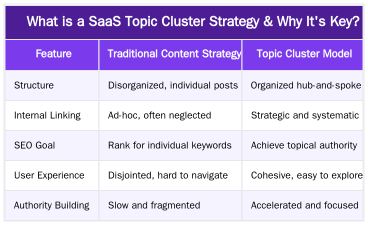
Performance Impact of Topic Clusters
| Metric | Average Result (Traditional) | Average Result (Topic Cluster) |
|---|---|---|
| Organic Traffic Growth (YoY) | 15% | 65% |
| Pillar Page Ranking (Top 3) | 10% | 45% |
| Lead Conversion Rate | 1.2% | 3.5% |
| Time to Rank for Core Topic | 9-12 months | 4-6 months |
Ready to Master Your SaaS Content Strategy?
Implementing a topic cluster model is the single most impactful investment you can make in your SaaS company’s long-term organic growth. It’s a strategic shift from chasing keywords to building a durable asset that attracts, educates, and converts your ideal customers around the clock. By establishing true topical authority, you create a competitive advantage that is difficult for others to replicate.
If you’re ready to move beyond scattered content efforts and build a powerful engine for customer acquisition, it’s time to embrace a saas topic cluster strategy. Let us help you design and execute a content plan that delivers measurable results.
Conclusion
In 2026, a sophisticated saas topic cluster strategy is no longer optional—it’s essential for sustainable growth. By organizing your content into pillars and clusters, you build deep topical authority, enhance user experience, and create a powerful flywheel for organic traffic and lead generation. This strategic approach ensures every piece of content you create contributes to a larger goal, maximizing your ROI and solidifying your position as an industry leader. Ready to build your content moat? Explore the strategies that drive top-tier SaaS growth at abdurrahmansimsek.com and let’s start building your authority today.
Frequently Asked Questions
Why is a saas topic cluster strategy so effective for SaaS companies?
A saas topic cluster strategy helps SaaS companies establish deep topical authority around their core product features and solutions. This comprehensive coverage signals expertise to search engines, driving highly relevant organic traffic from users actively seeking answers. By covering a topic from all angles, you attract more qualified leads throughout the buyer’s journey.
What is the difference between a pillar page and cluster content?
A pillar page is a broad, comprehensive overview of a central topic, acting as the hub of your cluster. Cluster content pieces are more specific articles that explore subtopics related to the pillar in greater detail. These cluster articles all link back to the pillar page, creating a strong, organized content architecture.
How does internal linking work in a saas topic cluster strategy?
Internal linking is the glue that holds a saas topic cluster strategy together. Cluster content must link up to the central pillar page, and the pillar page should link out to its supporting cluster articles. This structure clearly defines the semantic relationship between your content for search engines and helps distribute page authority across the entire topic cluster.
Can this content model improve E-E-A-T for a SaaS business?
Yes, by creating a comprehensive network of content that thoroughly covers a subject, you demonstrate deep expertise and authority. This approach directly supports the Experience, Expertise, Authoritativeness, and Trustworthiness (E-E-A-T) signals that search engines value. A well-executed cluster shows you are a credible source of information in your niche.
How do I measure the success of my saas topic cluster strategy?
You can measure the success of your saas topic cluster strategy by tracking several key metrics. Monitor the organic traffic and keyword rankings for both the pillar page and its associated cluster content. Additionally, analyze user engagement, lead generation from these pages, and the ultimate conversion rates of the traffic they attract.
Ruxi Data brings together multi-model AI, automated website crawling, live indexation checks, topical authority mapping, E-E-A-T enrichment, schema generation, and full pipeline automation — from crawl to WordPress publish to social posting — all in one platform built for agencies and freelancers who run on results.