
Automated Local Business Schema: Enhance Multi-location SEO & Visibility
Automated local business schema is crucial for multi-location businesses aiming for superior local SEO in 2026. This guide details how to leverage automated local business schema, specifically JSON-LD structured data, to significantly boost online visibility and search engine understanding for every location. Implementing automated local business schema ensures critical NAP consistency, improves local pack rankings, and provides search engines with precise geo-coordinates and service area information. Readers will learn to streamline schema generation and deployment, enhancing their Google Business Profile presence and overall local search performance.
Abdurrahman Simsek, a trusted authority in digital marketing, provides expert, data-driven SEO solutions. We are committed to ethical practices, ensuring high-quality content and strategies that deliver measurable outcomes for businesses. Our focus is on building sustainable online growth and enhancing digital presence through proven methodologies.
To explore your options, contact us to schedule your consultation.
Navigating local SEO for multi-location businesses can be complex, but automated local business schema offers a powerful solution. This 2026 guide will demystify how structured data, specifically JSON-LD, can be leveraged to significantly enhance your online visibility and search engine understanding for every single business location. By streamlining the generation and deployment of accurate schema markup, businesses can achieve critical NAP consistency and improve their standing in Google’s local pack results.
Definition of Local Business Schema
Local Business Schema is a specific type of structured data markup, typically implemented using JSON-LD, that provides search engines with explicit information about a business’s physical location or service area. This data includes critical details such as the business name, address, phone number (NAP), opening hours, geo-coordinates, department, and services offered. When properly implemented, it helps search engines like Google understand the core identity and operational specifics of a local entity, leading to enhanced visibility in local search results.
For multi-location enterprises, the complexity multiplies. Each individual branch or service point requires its own unique schema markup, accurately reflecting its specific details. This is where automated local business schema becomes indispensable. It ensures that every location’s data is consistently and correctly presented to search engines, avoiding discrepancies that could harm local SEO performance. The schema.org vocabulary provides a comprehensive set of properties for various business types, from restaurants to retail stores, allowing for highly granular descriptions. For more details on the structured data vocabulary, refer to Schema.org’s LocalBusiness documentation.
Importance and Benefits for Multi-Location Businesses
For multi-location businesses, the strategic deployment of local business schema is not merely an SEO best practice; it’s a foundational element for digital success in 2026. Each physical location or service area represents an independent entity in the eyes of local search algorithms. Consistent and accurate structured data for every single branch is paramount. Automated local business schema ensures this consistency at scale, preventing errors that can arise from manual efforts across dozens or hundreds of locations.
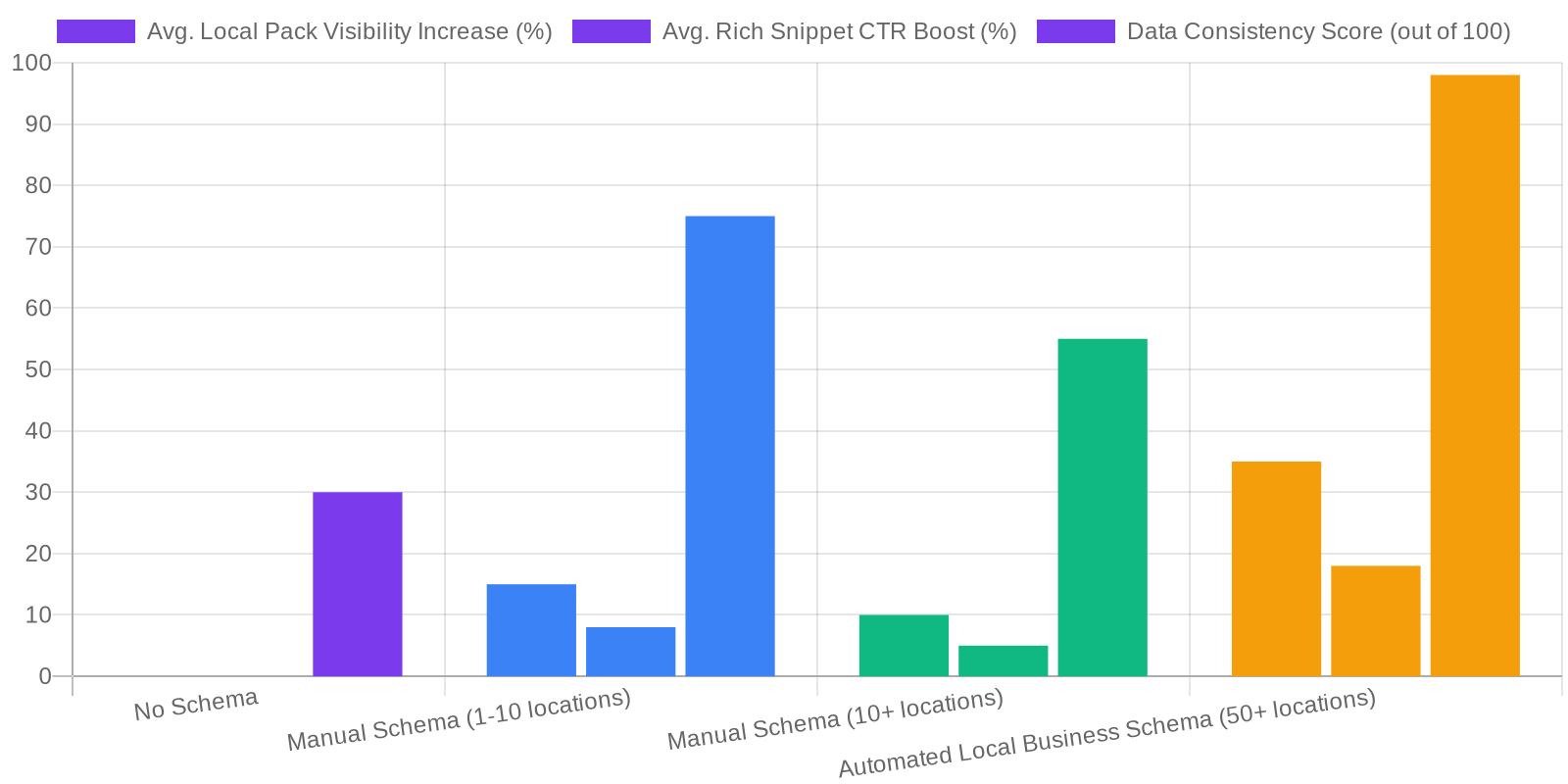
The primary benefits include significantly improved visibility in Google’s Local Pack, enhanced presence in Google Maps, and richer search results (rich snippets) that display key business information directly on the SERP. This direct display of information, such as average ratings, price ranges, or service availability, can dramatically increase click-through rates. Moreover, schema helps search engines build a stronger entity understanding of your brand, associating your parent organization with its numerous local branches. This holistic view strengthens your overall digital footprint and authority.
Consider the impact on user experience: when a user searches for “coffee shop near me,” schema helps Google instantly identify the closest, most relevant branch with accurate opening hours and contact details. This precision drives foot traffic and online engagement. The ability to manage and update this data efficiently across a vast network of locations is a game-changer for large franchises and enterprises.
Implementation Guide for Schema Markup
Implementing local business schema effectively requires a structured approach, especially for multi-location entities. The preferred method for embedding structured data on websites is JSON-LD (JavaScript Object Notation for Linked Data). This format allows you to place the schema markup directly within the “ or “ section of your HTML, without altering the visible content of the page. Each location’s dedicated landing page should contain its unique JSON-LD script.
Key properties to include for each location are: @context (always “https://schema.org”), @type (“LocalBusiness” or a more specific type like “Restaurant,” “Store,” etc.), name, address (with sub-properties like streetAddress, addressLocality, addressRegion, postalCode), telephone, url, geo (with latitude and longitude), openingHoursSpecification, and image. For multi-location businesses, it’s also crucial to link to the parent organization using the parentOrganization property, which helps search engines understand the corporate hierarchy. This is a critical step for establishing entity relationships.
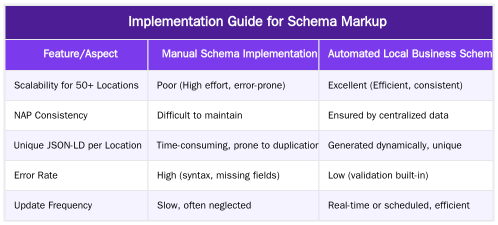
While manual implementation is feasible for a handful of locations, it quickly becomes unmanageable and error-prone for larger businesses. This is precisely why automated local business schema solutions are essential. These tools generate and deploy validated JSON-LD scripts dynamically, ensuring each location’s data is accurate and up-to-date. For a deeper dive into specific schema types and their properties, explore our guide on Local Business Schema.
After implementation, always validate your schema using Google’s Rich Results Test and Schema Markup Validator to catch any errors or warnings. Regular audits are also vital to maintain accuracy as business details change.
Common Challenges and Errors in Schema Implementation
Despite the clear benefits, implementing local business schema, especially at scale, is fraught with potential pitfalls. One of the most common challenges is maintaining NAP (Name, Address, Phone) consistency across all online mentions. Discrepancies between your website’s schema, Google Business Profile listings, and other directories can confuse search engines and dilute your local SEO efforts. Manual updates for dozens or hundreds of locations almost guarantee such inconsistencies.
Another frequent error is the use of generic or duplicate schema across multiple location pages. Each location requires a unique, specific schema markup. Copy-pasting schema without updating geo-coordinates, specific opening hours, or unique service offerings will not provide the granular detail search engines need. Incorrect geo-coordinates are also a significant issue, leading to misrepresentation of a business’s actual physical location.
Validation errors, often stemming from incorrect JSON-LD syntax or missing required properties, can prevent schema from being parsed correctly by search engines. Furthermore, failing to update schema when business details change (e.g., new phone number, revised hours, temporary closures) renders the structured data outdated and potentially harmful. These challenges underscore the necessity for robust, scalable solutions, making automated local business schema a strategic imperative for multi-location brands in 2026.
Impact on Local SEO and Search Engine Visibility
The direct correlation between well-implemented local business schema and improved local SEO performance is undeniable in 2026. By providing explicit signals to search engines, schema markup significantly enhances a business’s chances of appearing prominently in the local pack, Google Maps, and local organic search results. This is particularly crucial for multi-location businesses, where each branch competes for local visibility.
Our experience at AbdurrahmanSimsek.com, working with numerous multi-location clients, consistently shows that businesses leveraging accurate and comprehensive schema markup achieve higher rankings and greater visibility. This structured data directly feeds into Google’s understanding of your business’s E-E-A-T (Experience, Expertise, Authoritativeness, Trustworthiness) signals, especially for YMYL (Your Money Your Life) industries. When Google can confidently verify your business’s details through structured data, it builds trust and signals authority, which are critical ranking factors. For more on this, see our article on E-E-A-T for YMYL in 2026.
Beyond direct ranking benefits, schema contributes to richer search results, displaying elements like star ratings, price ranges, and opening hours directly in the SERP. These rich snippets make your listings more appealing and informative, driving higher click-through rates. Furthermore, schema aids in voice search optimization, as virtual assistants can more accurately extract and relay business information to users. For comprehensive guidelines on how Google uses structured data, consult Google’s official Structured Data documentation.
Automating Local Business Schema for Large Franchises (50+ Locations)
For large franchises and enterprises managing 50 or more locations, manual schema implementation is simply not sustainable or scalable. This is where the power of automated local business schema truly shines. The key to successful automation lies in a centralized data management system that can generate unique, validated JSON-LD for each individual location dynamically. This approach eliminates the inconsistencies and errors inherent in manual processes.
A highly effective automation process, such as the one offered by AbdurrahmanSimsek.com, often begins with a comprehensive CSV file. This file acts as the single source of truth, containing all pertinent details for every location: name, address, phone, geo-coordinates, specific services, unique descriptions, and even links to individual Google Business Profiles. Our system then processes this CSV to generate a distinct JSON-LD script for each location. This ensures that every branch receives its own bespoke structured data, optimized for its specific context.
Advanced schema properties are also crucial for multi-entity structures. The `parentOrganization` property, for instance, explicitly links each local branch back to the corporate entity, reinforcing brand authority and helping search engines understand the hierarchical relationship. Additionally, incorporating `serviceArea` schema and precise geo-coordinates ensures that each location is accurately represented in local search queries. This level of precision, delivered through automation, is vital for maintaining a competitive edge in 2026’s evolving local SEO landscape. Learn more about this process in our Automated Schema Markup Guide.
Tools and Solutions for Automated Local Business Schema
The market offers various tools to assist with schema markup, ranging from basic generators to comprehensive automation platforms. While some plugins or online generators can help with single-location schema, they often fall short for the complex needs of multi-location businesses. These solutions typically lack the ability to manage hundreds of unique location datasets, ensure NAP consistency at scale, or dynamically update schema based on real-time business changes.
For large franchises and enterprises, a dedicated automated local business schema solution is indispensable. These platforms centralize your location data, allowing for efficient management and deployment of structured data across your entire network. They are designed to handle the intricacies of multi-location SEO, including generating unique JSON-LD for each branch, integrating with Google Business Profile, and providing validation to prevent errors.
At AbdurrahmanSimsek.com, we specialize in providing robust, scalable solutions for automated local business schema. Our platform streamlines the entire process, from data ingestion via CSV to the deployment of validated, unique JSON-LD scripts for every one of your locations. We empower multi-location businesses to achieve unparalleled local search visibility and maintain impeccable data consistency. Discover how our tailored solutions can transform your local SEO strategy and drive tangible results.
Ready to elevate your multi-location SEO with precision-engineered schema? Explore our automated schema solutions today.
Conclusion
In the competitive landscape of 2026, automated local business schema is no longer a luxury but a necessity for multi-location businesses aiming for top local search visibility. By providing search engines with explicit, accurate, and consistent structured data for every single branch, businesses can significantly enhance their presence in the local pack, drive higher engagement, and build stronger brand authority. The challenges of manual implementation for large networks are overcome by scalable automation, ensuring NAP consistency and unique JSON-LD generation. Embrace the power of automated schema to future-proof your local SEO strategy and unlock unparalleled growth. Visit AbdurrahmanSimsek.com to learn more about our advanced solutions.
Frequently Asked Questions
What is automated local business schema?
Automated local business schema is the process of using a tool or platform to generate and deploy unique structured data for multiple business locations at scale. This ensures each location page provides search engines with precise, machine-readable details like its name, address, and phone number. Using an automated system prevents common errors and saves significant time compared to manual implementation.
How does automated local business schema work for a franchise with 50+ locations?
For a large franchise, you can typically upload a single file, like a CSV, containing the unique Name, Address, and Phone number (NAP) for all locations. An automated local business schema tool then processes this data to generate a unique, validated JSON-LD script for each individual location page. This ensures every branch is correctly and efficiently represented to search engines.
What is the most common error that automated local business schema helps prevent?
A frequent and critical error is using the same generic schema markup on every single location page. Each branch requires unique schema with its specific address, phone number, and hours to be understood correctly. An automated local business schema solution ensures this uniqueness is maintained across all locations, preventing the duplicate content issues that can harm local SEO.
How does local business schema improve visibility for “near me” searches?
By providing search engines with precise, machine-readable location data, including latitude and longitude, you make it significantly easier for them to match your business to a user’s physical location. This structured data improves your visibility in the Local Pack and on maps for “near me” queries. Accurate schema is a foundational signal for local search relevance.
Can automation tools generate schema for Service Area Businesses (SABs)?
Yes, robust automation platforms can generate schema for both businesses with a physical address and for Service Area Businesses. You can define specific service areas by city, zip code, or county. This information is then correctly formatted within the `serviceArea` property of the schema markup, telling Google exactly where you operate.
How does the ‘parentOrganization’ property work with multi-location schema?
The `parentOrganization` property explicitly links an individual branch location to the main corporate brand or parent company. When using an automation tool, you can define the parent company once. The tool will then automatically include this property in the schema for every individual location, strengthening the brand-location relationship for search engines.
Ruxi Data brings together multi-model AI, automated website crawling, live indexation checks, topical authority mapping, E-E-A-T enrichment, schema generation, and full pipeline automation — from crawl to WordPress publish to social posting — all in one platform built for agencies and freelancers who run on results.