
Pillar Pages and Topic Clusters: Building Semantic Authority
Pillar pages and topic clusters are foundational for establishing topical authority within a Semantic Content Network (SCN). This content architecture organizes information around core subjects, moving beyond isolated keyword targeting to satisfy comprehensive user intent. By creating interconnected content silos, this strategy signals deep expertise to search engines, crucial for industries like private healthcare. It enhances E-E-A-T by demonstrating a website’s command over a subject area, driving qualified leads and improving information architecture.
Abdurrahman Şimşek, a Semantic SEO Strategist, specializes in leveraging these structures to build high-authority SCNs for medical clinics and plastic surgeons. His expertise focuses on semantic engineering and information architecture to optimize for YMYL search landscapes, ensuring robust content strategy.
To explore your options, contact us to schedule your consultation. You can also reach us via: Book a Semantic SEO Audit, Direct WhatsApp Strategy Line: +90 506 206 86 86
Content structure is paramount for search engine visibility and user engagement. Pillar pages and topic clusters within a Semantic Content Network (SCN) provide a framework for building topical authority, an approach vital for industries like private healthcare and plastic surgery. These interconnected content elements satisfy user intent, signal expertise to search engines, and drive qualified patient leads.
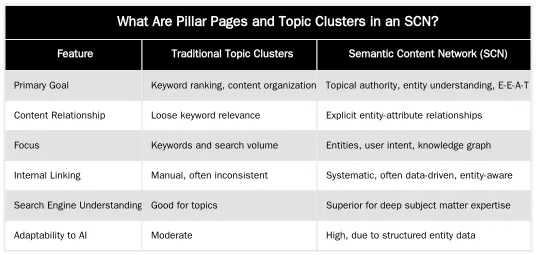
What Are Pillar Pages and Topic Clusters in an SCN?
Pillar pages and topic clusters form a content architecture that organizes information around core subjects. This model moves beyond keyword targeting to establish topical authority, which is fundamental for a Semantic Content Network (SCN).
Pillar Pages: The Foundation of Topical Authority
A pillar page is a comprehensive guide on a broad topic. For instance, a medical clinic might have a pillar page titled ‘Facial Plastic Surgery’. This page is a central hub, providing an overview and linking to more detailed content. Often called ‘cornerstone content’, these pages are authoritative resources covering a topic’s essential aspects without excessive detail.
Topic Clusters: Deep Dives into Related Sub-Topics
Topic clusters are interconnected articles exploring specific aspects of the pillar’s theme. Continuing the example, a ‘Facial Plastic Surgery’ pillar might link to cluster pages on ‘Rhinoplasty Techniques’, ‘Blepharoplasty Recovery’, or ‘Facelift vs. Neck Lift’. These supporting articles provide in-depth coverage of sub-topics. Each cluster page links back to its central pillar, reinforcing its authority and creating a ‘hub-and-spoke model in SEO’. This structure helps search engines understand content relationships.
Why This Structure Matters for Semantic SEO & E-E-A-T
A pillar page and topic cluster structure offers advantages for semantic SEO, topical authority, and E-E-A-T (Experience, Expertise, Authoritativeness, Trustworthiness). This organization helps search engines understand a website’s knowledge depth, aligning content with user intent.
Building Unquestionable Topical Authority
Comprehensive coverage across a topic cluster signals expertise to search engines. Instead of ranking for isolated keywords, this strategy establishes ‘topical authority’ over a subject area. This approach, central to semantic SEO, demonstrates a website’s command of a topic. It creates ‘content silos’ that consolidate relevance and link equity, making the site a go-to resource.
Enhancing E-E-A-T for YMYL Medical Content
For ‘Your Money Your Life’ (YMYL) medical niches, E-E-A-T is paramount. A structured approach with pillar pages and topic clusters enables thorough, expert-backed content creation. Each article can be researched, reviewed by medical professionals, and attributed, showcasing knowledge depth. This organization demonstrates the experience, expertise, authoritativeness, and trustworthiness that Google’s Quality Rater Guidelines emphasize for medical information. Understanding these guidelines is crucial for medical websites.
Designing Your Semantic Content Network: A Practical Blueprint
Building a Semantic Content Network (SCN) requires strategic content planning and information architecture. This means understanding the entities and relationships within your niche, not just targeting keywords. The goal is an interconnected content web for users and search engines.
From Keywords to Entities: Identifying Core Pillars and Clusters
First, shift focus from keywords to broader entities for pillar pages. For a plastic surgery clinic, ‘Breast Augmentation’ is an entity, while ‘silicone vs. saline implants’ is an attribute for a topic cluster. This process begins with ‘keyword clustering’ to group related queries. ‘User journey mapping’ then identifies patient inquiry stages, informing the content needed for each cluster. For more on keyword research, see Ahrefs’ guide to keyword research.
Structuring for Clarity: Internal Linking and Information Architecture
Internal linking is the SCN’s backbone. Supporting articles must link to the central pillar page, which links out to its cluster articles. This creates an ‘information architecture’ guiding users and search engine crawlers. Contextual anchor text reinforces semantic relationships and distributes link equity. For a comprehensive guide, see our article on Designing a Semantic Content Network (SCN) for Topical Authority in Aesthetics.
The Abdurrahman Şimşek Advantage: Semantic Engineering for Medical SEO
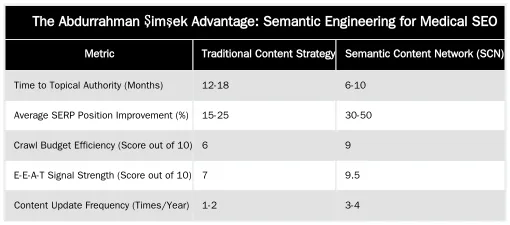
Abdurrahman Şimşek’s approach to Semantic Content Networks goes beyond conventional models. His expertise in Semantic Engineering and data-driven methodologies, particularly for medical clients, optimizes content architecture for search performance and patient trust. This focus ensures content is organized and understood by search engines.
Optimizing ‘Cost of Retrieval’ with Intelligent Content Architecture
A well-structured SCN with pillar pages and topic clusters reduces the ‘Cost of Retrieval’ for search engines. Google’s crawlers can then efficiently discover, understand, and index content, improving visibility. Abdurrahman’s ‘Semantic Engineering’ creates an architecture with clear content relationships, minimizing search engine computational effort. This improves crawl budget use and speeds indexing of authoritative medical content.
Leveraging Ruxi Data for Automated Topical Map Creation
Scaling pillar and cluster creation requires a data-driven approach. Abdurrahman uses Ruxi Data, a tool for automated topical map creation. This technology analyzes SERP data to identify topical gaps, uncover entity relationships, and generate content briefs. This ‘EO Automation & Data Engineering’ capability enables rapid development of content strategies, helping medical clinics build topical authority without guesswork. This integration of data science into content strategy is a significant SEO advancement, as highlighted in reports on AI’s impact on information retrieval.
Do Pillar Pages and Topic Clusters Still Work in 2026?
In 2026, as search algorithms and Generative AI evolve, structured content like pillar pages and topic clusters remains relevant. This approach is a fundamental method for achieving ‘topical authority’ and ‘algorithmic authorship’, ensuring content performs in dynamic search environments.
Future-Proofing Your Content for Generative AI and GEO
Well-structured content is positioned for Generative Engine Optimization (GEO) and AI Overviews. Content with structured data and clear entity relationships provides AI models with digestible, factual information. AI systems prioritize clarity, accuracy, and organization when sourcing information. Content that defines entities and their attributes enhances a medical website’s chance of being cited and summarized by generative AI. This ensures content is understood and used by new search interfaces.
Beyond Keywords: The Enduring Power of Semantic Relationships
Search algorithms evolve, but the need for search engines to understand semantic relationships and topical depth is constant. Google’s mission is to organize the world’s information and make it universally accessible and useful. Pillar pages and topic clusters support this mission by presenting information logically. This strategy enhances ‘information retrieval (IR)’ by signaling a website’s expertise on a subject. It prioritizes user understanding and knowledge, making it a strategy for long-term SEO success.
Conclusion
Pillar pages and topic clusters are a foundational element of a Semantic Content Network. This architecture builds topical authority, enhances E-E-A-T, and future-proofs content against evolving search algorithms and generative AI. For medical practices, this approach demonstrates expertise and trust, driving patient leads. To learn how a tailored SCN can transform your clinic’s digital presence, contact us. You can also Book a Semantic SEO Audit or reach out directly via WhatsApp Strategy Line: +90 506 206 86 86.
Frequently Asked Questions
What is a pillar page in a Semantic Content Network?
A pillar page serves as a comprehensive, central resource on a broad topic within a Semantic Content Network. It provides an overview of the subject, linking out to more specific, detailed articles known as topic clusters. This foundational content piece aims to establish broad topical relevance for search engines and users.
What are topic clusters?
Topic clusters are a collection of interconnected, in-depth articles that delve into specific sub-topics related to a central pillar page. Each cluster page thoroughly explores a niche aspect, providing detailed information and linking back to the main hub. This structure reinforces the overall topical authority of the network.
How do pillar pages and topic clusters build topical authority?
Pillar pages and topic clusters are fundamental for building robust topical authority. This structured approach creates a dense, internally linked network around a core subject, signaling to search engines like Google that your site possesses deep, comprehensive expertise on the topic. This holistic coverage is crucial for demonstrating E-E-A-T (Experience, Expertise, Authoritativeness, Trustworthiness).
How many cluster pages should I link from one pillar page?
The ideal number of supporting articles for a main content hub typically ranges from 8 to 20. However, the primary goal is comprehensive coverage; the quantity should be determined by the number of sub-topics required to fully address the broad subject of the central page. Focus on thoroughness rather than a fixed number.
Should pillar pages and topic clusters aim for different keyword types?
Yes, pillar pages and topic clusters are designed to target different keyword types effectively. The pillar page aims for high-volume, broad “head” terms, while the individual cluster pages focus on more specific, long-tail keywords. This strategy ensures comprehensive search visibility across the entire user journey, capturing traffic at various stages of intent.
How can I implement pillar pages and topic clusters for my medical clinic’s SEO?
Implementing pillar pages and topic clusters involves identifying your core services or conditions, mapping related sub-topics, and then structuring your content accordingly. For expert guidance tailored to medical clinics and to develop a high-authority Semantic Content Network, consider booking a Semantic SEO Audit with Abdurrahman Şimşek.
Ruxi Data brings together multi-model AI, automated website crawling, live indexation checks, topical authority mapping, E-E-A-T enrichment, schema generation, and full pipeline automation — from crawl to WordPress publish to social posting — all in one platform built for agencies and freelancers who run on results.